Aug 8, 2019 | Weekly Message
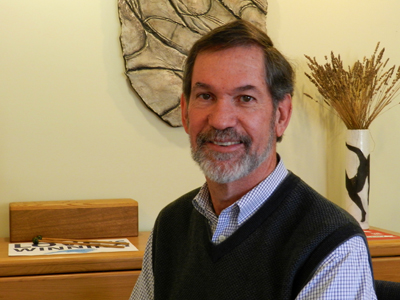
 Change is the river we swim in, friends, and the change I want to talk about this month has to do with me. As I announced on Sunday, this current church year will be my last at UUCA. I will retire as your lead minister as of June 30, 2020.
It’s a big change for all of us. For me, it will end my tenure here and open a new chapter in my life; for you, it will be a moment of taking stock, then starting the exciting process of self-reflection and search for the next person to serve as your lead minister.
I am happy to say that there is nothing particular driving this decision. My health is good, and I enjoy the work with you. For those reasons, though, this is also a good time to leave. Moving into what for many is retirement age, I find myself ready for a change, and you are a strong and vital congregation that has the resources and good leadership to get through a major transition like this and come out stronger.
Indeed, that is my hope for you. Change in leadership can be an occasion to challenge old assumptions or ways of doing things and open the door to newer, fresher ways living into the faith that you here embody. You are a happening congregation, and I feel certain that great things await you. I am making this announcement now, some 10 months before I actually leave, to give you the space to work through how you want this transition to go. I am already in conversation with the Board about how to structure that conversation. You will be hearing more from them soon about their plans.
What can you look forward to? I can tell you that people who work with churches recommend that congregations who are concluding a long-term ministry bring on an interim minister to work with them for one to two years. This gives the congregation time to get a strong sense of itself and gain clarity on the qualities of leadership they seek.
For many of you, I know, this process is new, but you have people in leadership and on staff who have been through ministerial transitions before and can help you navigate this. Also there are resources at the Unitarian Universalist Association to help coach you on this transition. In this next year, I promise to do what I can to help make this a successful transition.
In the midst of this, though, I have to own the sadness I feel to think about leaving this place. The nearly 16 years I have been here have changed me in the best possible ways. I love you, and I am so grateful for all that you have given me.
That said, you need to know that, while Debbie and I will remain in Asheville, once I leave in June you won’t be seeing me at church for at least a couple of years. It’s part of the commitment that we UU ministers ask of each other: to put distance between ourselves and the congregation we had been serving so that the congregation and the colleague who follows us can make their own covenants and find their own way together without our interference. Out of respect for you and whoever succeeds me I affirm that practice and consider it wise.
As for my own future, I am mulling lots of things. For a time, though, I plan to press the pause button and settle into this new life. But I know that there is too much in the world that calls to me to sit on the sidelines for long.
Meanwhile, we have a great year coming up, and I’m looking forward to my part in it. Please keep an eye out for our weekly enews and other announcements on what to expect. And do look for ways to dive in and take part. It is by participating that you get the greatest benefit of this community.
In peace,
Mark
Aug 5, 2019 | Sermons
Sunday, August 4. 2019 10am
Rev. Mark Ward, Lead Minister
The summer skies open wide and invite all sorts of meandering. Join us as spend a little time exploring what those pinpoints of light bring to mind.
READING
From Searching for the Stars on an Island in Maine by Alan Lightman
“It was a moonless night, and quiet. The only sounds I could hear was the soft churning of the engine of my boat. Far from the distracting lights of the mainland, the sky vibrated with stars. Taking a chance, I turned off the running lights, and it got even darker, Then I turned off my engine. I law down in the boat and looked up.
A very dark night sky seen from the ocean is a mystical experience. After a few minutes, my world had dissolved into that star-littered sky. The boat disappeared. My body disappeared. And I found myself falling into infinity.
A feeling came over me I’d not experienced before. . . . I felt an overwhelming connection to the stars, as if I were part of them. And the vast expanse of time – extending from the far distant past long before I was born and them into the far distant future long after I will die – seemed compressed to a dot.
I felt connected not only to the stars but to all of nature, and to the entire cosmos. I felt a merging with something for larger than myself, a grand and eternal unity. . . . After a time I sat up and started the engine again. I had no idea how long I’d been looking up.
SERMON
Summers are made for star-gazing expeditions like the one that Alan Lightman takes us on. Funny, isn’t it? It seems to take trips away from home – to the sea shore or camping in the mountains – to lure us outside to look up at the skies. Soft, sultry nights tug at us, and we wander outside and turn our eyes skyward.
Apparently, this is a thing these days, a practice some call “skying”: peering at the night sky with no particular end in mind, just receiving, taking it all in. And there is so much to take in.
It doesn’t take long looking over the spray of stars that greets us on a clear summer night for the oceanic feeling that Lightman describes to come over us. It is like opening a window on the universe, as if for the first time we really take in everything around us.
Before long, though, we start noticing patterns and someone will start calling out constellations. “There’s the big dipper. Find the side opposite the handle, follow it up. and, yep, there’s Polaris, the north star,” the point around which the whole sky seems to revolve. This goes on for a while and a few knowledgeable ones will start naming other stars. There’s Vega, one of our nearest neighbors, and Deneb. And so on. Before long, though, the talking stops, and we are left with the immensity before us.
Years ago when I was working in newspapers I was given the opportunity to cover science. I came to this assignment not as an expert but as an amateur, in the literal sense, one who was endlessly fascinated with science, who loved delving into almost every dimension of it.
Astronomy, though, was one field that was fairly new to me. As it happened, the institution that was the source of most of my reporting, the University of Wisconsin, was a leader in the field. So, I needed to orient myself quickly.
I quickly learned that the primary focus of astronomers’ work these days are phenomena we star-gazers cannot see: stars or galaxies too distant to be see with the naked eye or in wavelengths – infrared, radio waves, x-rays, gamma rays – that are invisible to us.
And what a chaotic, tumultuous universe they reveal! Stars exploding or spinning at inconceivable speeds, galaxies crashing into each other with ravenous black holes at their centers.
Serendipitously my time in science writing coincided with the heyday of the Hubble Space telescope. Also, lucky for me, the government was anxious to publicize the telescope’s findings. And so periodically I would receive fat packets of prints and slides of the Hubble’s latest discoveries.
The images were breath-taking: lacy nebulae – remainders of exploded stars – in stunning colors, swirling galaxies, clouds of bright gas that were stellar nurseries, and perhaps most astonishing of all, the image dubbed the Hubble Deep Field. We have a large reproduction of this image in this building in the light well just behind Sandburg Hall. It was created by focusing the Hubble camera for 10 days on a tiny spot of the night sky right near the Big Dipper that appeared to be totally empty of stars. How tiny a spot? Essentially, the size of a tennis ball seen at 100 meters.
In that apparently starless speck of sky, the Hubble captured an image of around 3,000 galaxies, equivalent to the number stars we see on a clear night. They have since repeated the exercise, just in case there was something extraordinary about that spot. But there wasn’t. They found essentially the same thing.
Imagine that! In every speck of dark sky between the stars that we see we could expect to find around 3,000 galaxies, another night sky full of nothing but galaxies, each of them home to hundreds of billions of stars. To this, add the fact that the light captured in that image had been traveling millions, perhaps billions of years before it entered Hubble’s lens.
So, the Hubble Telescope gives us a feeling for not just the astonishing plenitude of the universe – there is so much! – but also a greater feeling for time. In that image we are looking back to a moment some three-quarters of the way back to the Big Bang. Indeed, even in the visible night sky the stars that seem to twinkle and glow for us, represent ancient history.
The light we see is hundreds, thousands, maybe even millions of years old. And so it’s likely that some stars we see today winked out of existence thousands, or even millions of years ago, but it will not be us, but our descendants who discover this.
The more we learn about the stars, I can’t help but wonder if the image that best communicates the truth about the night sky might be not a static picture of the night sky but one of the last paintings that Vincent Van Gogh completed just before he ended his life. He called it “The Starry Night.” Do you remember it? Amid shimmering centers of light the sky is swirling with color, giving us an image of a universe that is not static and distant but dynamic, active and in tumult.
Van Gogh, who rejected organized religion, once wrote to his brother, Theo, that nonetheless he had a need for religion. So, he said, “I go outside at night to paint the stars.”
For us, too, the stars stir thoughts that turn us to religion. In the presence of such impossible vastness, what meaning can we find for our lives, our brief three score and 10?
The biologist Ursula Goodenough wrote of going on a camping trip in college shortly after sitting through a physics class. In the class she learned many of the details of our Solar System: the sun forming 4.5 billion years ago out on one of the spiral arms of our galaxy, the Milky Way, while a disc of rocks, water and dust spinning around it collected into planets, including ours, the Earth.
Then, how the Earth itself evolved wit life emerging and covering the planet And how the Earth will continue spinning and evolving until in about 5 billion years the Sun will expand and turn the Earth into a cinder.
“I found myself a sleeping bag looking up at the sky,” she said. “Before I could look around for Orion or the Big Dipper, I was overwhelmed with terror. The panic became so acute that I had to roll over and bury my face in my pillow.” The starkness of the picture was too much and created for her a kind of “Is that all there is?” moment. Maybe you’ve had one of those, too.
After all, we remember that all those constellations we have fun searching out we’re grounded in stories, stories that oriented people to a narrative of how the universe came to be and our place in it. And those stories were good at reassuring us that, as daunting as the world, the universe may appear there were forces greater than us seeing to things, forces that could somehow be appealed to and persuaded to work in our interest.
If that isn’t so, if we’re on our own down here, then where does that leave us?
Goodenough said she spent many years simply avoiding the subject, finding it too depressing to think about. In time, though, she came to the conclusion that she was satisfied simply to regard the world, in her words, as “a strange but wondrous given,” something that she was satisfied to accept and regard as “a locus of mystery.”
Alan Lightman said he finds it a comfort wandering about the small island of Maine where he kept his cottage reflecting that, as he put it, “the material of the doomed stars and my doomed body are actually the same material. Literally the same atoms.”
The universe, after all, began in a sea of hydrogen and helium, clumps of which later collapsed into stars. It was in those stars that those early gases were fused Into all the larger atoms that make up the universe. And as those early stars exploded and spewed those elements all throughout the universe they later coalesced Into planets, then organisms, then us.
“It is astonishing but true,” he said, “that if I could attach a small tag to each of the atoms of my body and travel with them backward in time, I would find that these atoms originated In particular stars in the sky. These very atoms.”
So then, the words of Robert Terry Weston’s meditation are literally true: “Out of the stars in their flight, Out of the dust of eternity, here have we come.” We are not adrift in a cold meaningless world: we are home in the place of our origin, connected via the atoms in our very bones to all things.
Once we get done imagining ourselves as somehow special, creatures given a unique destiny from some supernatural hand, we can tune into a truth that is far more profound: that we are a manifestation of an amazingly creative, endlessly evolving universe, creatures of inherent worth whose being, whose destiny is tied up with that of all things.
And so, looking out on the night sky we get a ring-side seat on all of this, knowing that the fires we see burning in distant stars are of a kind with the fires driving the cellular machinery of our bodies. And that’s not all. The fires that drive us impel us to survive, and not just survive but to continue beyond our three score and ten, not us as individuals, but us as carriers of life, creating and nurturing future generations.
For, we see that along with all the gases and such of the Big Bang there was born a tendency toward connectedness. It didn’t have to be there but somehow it emerged, and having emerged it made possible the universe we know. Quarks combined into atoms, atoms into molecules, molecules of increasing complexity into life, life in its latest manifestation into humans.
And humans – we curious, fragile, inventive creatures – turn out to possess one trait that offers us hope for the future, a trait the embodies once again that tendency toward for connectedness that was born with the Big Bang – the capacity to love. “This is the wonder of time; this is the marvel of space; out of the stars swung the Earth; life upon Earth rose to love.”
And so, I do not despair on looking at the night sky. True, it is astonishing in its vastness and complexity. Like Ursula Goodenough I do not seek to take it all in or understand it fully. In its whys and wherefores it is a mystery. And still, it fills me with awe, with gratitude and joy. To be alive, to simply be is a grace. What a wonder that out of all that is, this being that is me emerged and is present now to be part of the stream of life, capable of building on the human heritage of love.
I do not begrudge that in time my life will end – though I do hope that that time is a ways in the future. Instead, I am content to know that, as the poet David Ignatow wrote,
“I am of the family of the universe,” and so “in no way shall death part us.” For me, there is peace in that understanding.
“This is the marvel of life,” Robert T. Weston declares, “rising to see and to know; Out of your heart, cry wonder: Sing that we live.”
Aug 1, 2019 | Weekly Message
 From June 19-23, I was a delegate from UUCA for the 2019 General Assembly (GA) in Spokane, WA.
What is General Assembly (GA)? GA is the annual gathering of UUs to deal with the business of the Unitarian Universalist Association (UUA), worship together, and attend workshops. Worship was lively and multicultural including music such as “There is More Love (Somewhere)” and “Keep On Moving Forward.” The workshops ranged from those with broad appeal such as: “Strategies for Community Organizing,” “Faithing Family,” and “Achieving Our 6th Principle Goal of World Community” to specific “role-based programming” for specific positions in UU congregations (e.g., musicians, treasurers, religious educators). One of my favorite sessions was an interview with Robin DiAngelo, author of White Fragility, where she examined “whiteness” and how it shapes interracial interactions. See her work here.
One of the most beloved GA rituals, the “banner parade,” occurs at the Opening Ceremony. Each attending congregation marches into the convention hall with their unique congregational banner. It feels quite unusual and amazing to be surrounded by thousands of UUs. See the UUCA banner and our representatives from last year’s Banner Parade here.
I encourage you to watch the entire Sunday worship especially Reverend Marta Valentín’s powerful message about the need for full inclusion within Unitarian Universalism.
What is a delegate?
As a UUCA delegate you attend the General Sessions and vote your conscience on matters that affect the Unitarian Universalist Association.
What matters were voted on?
Every year “Actions of Immediate Witness” (AIWs) are selected by the body to “express the conscience of the delegates.” This year’s AIWs addressed: “Immigration and Asylum,” “Building the Movement for a Green New Deal,” and “Supporting Our First Amendment Right to Boycott” (related to Israel/Palestine).
Based on three years of congregational study, delegates also passed a Statement of Conscience titled “Our Democracy Uncorrupted.” While the statement passed by a large margin, there was a lively debate regarding the statement’s charge to “repeal the electoral college.”
Although UUs love to debate, a number of non-controversial issues quickly passed. There was a very close yet successful vote to make it more difficult to be a petition candidate for a UUA position (e.g. President). The most controversial thing that happened at GA was when a UU minister handed out a self-authored pamphlet that criticized, as overly “PC,” the UUA’s campaign to “dismantle white supremacy” within UUism. Read more here.
GA is a great way to meet UUs from around the country and to seek inspiration. If you are interested in being a delegate in the future speak to the Board of Trustees (and they might even help offset the cost of registration). Upcoming General Assemblies include Providence, RI (2020) and Milwaukee, WI (2021). Contact me, Mary Alm (“UUCA Queen of GA” [my term]), or Linda Topp for more info.
Brett Johnson