Dear all,
Last week I officiated Bill Moore’s memorial service in the sanctuary he designed for UU Asheville. Because Bill loved this congregation and was a member since services were held in a house on Vermont Ave in West Asheville, the sanctuary he designed for you is thick with meaning and a labor of love. In an interview with Gina Phairas prior to Covid, Bill spoke about his process and intention, and I was so moved and inspired that I decided to share his eulogy so Bill’s legacy will not only not be forgotten but celebrated and honored for years to come. After the service, Jerry McClellan revealed to me that Bill left you one more unopened gift. Jerry will give you a glimpse of that gift following the eulogy.
I wish for you a future graced with love and joy.
Warmly, Cathy Harrington, Interim Lead Minister
William Oliver “Bill” Moore, 87, a North Carolina Modernist architect who made Asheville his home for nearly 60 years, died May 10, 2023. In addition to his parents, he is preceded in death by his sister, Mary Jane O’Toole.
He is survived by his daughter, Melissa Moore, and her husband, Al Wheless, of Creedmoor, NC; his former wife, Willa Newell, of Black Mountain, N.C.; and good friends in Asheville, NC.
Bill was a loving father, son, and brother, and a good friend. From what I have gleaned from Bill’s family and friends, Bill knew early on what he planned to do with his wild and precious life. It was Architecture that became his passion, his livelihood, and his hobby. As he said in an Odyssey interview with Gina Phairas, architecture was his life.
Bill was the son of James Oliver Moore and Mildred Moore. He was raised in Cleveland, NC, a small, rural town in Rowan County. Born in 1935 at the brink of WWII and during the Great Depression as a WWII kid, the toys he played with were weapons, bombers, an aluminum canteen; anything military.
His first-grade teacher, in December of 1941, showed the class two photos that left a powerful impression on Bill; they were photos of General Douglas MacArthur and the USS Arizona, the famous battleship that was attacked and sunk by the Japanese at Pearl Harbor killing 1,177 of its officers and crewmen. It is not surprising that later in his life, Bill was drawn to reading about the history of the United States and WWII.
Bill’s father and his Uncle Neal ran a country general store. Bill worked in the store from age 14 after school and summers and blames too much free candy and Coca Cola as a child for his problem teeth. Bill remembers helping his father deliver ice to members of the community who did not have refrigeration.
Bill’s mother ran a small boarding house and there were two teachers who lived with them. Often, as many as six teachers would walk over for a homemade lunch prepared by his mom. During the war, his mom also held a job sewing military clothing. It was his mother who got Bill interested correspondence course when he was in the eighth grade. She paid $200 for four years of study to be a commercial artist. He loved it. Clearly, Bill’s parents taught him a work ethic and to care about other people.
During high school, Bill played football and basketball and was the president of the Beta Club. After high school, Bill studied at North Carolina State University’s School of Design and graduated in 1959 with a BA in Architecture. He also did coursework in City Planning at The University of North Carolina at Chapel Hill. After marrying his high school sweetheart, Willa in 1957, the two finished their studies and then took a trip, planned by Willa, to Europe for nearly three months and in a rented car, they managed to visit at least one hundred cathedrals and “lots of other old buildings,” Willa said. Their daughter, Melissa was born in 1962. Melissa has fond memories of visiting the ocean and going on picnics and hikes in the mountains. Though Bill was very busy with his career, he loved being a father. Melissa said that his unconditional love and support for her has made all the difference in her life. She said, “Daddy was completely disinterested in Rock and Roll, but he liked Bob Dylan, Joan Baez, and John Denver and jazz and blues singer Leadbelly. He also loved Vivaldi’s Four Seasons to the degree, according to Melissa that he hummed three lines joyfully and endlessly.”
The only television Bill watched was PBS because he couldn’t stand commercials. He supported and valued Melissa’s love of poetry writing as a teenager, and it was his unconditional love for Melissa that made all the difference.
After working briefly in Raleigh, the family moved to Asheville in 1963. It 1966 Bill opened his own office and retired in 2008 after a long successful and fulfilling career.
A self-describe back-slid Methodist, Bill sought out the Unitarians who happened to be meeting in an old house on Vermont in West Asheville. Since high school, Bill’s heroes were Thomas Jefferson and Frank Lloyd Wright, and both men happened to be Unitarians. Thomas Jefferson because he juxtaposed western civilization on the American frontier besides life liberty and the pursuit of justice. Monticello looking off to the West; that was the forefront in America of Western Civilization. He doubled the size of the country without a war, and Frank Lloyd Wright gave us a modern architecture.
After Bill sought out the Unitarians, a whole new world opened to him. He told Gina that he found people who were “seeking knowledge instead of preaching it.” She asked why he was still a member of this church (he was a member since the early sixties), he said, “With all due respect to our ministers, what I love is the sense of community and shared values.”
There are some interesting intentional design elements that Bill included in this sacred space. I was moved as I watched the odyssey interview video with Gina and listened to Bill explain his thoughtful motives behind the design. The sanctuary is designed as a square for a reason; Frank Lloyd Wright believed that the square is a perfect symbol for Unitarianism. Unity, and the oneness of God. Bill said that he didn’t believe he was plagiarizing Wright but honoring him instead. He thought of himself as one of the good guys who didn’t plagiarize Wright as so many have done.
Bill put his heart and soul into this church. It was created out of a deep love and devotion to this church community and our faith tradition. This sanctuary is intentionally built with yellow pine because it is the strongest structural wood in the South. The site initially dictated the final project: We wanted to turn our backs to a busy street. Solid walls. Come in from the front and the back which also served as a front, welcoming folks from both sides.
The lighting was also integral to the design. The sky light over the pulpit wasn’t loved by everyone, he remembered. The engineer that helped design it called it a “light scoop.” But there was one member of the building committee who called the skylight, “an unsightly sawtooth cupola.” Bill said those words continued to ring in his head up to the time of the Interview with Gina. “But everybody knows that north light is the softest and the best.”
The seating design is the amphitheater style seating as opposed to the typical Christian seating. Bill had the opportunity with other architects to go to Duke Divinity school and meet with ministers to talk about church design. He said, “These pews were designed to build a sense of community.” Bill remembered a time when Dick Wood, the mayor of Asheville, visited the church and compared theses stone walls to a community. He said that we should all strive to fit together like these stones do.
His design for this beautiful church received a Merit Award from the North Carolina chapter of the American Institute of Architects for that building. He also received an N.C. AIA award for another building. Bill said he would have been happy to design a hundred Unitarian churches, and this church was his favorite project. Understanding the love that went into this design critically important so that it is never taken for granted. Designing this church was the pinnacle project of entire career. It is a gift that should be cherished and celebrated.
There were many noteworthy projects that received acclaim. In 1975, his modernist architecture firm of Moore-Robinson Associates won both a regional design award and the grand award winner in the North Carolina Environmental Design Awards competition for the family home on North Griffing Boulevard. Following publication in Southern Living, he put the plans up for sale through plan book brokers. Melissa fondly remembers the serenely beautiful home where she grew up that was built on the side of a mountain so that views of nature could be seen from all sides. They were surrounded by trees. Bill appreciated the beauty and quiet life of living in the country but loved entertaining and spending time with friends and acquaintances. Integrating nature into his designs was essential to Bill. He was a spiritual man in this way. Melissa once asked him if he believed in God, and he told her, “Yes.” She is clear that he didn’t believe in a man in the sky with a beard but more as a nature and the power of love, and perhaps like Unitarian scholar and theologian, James Luther Adams’ favorite definition of God as “community-forming power.” He cared deeply and strived to make the world a better place through his work and by volunteering.
Bill was a member of the Kiwanis Club of Asheville for many years, serving on projects that benefited the children of Asheville. He served on Asheville’s Planning and Zoning Committee. Bill spoke of a book by David Brooks called Leading Lives that Matter, that was an inspiration. Brooks said that once we are stable it’s time to help people. Bill told Gina that he wished he had done more. She asked him what is your favorite word? “Love.” Your least favorite word? “Hate.”
Life lesson like to pass on to others? “One of life’s greatest’s rewards is helping others.” This is how Bill lived his life. Not only did he leave a legacy of love within the design of the building he was a member of the legacy circle committing a portion of his estate to the well-being and future of Unitarian Universalism in Asheville, North Carolina.
 Bill Moore – Gift to be Unwrapped.
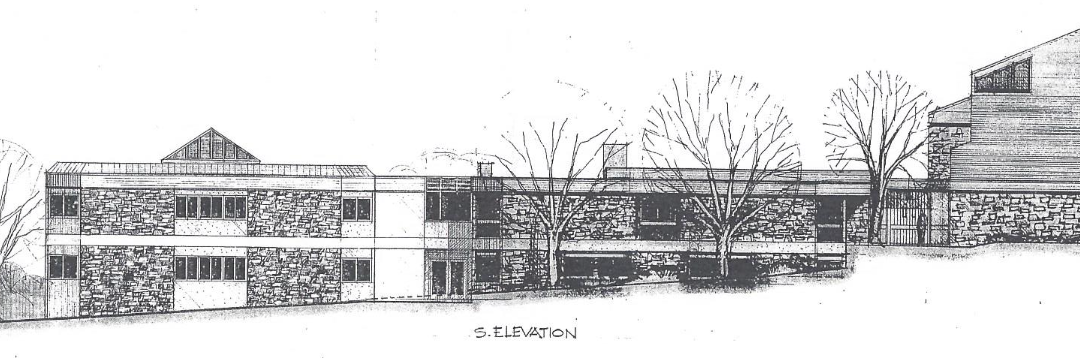
Several years ago, I was talking To Bill Moore about the need for more space at UU Asheville as we were growing and needed more classroom and office space, and more room in Sandburg Hall. He said he had anticipated the eventual need and had drafted a complete set of plans for a matching addition to our existing building. I asked if he could send me a reduced copy of the plan as I was not aware it existed, or it being discussed in our long-range planning.
After receiving the drawing, I could see he had tied it in beautifully to his original plan, not as an afterthought but part of a master plan. It extends our building toward Jefferson House in matching field stone, adds an entrance into expanded RE space and includes an elevator to the offices above. As a crowning conception he added a glass pyramid structure over the office general area much like you see visiting the Louvre in Paris. By moving the present offices, it made room for an enlarged Sandburg Hall and other improvements. Bill said it could not be afforded at the time so the plans for it have been tucked away for future use when the congregation is ready to expand our facility, if ever.
So, like sleeping beauty (which it is) the plans sit rolled up in a closet somewhere at UU Asheville waiting …an unwrapped gift for the future from Bill Moore.
Jerry McLellan