
Aug 28, 2025 | Weekly Message
We’re back in action on Sunday, September 14th!
Your Faith Formation team and our fabulous collaborators have been busy getting ready for another transformative year. We’ve been meeting, sharing, and learning together over the last month to prepare to welcome our children and youth back to Faith Formation groups on Sunday, September 14th. We’ll all begin together in worship as usual and we will have a dedication for our teachers before we head to our groups. We’ll create covenants together and get to know each other, please plan to join us!
Thank you to all of our fabulous collaborators who joined us for an amazing orientation this past weekend. Our congregation is blessed to have so many awesome people serving with our program. Your gifts are tremendously appreciated!
In addition to our regular theme based sessions, we are offering a new liberation and antiracism based curriculum from the UUA called Mosaic. This curriculum series includes lessons designed to support the faith development and engagement of each age group, as well as to enhance our growing collective understanding of best practices and justice-centered discourse arising from BIPOC movements to decolonize and decenter whiteness. Mosaic Sundays will happen the first Sunday of each month in regular Faith Formation groups.
The Youth Choir is back too! If your kiddo loves to sing and wants to be a part of worship, Let us know here: https://forms.gle/BQW4HhA1FdfwN8fQ8
Have you registered for Faith Formation yet? It is vital that you do! Registration helps us with planning, keeping everyone safe, and knowing who we’re serving. We ask you to do it every year so that we have the most current information for your family. Not sure if you’ve registered yet? Email Kim to find out! You can register here: https://forms.gle/zunm7ZWVXvE6N3gSA
Family Ice Cream Socials are here! Bring the whole family for some ice cream, fellowship, and exploration of the monthly theme! On Friday, September 5th join us for the theme of Building Belonging and on Friday, October 17th we’ll explore Cultivating Compassion. We’ll meet in Sandburg Hall from 7:00-8:30 pm. Please RSVP with any dietary needs to Kim Thanks to Amy Wright Glenn for facilitating!
Chalice Lighters Needed! Chalice lighting sign ups are open through May 2026! Please note that you should sign up by Thursday at noon for the coming Sunday. Chalice lighters need to arrive 15 minutes before worship begins and check in with the worship leader! https://www.signupgenius.com/go/20F0548ADA92BA2F85-55350830-sunday#/
We’ll be offering a Soul Matters group for parents and caregivers again this year, beginning in October. Look out for more details soon!
Want to get involved with Faith Formation? We have opportunities available at all different levels of commitment! Reach out Kim or Jen!
In faith,
Kim Collins, Lifespan Religious Educator

Aug 20, 2025 | Weekly Message
“The earth has music for those who will listen.”*
I’ll be honest: When it comes to nature, I was never much of a listener. Oh, I’ve always done my best to help preserve the earth, believing fervently in the critical importance of environmentalism – but in those hectic work and family years, I’m not sure I stopped to appreciate more than an occasional mountaintop view or sunset.
In retirement, however, my perspective has changed. My recent training to become an Extension Master Gardener – (a title I feel sheepish sporting given the many far more experienced folks in my cohort) taught me to more closely observe plants, which has in turn shifted my perceptions of the nature around me. Suddenly, while I can’t necessarily tell you the colors of my neighbors’ houses, I can describe in detail the shrubs and flowers they’re growing in their front yards. And with noticing comes appreciation, micro-joys to brighten my day.
It’s this awakening that has caused me to belatedly become aware of our lovely gardens at UU Asheville! I am deeply grateful for the work of Kate Jerome and Venny Zachritz, who coordinate the Landscape Team that is responsible for this amazing, all-volunteer effort. As a subcommittee of the Environmental Action Team, the Landscape Team practices sustainable gardening, using native and food plants to attract pollinators and support wildlife. In the last five years, the group has worked tirelessly to plant, transplant, and maintain gorgeous pollinator, wildflower, butterfly, and diversity gardens – all spectacular additions to the UU landscape.
Kate and Venny are aided by a team of about ten congregation members, but they can always use more help! The team meets on the first and third Saturdays of every month for a two-hour work shift. If you’re interested in helping out – even if Saturdays don’t work for you – please contact them: katejerome2020@gmail.com (Kate) or VPWZ5258@gmail.com (Venny).
I asked Kate and Venny about their inspiration for this service; after all, gardening is tough work! Kate loves the enthusiasm of volunteers for climate justice, the opportunity to share information about sustainable gardening with the community, and the knowledge that “we are making a difference in our landscape.” Venny is likewise inspired by the dedication of helpers, as well as by her ability to share “this service of dirt and sweat…with the congregation.”
If you haven’t taken a walk around our UU campus in a while, I encourage you to make time to do so before or after your next visit. I hope that, like me, you’ll find the rainbow of colors lining the sidewalks, and the lively bees and butterflies darting among the coneflowers, to add cheer to the landscape and a lift to your spirits.
Melissa Himelein
Board of Trustees
*Attributed to varied writers, including William Shakespeare, George Santayana, and Reginald Vincent Holmes
Aug 14, 2025 | Weekly Message
In these times when it is difficult to express the heaviness in so many of our hearts as we witness immoral leadership making decisions that impact our communities, this story shared recently in Piloting Faith reminds me that we are not in this alone.
“They say that long ago, when the world was quieter and people still listened with their whole bodies, a young woman named Amaru lived high in the mountains of the Andes. She came from a long line of weavers—women who threaded the memory of the earth into cloth, each design a quiet offering to the sacred.
But Amaru was untethered. Her mother had died. Her teacher had gone. The elders whispered that the thread of her spirit had become tangled. She felt it, too—like a silence inside her that had once been singing. One day, she climbed to the highest ridge. The wind was thin. The stillness vast. She pressed her back against a stone and wept—not with drama, but with that ancient kind of sorrow that lives in the bones. The kind that asks no questions. The kind that simply aches.
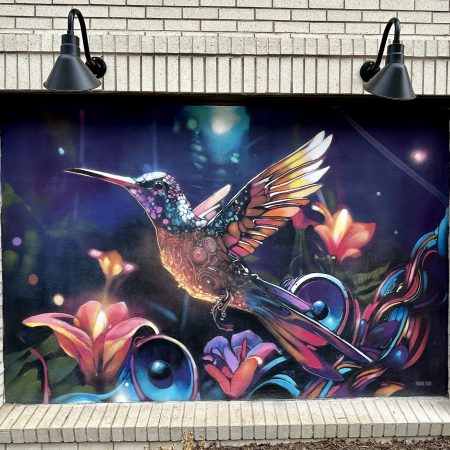
Then—a sound. Whirrrrr. A flash of color, a shimmer of wings: a hummingbird.
 It hovered in front of her, still as breath, beating like a heart just beneath the surface of silence. She followed it—not with certainty, but with that soft kind of instinct that rises when words fall away. It led her over stone and through thickets, to a cave hidden behind a waterfall. Inside, the darkness pulsed. The walls shimmered faintly, as if remembering. And in that remembering, Amaru began to remember too.
She closed her eyes, and the cave became the sky. She saw her ancestors—not as names or photos, but as presence, as rhythm, as song. They were dancing and weaving and soaring, reminding her: you are not alone.
The hummingbird hovered near her chest. And a voice—not outside, but within—whispered:
We walk with you. We always have. Be still, and you will remember.
When she returned to her village, Amaru weaved differently. The stories in her cloth shimmered with new color, new memory. She didn’t speak of the cave. She didn’t need to. People felt it. In her presence, they remembered their own rootedness, their own sky. And ever since, when someone in the village is lost, they say:
Look for the hummingbird. She shows the way back to those who walk with you.”
I wonder who the ancestors that walk with you are.
I wonder how you are remembering your “rootedness” in these times.
May his story be a reminder that we are not alone.
May we resist together knowing we are buoyed by the ancestors and justice seekers that came before us.
In faith,
Rev. Claudia Jiménez
Minister of Faith Formation
PS Do you recognize where this photo was taken?

Aug 7, 2025 | Featured, Weekly Message
Beloveds, my Ministerial Internship is wrapping up. My farewell service is Sunday, August 31 st . In that service I will reflect on my time as your intern: what it has meant to me, the healing power of community, how I’ve learned, some challenges I’ve faced, and so on. My experience has been extraordinary! You have indeed been a remarkable “teaching congregation” for me. For now, I’d like to address
 some important guidelines—especially about communication with you—that we need to observe once my internship is over.
Because I have been practicing as a minister during my internship, I must observe the customary protocols and guidelines that take place when a minister leaves a congregation. Since I have been an intern—and not, let’s say, a settled or interim minister—the guidelines will be a little different. Typically when a minister says farewell to a congregation, the minister and congregation observe a two-year period of no communication and/or contact. In my case, that period will be one year.
The purpose of this year-long period of no communication and/or contact is to give everyone the space to fully take on board that an important change has happened: “the minister” has moved on. In this case, my internship is over and I will turn to pursuing the next steps of my vocation as a UU minister. The UU Asheville community will also move on and turn to pursuing the next steps of its vocation, without me. And in this case, the congregation will go back to a period of time with two outstanding settled ministers.
Some of you will experience this change more than others. I know that I will grieve my separation from you; and you may grieve as well. Leaving you is going to be hard. I’ve grown to love this community and being a small part of its sacred Whole. For me, leaving UU Asheville is going to feel like a kind of death—the cessation of something vital. That, really, is a key dimension of the protocols around no communication and/or contact. We all need the space to contend with my absence from UU Asheville in a healthy way. As much as I’d love to continue
my internship with you—I really really would!—my growth requires that I move on to new challenges, experiences, and contexts. Likewise, UU Asheville will shift into a new normal, without interns, facing new challenges, experience, and contexts—and it will thrive.
During our period of no communication and/or contact, please do not email or call me. I will not be able to schedule and keep appointments or social events with you. I cannot provide pastoral care, or advise any of the many committees I have participated in during my internship. On the other hand, if I bump into you at the grocery store, on a trail somewhere, or at a rally downtown, we don’t need to pretend as if we don’t know one another. Let’s even have a hug! But if and when we bump into one another, we must strictly observe a moratorium on talking about the congregation. If and when we bump into one another, I’m surely going to ask you, “Hey! How are you doing?!” I’m permitted to ask the question and you’re permitted to answer. You can even ask me how I’m doing—though, of course, you’re probably going to get a Matt-length looooooong answer (so if your ice cream is melting, or you have to be somewhere soon, you might just want to say “Hello” and politely run away). We can also keep track of one another on Facebook. The purpose of the guidelines is not to deny that Love is at the Center of our community and our congregational relationship, but rather for us to make space for a new relationship to potentially develop later, with Love at the Center, but without our connection being UU Asheville.
Finally, my Ministerial Internship at UU Asheville isn’t over until the end of August, so let’s make the most of our remaining time together! If you have questions about these post-internship guidelines and protocols, please ask me. While there are great reasons for our no communication and/or contact phase, it may feel quite unnatural—even unnecessary. That’s OK. Let’s talk about it. We have time. I care about you, and you care about me, and that is a blessing that won’t end with my internship. May it be so!
Matt Farris
Ministerial Intern