Jun 10, 2015 | Weekly Message

‘…Come ‘round right’ is the last line of the Shaker song ‘Simple Gifts’ that you’ve probably sung at service. It’s a short song with an easy melody that has become part of the Old American Songs for voice and piano and now widely used. For me, those words seem to capture where the Congregation is here at the end of the year. Lots has been happening in the Congregation over the past several years – buying 23 Edwin, hiring new staff and transforming our Lifespan Religious Education program, calling a second minister, an all-member combined annual and capital campaign. These were capped by a wonderful music service and the best attended annual meeting I can remember. And as I helped clean up after the annual meeting, I had this feeling of peace and accomplishment. That spirit seemed to be all throughout the campus – we had come ‘round right. We’re in a groove…on a roll…but that Shaker song stuck with me as best capturing the essence. It’s a nice place to be and good to enjoy the moment.
I’m still working on getting into the role of President and doing more UU thinking. I’m looking forward to going to General Assembly (GA) in Portland, Oregon, later this month to really get me in a UU mindset. Mara and I are going to take a few days before and be tourists in Portland. The Board discussed some of the major themes we want to discuss at our June meeting, but we need to work on them some more so I’m looking to GA for some inspiration. I floated the idea of a mid-term strategic planning where we could again engage the congregation. And never one to miss an opportunity for a bad pun, I thought we might call a 5-year plan a ‘20/20 vision’ (groan…). So, let me know your thoughts.
Jun 5, 2015 | Weekly Message

Well, we knew last spring when we proposed the Welcome Project that it would be an adventure, and it sure has been. Most of you have heard the story of how this project began as a proposal to replace the 40-year-old sign at the corner of Charlotte St. and Edwin Pl. And once we got started talking we decided, hey, maybe this is the time to do the work on our main building that we’ve been waiting forever to do: provide more room for Sunday morning greeting so Sandburg Hall doesn’t feel so crowded and make our Sanctuary more accessible to people with mobility concerns while upgrading our sound and lighting there.
It wasn’t hard to draw up the plans. We knew what we wanted. But raising the money, we knew, would be a challenge. Then, in walked Larry Wheeler and Nancy Heath who proposed that we do a combined operating-capital drive and, even better, that they co-lead it. Knowing their skills – Larry is a former UUA fund-raising consultant and Nancy has years of prior church work – we recognized a windfall when we saw one. We said, Yes! You all know that the campaign was conducted, but what few people know is the incredible dedication that so many people gave to it. Some 165 members of the congregation participated in organizing people, making calls, following up, spreading the word. From where I sit, let me tell you it was a thing of beauty to behold.
Of course, we had surprises along the way: from the positive side, the generous contribution and challenge from Darwin & Myra Smith; on the negative side, the rapid decline and death of Stephen Jones, who together with his wife, Suzanne, were the campaign’s honorary co-chairs. Beyond his role, Stephen’s energy, enthusiasm, and deep caring for the congregation were and continue to be sorely missed.
Our $750,000 goal frankly looked like a big lift, but from early in the campaign the generosity of this congregation was amazing and it stayed that way throughout, so that when it finally ended we could break ground being able to say that we did it. Then, as you know, came another terrible surprise. We learned that our lowest bid was $200,000 over our budget. We had set our budget based on what turned out at the time to be a depressed construction industry. What a difference a year makes!
Knowing how much energy had gone into the campaign and how people had stretched to reach our goal, we looked for changes we could make in the proposal to keep us within our budget. What we called the “South Foyer” seemed like the simplest piece to remove. But when we brought that proposal to the Board of Trustees, board members insisted that we make one more effort to find money to cover the overages.
They pointed out that people were attached to the project, that we had some funds available, and they predicted that members would increase their giving to cover the gap. Project coordinator Bob Roepnack had already negotiated with the contractor to reduce the overage to $150,000. We proposed taking $50,000 from existing funds and asking congregation members for another $100,000. And you came through: more than 40 members have contributed more than $90,000 over our initial goal. We still have hopes of reaching that $100,000.
In my latest report to the Board I described this series of events with the old saw about getting lemons and making lemonade. What that saying argues is that with creativity and grit people can take something negative and turn it around to their advantage. And that’s true of us. Not only did we respond well to the challenge presented to us, but we used it as an opportunity to unite and work together for a project that we clearly believe in. How great now to see the construction getting under way and knowing what we have to look forward to. Thank you all so much for helping to make this happen, for all your hard work and your incredible generosity. This sweet lemonade!
May 27, 2015 | Weekly Message

A few years ago, spurred by Linda Kooiker‘s retirement from her good work as Membership Coordinator, we began a period of assessing and adjusting our membership processes. The change in staffing was a wonderful opportunity to regroup and see how things were going. Linda’s great work with connecting new folks and her strong gift of hospitality were invaluable, and provided a strong foundation to the membership program which we have been able to build upon in the intervening years.
There are many aspects to the congregational work that is classified as “membership,” and I have found it helpful to articulate three stages of engagement:
- From the moment the person walks in the door to signing the membership book.
- Becoming a member to year three of membership.
- Year three to the end of their membership – hopefully only ending with a move away from Asheville or death.
We know that this work belongs to all of us – staff, dedicated membership volunteers, and every congregant – but it is helpful to know that there is a structure underlying the work that you do on Sunday morning greeting and welcoming newcomers to the congregation.
The Sunday Morning Welcome Team is the first line of engagement. From Greeters who open doors and say good morning to Ushers who help people find their way, to the Welcome Table volunteers who help newcomers get connected to enews and answer their first questions, there are 48 volunteers each month who step up to offer a wide open welcome on behalf of our community. Additionally, last year we added a new role to this group, the Connectors, whom you may have seen wearing “Ask Me” buttons. The Connectors are charged with two simple tasks each Sunday morning: To answer questions or help people find someone who knows the answer, and to engage with newcomers and introduce them to other members.
Some Connectors also work with me in the New Member Class series (Beginning Point & Connecting Point), leading spiritual journey groups, meeting the new members, and helping them to find their niche in the congregation. We know that the time between signing the membership book and year three of membership is a crucial time in the life of a UUCA member. Those years are the ones in which deep connections are made (or not), and the way we help people make those connections is essential to our ability to retain members and sustain a vibrant and engaged congregation.
Over the past two and a half years we have worked very hard to adjust and sustain our infrastructure for Phase 1, and I believe we have been successful in this. The program is running well, and feedback from new member classes is that people feel welcomed and supported on their path to membership. We have gotten into a good routine with the new member classes as well. If we stay the course and continue as we have begun, this part of our ministry will continue to thrive. Therefore, I am pleased to be able to shift our focus to building a stronger infrastructure for Phase 2.
Last summer, we added 5 staff hours for membership back into the mix, and Christine Magnarella Ray has been a fantastic addition to the team. I’m pleased that she will be increasing her membership hours to 15 on July 1. This will only improve our ability to meet the needs of this essential ministry of the congregation.
Our first focus in Phase 2 will be to increase volunteer engagement in helping new members to connect. I am recruiting a team of Connectors to work with us, increasing one-on-one contacts for new members and helping them to find their way to deeper engagement in congregational life.
Small Group Ministry is another essential piece of Phase 2. We know from our own experience and from outside evidence that in a large congregation, smaller group experiences are key to helping people feel connected and invested. We would like every new member to have the opportunity to participate in a small group immediately upon joining the congregation. We also would like every long-term member to have this opportunity as well.
The work we have done as a congregation over the past few years is really stupendous, and I look forward to continuing to build a wide open welcome for all who cross our threshold, whether it is for the first time or the five hundredth.
If you’d like to be a part of this foundational ministry of our congregation, please let either me or Christine know. We particularly need Connectors and Small Group Facilitators, but there are many other opportunities to help out – from light clerical (making name tags and returning emails) to Sunday morning roles, and more. Training will be provided
May 21, 2015 | Weekly Message

It’s hard to believe, but the last day of Lifespan Religious Education (until Fall) is approaching. Last Sunday marked the perennially popular and deeply moving Coming of Age service, when 9th graders shared their credos (“what I set my heart to”) after a year of discernment in a supportive class with both teachers and mentors to guide them. This Sunday, May 24, our classes celebrate the end of the year with feasts and ceremonies to close out a year of thinking, learning, singing, dancing, contemplating, questioning, and growing together.
The RE annual report is done, but I thought I’d use this time to hit the highlights of the year in RE. Let me say first and foremost that I am so grateful for this year and this congregation. I have enjoyed myself immensely, despite some formidable challenges, and can honestly say I am lucky to be working in my dream job. Thank you for the opportunity to do what I love, surrounded by competent, affirming, inspiring, passionate people.
I came into the position in July 2014 with a brand new RE approach all planned out by the previous DLRE and LRE committee (though not fully recruited for). It was a progressive shift, needed for its pivot toward hands-on, multi-age teaching and learning, a divine and elegant idea. The devil was in the details: We recruited for a total of 200 roles in this year’s RE lineup, a daunting task that led to much concern and collaboration between the DLRE and LRE committee. By year’s end we agreed that the experiment had yielded clear results: it was working great for the kids, but not so well for the adults in charge.We determined that we could return to team-based leaders in the new program without sacrificing the radical shift so loved by those involved. Teams, we believe, are key in helping adults covenant together and deepen their own growth while teaching and leading children and youth.
We learned that we have a blossoming group of 4th and 5th graders who were ready for their own class and needed time and space, as big kids, to leave Spirit Play and the younger children behind. They got their own classroom and a solid team of teachers and began the more structured, guided, dialectical approach to our arc of faith development that we know tweens and teens are ready for, while maintaining a learning environment that encouraged movement, process, and creativity.
We began a Junior Youth Group for 6th-8th graders, with a goal of strengthening bonds in this key age when interest and connection to church can sometimes level off. We learned that we do have a core group that will benefit from such socializing and community building, though we are still in conversation about how to manage the time such a group requires without volunteer leaders.
We had a successful year in Coming of Age, and a truly memorable Credo Service. The CoA class now turns its attention to the Boston Heritage Trip, happening June 13-17. Group leaders Rev. Lisa Bovee-Kemper, Brett Johnson, and DiAnna Ritola will serve as guides for the fun and fellowship and learning that the trip traditionally provides.
10th-12th grade programming is in a state of transition. We recognized a few months into the year that no one was having fun, and made substantial changes, but knew a sea change was needed. Next year’s program will focus on youth leadership and empowerment, with an emphasis on the active process of bridging youth into congregational life and roles. To that end, incoming 10th graders, who have just finished CoA, will collaborate with older youth, the DLRE, and the new RE Coordinator (who is receiving training in youth program development) to develop our new approach.
Adult RE is being transformed into a program that is consistent with the arc of faith development used by the DLRE to provide continuity and clarity for children and youth programs, and that reflects our mission and the spiritual needs of the congregation. A pillars approach will be used in the coming year, so that we have balance and integrity in our adult offerings. In particular, “foundational” classes are being developed – UU 101, if you will–that can serve to bring adults, who often have no experience in UU RE, up to a baseline of knowledge about our unique theology, heritage, and current day work in the world.
The LRE committee is being retired, as most members’ terms were ending this June. In its place, we are developing several small “vision teams” to think deeply and clearly on specific tasks and facets of the program–OWL, CoA, Spirit Play, YRUU, Adult RE, for example. These teams will allow three-four people to collaborate with the DLRE and RE coordinator to ensure excellence in our program. Virtual (teleconferencing) meetings and work by email will reduce the onus of “committee work” that keeps people from engaging deeply in the areas they are most competent and passionate about. We believe this experiment may build access to RE and increase a sense of ownership and engagement with the larger community.
We end the year with over 200 registered children and youth. We have an RE staff that works well together and manages the balancing act in RE of the profoundly mundane and the daily sacred with a healthy dose of laughter and spiritual maturity. We have managed to do substantial renovations, both aesthetic and structural, in RE spaces, and to creatively use our space when new classrooms are needed.
May 14, 2015 | Weekly Message

We work together. We nurture each other’s search for meaning. We are a Unitarian Universalist community. The Board and I heard through the year how vital making and deepening connection is to your experience of UUCA. We like eating, learning, singing and working together.
The Board has written a description, based on listening to you, of a vision of what UUCA can look like. We’ve seen you together in action this year: singing in the choir, adding up to 168 Combined Campaign volunteers, teaching RE, celebrating Day One, baking pies and eating them, reading The New Jim Crow and talking about what that means for us, celebrating the growth of our congregation and installing our new Associate Minister Rev. Lisa Bovee-Kemper, checking out the Welcome Project plans. We call this description our Ends, and the Ends come to you worded for action, ready for feedback from you, and intended as our framework for moving forward together.
Within Each Congregant: We Seek
Embrace principles, values and practices which explore the sacred in the world and the mystery of existence.
Gather together in worship which guides and sustains our individual and communal response to the sacred through multifaceted creative artistic and musical experiences.
Among the Congregants: We Care
Feel welcome and connected with each other.
Share generously of our personal resources of time, talent, and money.
Honor and support each other in times of celebration and need.
Beyond our Congregation: We Work
Act meaningfully and visibly in community service, social justice advocacy and education.
Serve as a beacon of liberal religious thought and action.
Offer our space for events which serve a varied audience and inspire community dialogue.
Partner with other congregations and organizations in support of shared objectives.
It has been a very busy year, which I suspect is what we say at the end of every year, and we are all looking forward to the different rhythm of summer. When Cam and I lived in Kentucky we had a lake house that I say saved my life. It was the space removed from the demands of my work, a place that gave me permission to just be there and swing in the hammock. I slept and rested. You might call it a sanity break, or understand it as sabbath; we called those times lake days.
I’m watching the May calendar numbers move up to 31, the date that marks our congregational celebration of the year past and anticipation of the year to come. The end of this month is also the end of my year as Board president and my four years on the Board. I am very grateful for your trust and support. The reward of this year as President has been the opportunity to better know many of you. I want to savor this last reflection, one more Board vote. I’ve wanted time to slow down just a little; I want us to share a “lake day” at our Annual Meeting May 31.
 In his sermon after returning from the Selma 50th Anniversary, Mark described the slowing of the pace of the march until they were moving inch by inch, and then a pause with the feeling of peace at the peak of the bridge. Mark said in his challenge to us “The fantasy I hold to is that that glimpse of peace that I experienced on the crest of the Edmund Pettus Bridge is not just a fleeting moment but a foretaste of the future, a future that we here might be agents in bringing about, where all people learn to be easy with one another, where caring, respect, and love flow freely among us.”
Let’s pause to recognize what has been accomplished this year, and in the pause listen to each other and learn what work it is we want do together toward that future of freedom, justice and love. In Tom T. Hall’s words, let us walk slow, listen, and pay attention as we move forward together.
Walk slow as your travel down life’s way
Walk slow as you live it day by day
Pay attention as you go … walk slow
Walk slow and maybe you’ll lead the way.
Walk slow don’t let any go astray.
Be confident upon the path you chose.
So that others may keep up … walk slow.
May 7, 2015 | Weekly Message

So, how are we doing? It’s a question that every organization needs to ask on a regular basis to make sure that what it is doing aligns with its mission and values and connects with those who it serves. One of the chief ways that we have developed to get feedback from you about how things are going at UUCA is a yearly congregational survey. The survey, now in its third year, is organized around what we call Ends Statements. These statements, developed by the Board of Trustees, describe what we hope to accomplish as a congregation. You can find them here on our website.
You’ll notice that they are organized in terms of how we hope participation in this congregation shapes our individual faith journeys (Within), how it influences the ways we relate to one another (Among) and how it influences the way we work in the larger world (Beyond). We began with a survey on all three areas. Last year we concentrated on the Among Ends. This year we’ll focus on the Within Ends.
All of these – and especially Within Ends – are notoriously hard to measure, since we are seeking input on impressionist things like the state of our spiritual lives. And yet it is important that we try so that we might offer some guidance to staff and lay leaders as to whether what they do is having any impact. Also, given how diverse our congregation is, it’s important that we receive feedback from as many members of our community as possible. So, please keep an eye out for a Survey Monkey instrument from us in the coming week and complete it as soon as you can. In addition to questions rating how we’re doing, you’ll have ample opportunity for written feedback. Thank you in advance for completing this and helping us shape the future of the Unitarian Universalist Congregation of Asheville.
Apr 30, 2015 | Weekly Message

Just over a week ago, I spent the weekend at the Campaign for Southern Equality’s second annual “LGBT in the South” conference. The conference was attended by nearly 500 people from all across the south. I was a lead volunteer this year, responsible for wrangling volunteers and assisting conference attendees at the Pack Place conference location. In this role I got to see many old friends, and meet lots of new people. It was a fun weekend for me personally, but the best thing about it was the community-building I got to witness.
I have been working in the LGBT-rights movement for over a decade. I’ve been out since 1995. I tend to move in circles where my sexual orientation is not much of an issue, or where it is considered mostly part of the mainstream. And so I forget sometimes what it means to be in queer community. I know that many LGBT persons across the south have very different experiences, whether they live in rural areas, attend conservative churches, or have unsupportive families.
The conference is intended to be a safe space for LGBT persons, and is organized carefully to meet that goal. From gender-neutral bathrooms to pronoun buttons, to the simple fact that the majority of attendees are part of the queer community, and ALL of the attendees are supportive, the weekend was a powerful reminder for me.
I remember times in my life when it was novel to be accepted as a lesbian at work, or at school. I remember the first time I attended a pride parade and experienced the power of being in the majority and not second-guessing my actions and surroundings, even if just for a few short hours. I remember how free and empowered I felt, and how that contributed to my ability to stand up today as secure and grounded in my identity as I do every day.
It was so wonderful to watch the youth and young adults at the conference enjoying the freedom of inclusive community. It was so lovely to see genderqueer people in all stages of transition having their identity honored. The experience made me recall my own history, and feel grateful for the work of the conference organizers.
 But most of all, it made me so deeply grateful to be a part of this UUCA community. From our Sunday morning words of welcome – whatever your history, whatever your heritage, whoever you love, you are welcome – to our marquee stating Black Lives Matter, to the new trans* inclusive signage on the bathroom doors, you are creating a place that strives to welcome ALL. And that is important, sacred work. Because we can’t always be in safe spaces for our individual identity groups, and it is an amazing gift to come into a space like UUCA and have all these different identities welcomed.
It’s a beautiful thing.
Apr 16, 2015 | Weekly Message
One of my favorite UU sermons includes this gem from Reverend Dr. Patrick T O Neill, First Parish Unitarian Universal Church in Framingham, MA:
Among the most accomplished and fabled tribes of Africa, no tribe was considered to have more warriors more fearsome or more intelligent than the mighty Masai. It is perhaps surprising, then, to learn the traditional greeting that passed between Masai warrior s “Kasserian ingera,” one would always say to another. It means, “and how are the children?”
It is still the traditional greeting among the Masai, acknowledging the high value that the Masai always place on their children’s well-being. Even warriors with no children of their own would always give the traditional answer. “All the children are well.” Meaning, of course, that peace and safety prevail, that the priorities of protecting the young, the powerless are in place, that Masai society has not forgotten its reason for being, its proper functions and responsibilities.
Soon after taking the position of DLRE here I learned that the Board of Trustees was reaching out to “build access” for the whole congregation, making sure they heard from and considered the input from all stakeholders. Being a mama hen, probably from birth, my first response was a less than graceful “That’s wonderful. Have you asked the children?”
Now I’ve been a professional religious educator for six years now, and have worked with kids my whole adult life, and I’ve gotten used to asking that question, and having the answer be a less-than-satisfying, sometimes vexing, often vague one. Boy, was I surprised to hear from the board just a few days after I asked, with a note that indicated they too had been considering how to do just that. We began planning the best way to get feedback from our kids. We used an approach based in Appreciative Inquiry (read about that here: https://appreciativeinquiry.case.edu/intro/whatisai.cfm) and modified the questions the board was asking the whole congregation, making them a little more sensible and accessible for kids. Finally we decided that having an adult the kids feel connected to would elicit the best results. We had a plan!
On Easter morning, between Time For All Ages upstairs and an Easter Egg hunt downstairs, we gathered the K-5th graders in RE Commons and welcomed members of the Board of Trustees to join us in considering three questions:
1) What is your best memory of church?
2) If you were in charge of church, how would it be different?
3) What would you like to do more of in church?
Even with the small group there for holiday service, we had a great conversation. I wanted to share with you some of their answers–some of them are surprising.
Best Memory? Fun, All Ages, Food, Making Art, Play, Contemplation, Stories
Kids mentioned Game Night right away, talking about the fun of everyone, all ages, playing games together and eating. Some remembered a Seder Feast at Passover, and told about the fun of multigenerational story and food. Food came up again with a mention of Stone Soup, a story we heard and then engaged more deeply with by making and eating soup in our science classroom. Art came up, with kids talking about how exciting it was to make things with their own hands after hearing a story, and the feeling of pride they experienced at seeing their creations. A particular memory was that of making Social Justice signs that showed what they believed in and were willing to work for. They mentioned making choices and being able to play in RE, and not be told exactly what to do all the time. They mentioned the Contemplation Center, a favorite classroom with a structure that supports their learning healthy habits toward peace and self-calming through activities that are deeply engaging and creative. They didn’t say all that–they said they liked how peaceful the classroom is (it’s one spot in the church on Sunday morning that is almost always silent, with children working hard on their own chosen activity).
But then the conversation turned to STORIES. They said they like the stories upstairs in Time for All Ages when I use the Wonder Box to get everyone thinking and listening, and they like the stories we enjoy weekly in Spirit Play as our centering, guided element for the day in RE. Asked why they liked stories so much, they got into a fairly deep philosophical discussion about how how, yes, they are fun and interesting, bt that you really learn things from them. After some back and forth, they decided they were talking about how stories tell us how to live, and they think those stories are very good, because we learn more deeply from them. We talked about how stories, especially the ones we enjoy here together, are moral tales, helping us orient our thoughts and action toward the good.
If They Were in Charge…What Would They Change?
I expected lots of requests here for candy and ponies, but only the trampoline seemed like a crazy idea. They edited themselves quickly on this, talking about how this would be a blast, but trampolines would mean lots and lots of rules, which would take time and would have to keep us safe. Then they voted (almost unanimously) that we need to figure out how to have more time outside, maybe not on a trampoline, so they can be more active. (We can absolutely have more outside play: I began plans for a nature classroom to support the container garden and vermiculture plans already in the works!)
Then they focused in: could they have more, bigger, signs showing the UU Seven Principles in the RE Commons (Yes!) They would like big posters with each of the Seven Principles printed n large letters, so we can talk about them and see them more. (Working on that now–great idea, kids!) Could we have a circle of light surrounding us sometimes, to make it seem really special when we worship or have stories? (Maybe; that sounds lovely). Could we have MORE CHURCH? (Ask your parents! We’re here more than you may think.)
And then they turned toward a brilliant idea: What if we did REVERSE CHURCH? Could we have the adults come downstairs for a day, while the kids go to worship? What would that be like, I asked them? They said adults would learn what we learn downstairs, and when prompted they said that would be all about chalices, stories, and morals. And what would they do upstairs, I wondered, in the adults’ place? They said: Sing, worship, talk about God, share ideas for change (like we do downstairs, one said), talk, and drink coffee. They wondered about being separate so much, and what might happen if we were together more. I told them this was a BIG IDEA and needed some serious contemplation, but that I was impressed and excited by it.
What Would They Like to See More of in Church?
They said they’d like more art, with many votes in that category, and a few kids wanted more talk and learning about God and about Jesus. They had already shared they wanted more time outside. But the runaway winner in this category was STORIES. Every child in the room shared or voted for more stories. They like stories told to them, they said, by a storyteller, and not on paper. Why? Because a storyteller can help you learn more, make you see the details more clearly, ask you questions that make you think, and help answer questions you may be wondering about. A story told to you makes you FEEL, they said.
I was so grateful to be part of this amazing conversation with our youngest kids. I’ve already taken some of their requests and worked to bring in their ideas to our Summer and Fall programming. I know the Board was pleased to be part of this important conversation too. Our kids are learning from us every day, and what we do in church to include, welcome, support, and listen to them helps US to learn from THEM too.
And so now, if someone asks you “How are the children?” you’ll know better how to answer, because we asked them. As always, I hope you’ll consider how your own spiritual journey would be enriched by joining us in Religious Education, in some way.
Apr 9, 2015 | Weekly Message
You discover a colleague has an exhibit of her pots, a skill of which you weren’t aware. An acquaintance turns out to be from the same small town as one of your grandparents. In conversation with a friend you learn they have a political opinion in opposition to what you thought was a shared belief. Each revelation elicits an “I didn’t know that.” In a reflective vein, you could ask why you didn’t think she was artistic, why you’re surprised that their geographic history overlaps yours, why you assumed a common partisanship. Such revelations widen your view of the other person.
There is some “I didn’t know that” when it comes to the Lead Minister’s job description, specifically the expectations in his Letter of Call and, with respect to his administrative role, described in our Governance Document. The Board of Trustees received, discussed and accepted the Ministerial Review Task Force report in March, and has reviewed the findings with Rev. Mark Ward. The Task Force reported “there was a surprising lack of specific clarity as to what exactly he is responsible for. On the other hand, there was a general appreciation that the job must be complex.” In last week’s Staff & President Reflections, Mark described elements of his job, and I encourage you to look back at his report. Mentally add up the hours it takes to accomplish the variety of worship, pastoral, administrative and outreach tasks – each of which has its own skill set that make up his week – and you will have a deeper sense for the dedication, time, and skills Mark’s work entails.
WORSHIP is the most visible, and creating “thematic, interconnected flow” to each worship experience takes lots of time. In addition to coordination with staff members, Rev. Lisa Bovee-Kemper, Joy Berry, and Milton Crotts, he promotes lay participation in Sunday services in various ways, including training Worship Associates. PASTORAL CARE, a more personal and thus less visible activity, is a role in which he is felt to be trustworthy and compassionate. We take pride in seeing his COMMUNITY ACTIVITIES in the news; he is creating new connections in our Asheville community, as well as with his community of UU ministers regionally and the wider UUA.
In my four years on UUCA Board, the Trustees who have served, and I, have observed Rev. Mark Ward grow in leadership through a complex transformation of congregational governance, learn along with us and work collaboratively and creatively with the Board. I concur with the Task Force conclusion that he “has been and continues to function as an exemplary lead minister.” I think you are saying “I already know that!”
I hope you say “I know that!” and “I’ll be there!” for these upcoming events:
- Welcome Project groundbreaking is this Sunday, April 12 between services at 10:30am.
- Town Hall Meeting, April 26, 2pm is an opportunity to hear and ask about two items prior to voting at the Annual Meeting. The first item is the budget. The administration prepared a budget with input from Annual Budget Drive and Finance Advisory committees and presented it to the Board, which on April 7 approved this budget for presentation to the congregation. The second item for discussion is an amendment to our Bylaws. Planned Giving and Finance Advisory committees worked with the Board to craft a bylaw amendment on using Bequests to UUCA.
- The Annual Meeting will follow the one Sunday service on May 31. At this meeting the Congregation elects Trustees and members of the Leadership Development Committee, votes on the budget and the bylaw amendment, and celebrates this year’s volunteers and our accomplishments.
The next time you are sitting in the pew or getting coffee in Sandburg Hall, take time to talk to someone and try to find an “I didn’t know that” which might create one of those connections we are seeking by being members of this congregation.
Apr 2, 2015 | Weekly Message
As part of a recent review of my performance as Lead Minister of this congregation, the Board of Trustees asked me to give them a sense of how I organize and prioritize my work here. It was an illuminating exercise for us both. My Letter of Agreement with this congregation identifies those areas of work that are my responsibility, but how that work gets organized changes over time as my role here changes and as particular circumstances demand. In keeping with our theme of “Revelation” for worship and small group ministry this month, I thought it might be useful to share with you some key elements from that document in the hope that it might offer a revealing look at the shape of my ministry with you.
My report to the board focused on four areas – Worship, Administration, Pastoral Care, and Outreach. So, let’s touch on each of those.
WORSHIP
You have made clear that providing vital, engaging, even transformative worship is one of the central ways that you hope to realize your mission as a congregation. And so as your worship leader, I make it my top priority to make sure that Sunday morning services meet that expectation. Specifically, the Ends Statements in the Governance Document created by the Board of Trustees says I should see that Sunday worship “guides us in individual and communal response to the sacred, honors our Unitarian Universalist traditions, and embraces a wide range of creative, artistic, and musical experiences that move, uplift, and sustain us.”
Doing this requires research and reflection on my own as well as planning and coordination with other staff and lay leaders and participants. My own planning begins around this time of year, when I am developing a sense of the arc of the worship year ahead, including what next year’s themes might be. But I’m also in conversation with Music Director Milt Crotts, Lifespan Religious Education Director Joy Berry, and Associate Minister Lisa Bovee-Kemper about their hopes and plans for the worship in coming year.
Otherwise, Milt and I meet for at least an hour a week to talk over upcoming services, and I meet with others, too, depending on what’s coming up. I’m also in conversation with our eight Worship Associates about their roles in upcoming services. I also conduct an annual training for new and continuing Worship Associates as well as meeting every other month to review past services. For myself, I set aside two afternoons a week for worship planning and preparation and set aside Fridays to write for Sunday, though circumstances often push the writing into Saturday as well. And then, of course, there is presenting worship on three out of every four Sundays during the church year.
ADMINISTRATION
A congregation of our size and complexity demands a good deal of time and attention to make sure that things are running well, that staff and lay leaders have what they need to do their work, and that we’re all onboard with where we’re going. The “org chart” of our governance puts me at the top as Executive, but in many ways that’s an illusion. I collaborate closely with other senior staff – Lisa, Joy, and Director of Administration Linda Topp – as well as leaders of the Board of Trustees, especially President Jane Bramham.
Our four senior staff – Linda, Lisa, Joy and me – have a standing meeting every Tuesday morning, and our full staff meets monthly on the first Wednesday morning. And, of course, there are many impromptu meetings, emails, and phone calls in between. As chief of staff, I’m also responsible for reviewing the performance of senior staff and working with Linda on the ongoing development of our personnel policies.
Our bylaws make me an ex-officio, non-voting member of the Board of Trustees, so I attend and participate in all meetings as well as meetings of its Executive Council. Policy Governance provides that I make regular reports to the Board noting progress that staff and lay leaders are making in achieving our Ends Statements and staying within its Executive Limitations. The Board sets a schedule for me to report on each of those. In addition, I give them a monthly report on “What’s Happening Now” in the congregation to keep them apprised on important developments in the life of the congregation.
Other important areas of administration where my attention is needed is in the development of our annual budget and in the work of our Annual Budget Drive. Linda is charged with putting together the budget, but we work closely in deciding priorities and areas of focus. To get a look at our proposed budget for the coming year, please plan to attend a Town Hall meeting at 2pm on Sunday, April 26. With our combined capital and annual campaign, this has been a year when I’ve been deeply involved in planning, development, and even participating in the campaign.
PASTORAL CARE
We are blessed with a strong and effective pastoral care program at UUCA, led by Lisa and her team of Pastoral Visitors, but the ministry of pastoral care really touches all of us and is an important dimension of what makes ours a caring congregation. So, Lisa and I meet frequently to talk about and plan for care needs. I make myself available for visits when requested or when it seems appropriate. In the case of a death, I am in touch with the family and make arrangements for and usually officiate at a memorial service.
On the happier side, I also offer child dedications to families in the congregations. In the case of weddings, I pretty much limit myself to members of the congregation and refer outside weddings to Lisa or other area UU clergy.
OUTREACH
To make a difference in the world, the ministry of this congregation has to reach out beyond its walls. For my role in this, I look for areas where my time and my leadership can help promote the values we stand for and build bridges to others who we can work with in common cause. Sometimes this is a matter of writing letters or op-ed columns to the newspaper. Other times it is joining as a clergy leader or simply as a witness in public events that promote our values. And it is also looking for opportunities to reach out to others in need of our support. An example of this currently is my participation in Asheville’s Stop the Violence coalition, an interfaith, interracial group working to promote conditions that reduce violence, especially against African-American men.
I also am in regular contact with other UU clergy in our area and in our wider denomination. Our campus regularly hosts meetings of ministers at congregations in the Western Carolinas Cluster. I chair the Nominating Committee of the Unitarian Universalist Ministers Association and I serve on the Nominating Committee of the Southeastern UU Ministers Association. I attend meetings twice a year of the Southeast Minister’s group and a week-long annual meeting of the Senior Ministers of Large UU Churches. And I attend our UU General Assembly each year.
It’s a busy life, but also rich and full, and I’m grateful to have it. I’ve taken a good amount of space to lay this out, but I hope it has been useful to give you a better understanding of how I have framed this ministry with you.
Mar 26, 2015 | Weekly Message

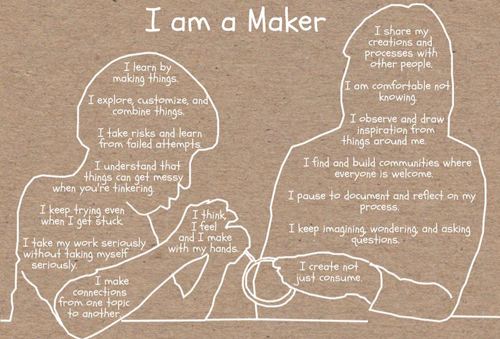
If you could design religious education experiences for kids that were so memorable and compelling that they’d continue to seek out those kinds of experience as adults, what would they look like? I’m convinced, after asking dozens of people about their best memory of learning in church, that it should be as hands-on, as innovative, and as creative as possible.
Around the country, “Maker Culture” is developing. Even public schools are setting up Maker Spaces that encourage kids to use their minds and hands to design, collaborate, and create. But what does all this have to do with Sunday School? William Ellery Channing said that “The great end on religious education is not to stamp our minds upon the young, but to stir up their own.” It seems to me the best way to do that is to hand them tools now and let them know we expect them to come up with great ideas that will change the world.
Tony Wagner, current expert in residence at Harvard University’s new Innovation Lab and the founder of Harvard’s Change Leadership Group says, about MakerSpace classrooms: “That’s the future.” According to Wagner, the idea of school as a place where knowledge is transferred from teacher to student, whose success is measured by the accuracy of his/her regurgitation of it, is antiquated. This instructional model does not foster what Wagner believes is the most essential skill in today’s world: the ability to innovate.
In his most recent book, Creating Innovators: The Making of Young People Who Will Change the World, Wagner profiles some of America’s great innovators and observes a pattern in their youths: A childhood of creative play led to their development of deep-seated interests and curiosities, and these passions fueled their intrinsic motivation to set and achieve career and life goals. Another trend Wagner found was that the adults in these innovators’ young lives nurtured their imaginations and taught them to persevere and learn from failure. Read the related Newsweek article here.
My own previous career as an educator in a children’s museum showed me that kids love to create and build and invent, and learn, quite by default, while doing so. So as I consider what to do for our kids on Sundays this summer, I can’t help but gravitate toward this approach.
My question for you is, what would you like to bring to this endeavor? We have one volunteer already planning to support a small group in setting up an A/V system downstairs. I plan to work with the kids to set up a vermiculture system (worm farm!) and a container garden. Would you like to help them build birdhouses, bathouses, or something else for the playground? Learn to make their own toys from recycled objects? Work on community artwork for display in the church? Make and edit a video about RE that new families or potential members might enjoy seeing? The key: projects they can actively MAKE and call their own.
What makes your heart come alive?
Can you share that on one or more Sundays this summer?
Our kids thrive on learning to do things. It changes their brains, and the way they see themselves: when we make things, we are more confident, more willing to experiment, less anxious about failure and perfection. We naturally collaborate and take risks, and we begin to see ourselves as creators of the world around us, not passive consumers. Let me know how you can help MAKE this happen.
Read more about Maker Culture here.
Photo credit: http://philippe.ameline.net/images/IAmAMaker.png
Mar 19, 2015 | Weekly Message

Well, it’s that time of year again! We are approaching April 16, National Health Care Decisions Day, and I’m excited to tell you about a new initiative that will be launched next week. The JLC Initiative is the brainchild of Jill Preyer, Cindy Bovee-Kemper, and myself, and our goal is to drastically increase access to health care decision-making education and forms across Western North Carolina (WNC). Part of our strategy is to use diverse and accessible locations for class sessions, including educational institutions, community centers, and faith communities. We have created a pilot program that we are launching first at UUCA, then assessing, tweaking, and rolling it out to other congregations in WNC. Ultimately, we will have a simple toolkit we can share so that every person in WNC has access to this essential information. Beginning the conversation with loved ones starts with education on the issues and forms.
This week, collaborating with the WNC Advance Care Planning Community Initiative, we begin training facilitators from within the congregation (by invitation) to teach Advance Care Planning seminars. On March 29, we will launch workshops here at UUCA – these are free and open to the UUCA community and the public. We will give adults in WNC opportunities to talk about their end-of-life care and create legal documents (Advance Directive) to reflect their goals. In addition, we intend to maximize impact by providing information regarding class locations and schedules to primary care physicians, educating them about the initiative, and working with other community organizations.
As you may already know, when I was working as a chaplain, I had many experiences with families who had never communicated a single word to one another about their wishes, should they be incapacitated. They found themselves in ICU with a loved one and no idea what their wishes were. As a result of these experiences, I pledged that when I returned to the congregation, I would bring these end-of-life conversations into the local church setting. Where better to talk about your values and life goals than in your faith community? Many of you have already completed your forms, and some have had in-depth conversations with me or others about how to manage your individual needs and situations. It is a privilege to sit with you and be of support as you consider these essential and personal decisions.
I hope that if you have not already completed your own documents, you will attend one of the UUCA workshops, and encourage others to attend as well. Beginning the conversation is the first step. If you are interested in being considered to attend facilitator training, please contact me. Workshops will be held at UUCA on the following dates. Please check UUCA’s eNews articles for locations. All are welcome!
- Sunday, March 29, 1:30-3:30pm
- Tuesday, March 31, 10am-Noon
- Sunday, April 5, 1:30-3:30pm
- Saturday, April 11, 10am-Noon
- Thursday, April 16, 6-8pm
Mar 12, 2015 | Weekly Message

My finger pokes into the bread dough, and the resilient flour and yeast mixture springs back. It is ready for the next step. The instructions say “Punch down,” and, while I wish for a less violent command, I use my fist to deflate the dough. Then, reshaped, it rises again in a new, less amorphous form. Even the time the baking sheet with its braided loaf slid to the floor, knocking the air out of it, the bread rose again.
How do we create that resiliency for ourselves? Bread rises because the leavening—whether yeast, baking powder, or soda—produces carbon dioxide bubbles which are held by networks of proteins; without the protein bonds, the gas would escape and the bread would lose its resilience. When we have been deflated, whether by difficulties in our own lives or by the enormity of the task of achieving justice for all, we can be buoyed up and our congregation can be reshaped, and both can rise if the truths of the principles we agree to are surrounded by human connections nurtured and deepened by the congregation.
The editorial “Race, Poverty and Medicine” in today’s electronic version of the Journal of the American Medical Association (JAMA) suggests that in trying to achieve health outcome equity, “One goal of medicine is to better understand resiliency and to support it so that all people can fulfill their potential and enjoy healthy and productive lives.”
T. Edward Nickens wrote in this month’s Our State that sacred places “help us understand where we are, and who we are, and why we are. They’re places where we can stand, feet rooted to the ground, and see the past and the present and the future in a single moment.”
Picture one of your sacred places.
Were you, like the author, imagining a sacred landscape? What if, in addition to that mountain vista or sandy shore or shading tree, you pictured this congregation as your sacred space? Is this not a place where, and people with whom, to “understand where we are, and who we are and why we are?” I believe the power of our covenant and the strength of our relationships will keep us resilient people, able to truly see our present and to work together to achieve the just, equitable and compassionate future we envision.
Photo credit: mtrichardson / Foter / CC BY
Mar 5, 2015 | Weekly Message
On receiving an Academy Award for the song “Glory” that he wrote with John Legend for the film Selma, the rap singer Common told the audience in Hollywood that the Edmund Pettus Bridge in Selma, Alabama, that was a focus of the movie “was once a landmark of a divided nation,”
No question. That was the bridge that civil rights workers in 1965, led by John Lewis, crossed in an ill-fated attempt to begin a march to Montgomery seeking to assure African-Americans the right to vote. The march was cut short by police and volunteer deputies who savagely beat the protesters and drove them back. The steel arch had been built only 25 years before and named after a former Confederate general, U.S Senator and Alabama Grand Dragon (chief leader) of the Ku Klux Klan.
But, 50 years later, Common told the audience, the bridge “is a symbol for change.” The now-aging steel structure, he said, has become a reminder that determined action can bring about justice. For, not a week after civil rights workers were turned back, they marched again, and this time a path was cleared for their march to Montgomery and eventually the passage of the Voting Rights Act. It was a hard-won victory, and two Unitarian Universalists, Rev. James Reeb and Violet Liuzzo, among others, died to bring it about.
So, it made it all the more sweet to hear Common declare that, “The spirit of this bridge transcends race, gender, religion, sexual orientation and social status. . . . This bridge is built on hope, welded with compassion and elevated with the love for all human beings.”
This coming Sunday I’ll be joining what could easily be thousands, including hundreds of Unitarian Universalists, in a ceremonial crossing of that bridge. In the days before I’ll be part of a Living Legacy conference that will examine those times, what’s been achieved for civil rights and the work that remains before us. I’ll be there with Clark Olsen of UUCA who was attacked with Jim Reeb in 1965 and has spent so much time since telling the story of Selma and working for civil rights.
I wanted to be in Selma not just to mark an important anniversary but to remind myself, as I hope we will remember, that, as John Legend told that Oscar crowd, “Selma is now, the struggle for justice is right now, the struggle for freedom and justice is now.” I look forward to our conversation about how we in this congregation can be a part of this struggle.
Feb 26, 2015 | Weekly Message
As I stated in my sermon last week, the season of Lent is a time that speaks to me. Though I don’t practice it myself, I am always inspired to dig deeper into my own faith as I witness friends walk the forty-day journey. And so I share this story, which takes us a bit deeper into the meaning of Lent than I was able to get on Sunday.
One day, a colleague with two young children was working in her home. Suddenly, my friend was interrupted by the shrieks of her 6-year-old daughter, incredulously trumpeting a particularly egregious transgression committed by her older brother. “He said the ‘A’ word!! He said the ‘A’ word!!!” she cried.
My friend, assuming the worst—that her 8-year-old had learned to swear—prepared to reprimand and punish, since the pastor’s children really ought not cuss like sailors. And then her son arrived on the scene, equally incredulous, ready to defend his own honor.
It turns out that the ‘A’ word he said was not the one we all assumed. The ‘A’ word he had, in fact, said, was “Alleluia.” You see, the week before at an Ash Wednesday service, the children’s time had included a ritual packing-away of the word “Alleluia,” in preparation for the fasting and reflecting time of Lent. The 6-year-old had taken a literal reading of this particular children’s sermon, and elevated the word “Alleluia” to the level of the worst swear she could imagine.
I didn’t understand the purpose of Lent until I went to seminary. That first year I attended a Christian theological school, I watched my friends live—actually live—the forty days of Lent. I had only ever known Lent as a time during which people gave things up, like chocolate, or hitting their brother, and nobody had ever explained to me why they were doing this.
It always seemed kind of strange, and didn’t make much logical sense to me un-churched as I was. And when we did become churchgoers, I did not learn much about Lent in the humanist congregation my family attended.
I participated in an Ash Wednesday service that first year, in which we were encouraged to use the forty days of Lent to repent. Usually we think of repentance as pejorative—when we do something wrong, we must repent of our sin, we feel regret about something we have done, sorrowful or penitent. But in Greek, repentance is most often translated as metanoia, which has a much deeper and more complex meaning.
Meta means after, with, or outside of, and noia means to perceive, think or observe.
Theologically, metanoia is used to refer to a change of mind, a turning, a fundamental shift in consciousness. Further, in the Ash Wednesday service, it was explained that in ancient Greek culture, the soul was thought to reside in the head, rather than in the heart, as we might think today. So, if the soul resides in the mind, and repentance is a change of mind, we can really think of metanoia as a change of heart.
I think of repentance, or metanoia, as a turning. It is the fundamental shift in my consciousness that comes with deep self-reflection, with self-awareness and engagement with my own life’s journey. Lent, a time of repentance, self-denial and fasting, which is meant to bring the Christian penitent closer to God, can be relevant to us as well. We may be humanist, atheist, Christian or non-Christian Unitarian Universalists, but ultimately the practice of observing Lent is meant to bring us closer to the truth that resides in our own hearts.
We pack away the “Alleluias,” not to be morbid or arbitrarily give up a vice, but because taking time to reflect deeply on who we are and what is important in our lives is a good practice. This is not about random self-denial, but about clearing away the things that distract us from our larger purpose, from our deepest thoughts and highest purpose.
Whether or not we are waiting to commemorate the death and resurrection of Christ in a literal sense, the season of winter is not over yet, and as we live in the chill air of a February afternoon, we wait for the time when green buds will appear on trees and the crocus will peek its tender green bloom from a crack in the still-frozen ground.
When Easter comes, when the spring begins, what will you have turned away from? What old habits and sadnesses will you have left behind? How are you preparing the garden of your soul for the growing season ahead?
Feb 19, 2015 | Weekly Message
The 10,000-foot view. It’s what makes an IMAX film of the Grand Canyon more breathtaking than walking it step-by-step, at ground level. It’s what helps us see the forest, and not just individual trees. It is very different from what I like to call the “in the trenches” perspective, where we solve problems, plan for the short-term, and manage the nitty-gritty. In the world of religious education, that’s where professionals spend most of their time. Emails, phone calls, calendaring, room reservations, meetings, permission slips, recruitment, committees, time sheets, staff management, more meetings, more emails, and lots of planning to make sure Sunday morning won’t flop.
It can be easy to keep my focus there – there is certainly plenty to be done, and it never really seems “finished” when I lock up the office at 23 Edwin and leave on Thursday afternoon for my Sabbath. The daily management and oversight of RE is an essential piece of a healthy ministry, and a big reason you have a professional religious educator. But without the 10,000-foot view, which might be called vision, we can get to the end of the event or the curriculum of the year and not have an idea of where to go next.
You trust me to manage the ground-level view. The Lifespan Religious Education program has an excellent committee and dedicated staff, and in collaboration with the UUCA staff team, ministers, and lay leadership, we do a pretty good job with RE.
But the 10,000-foot view? That perspective comes from the picture that develops when the wider faith community and leadership engage in meaningful dialogue on the big questions. Where do we come from? Who are we? Where are we going? What are our shared values and dreams for the essential ministry of faith development? And how can we get there from here?
I hope you’ll join in this important conversation coming up soon. Songwriter Ani Difranco wrote “When I look down, I miss all the good stuff/And when I look up, I just trip over things.” Your vision is needed to help RE leadership navigate toward “the good stuff” you can see from the 10,000-foot view, while we continue to offer a program that runs smoothly on the ground.
Visioning for the Future: Lifespan Religious Education at UUCA
- Friday, February 27, 5-8pm: It’s a Potluck History Party!! (Note: Long-time members needed here!) (RE C)
- Saturday, February 28, 9am-3pm: On to the Future!! (RE C/S) Lunch provided with RSVP.
Please plan on attending this important opportunity to talk about the ministry of religious education and faith development at UUCA. During this time, we will share our knowledge of the history of religious education at UUCA and look to the future as we envision the program of faith formation we will work to create together. This work is covenantal in nature, and so we are inviting all who have an interest in religious education and faith formation to attend – lay leaders, board members, parents, elders, teachers, and youth are especially invited. Click here for more information.
Friday night, 5-8pm: Childcare will be provided. RSVP here (specify ages please).
Saturday, 9am-3pm: Childcare will be provided. RSVP here for lunch and/or childcare needs (specify ages please).
We hope you can come to one or both of these important events.
Feb 12, 2015 | Weekly Message
My mother Roberta writes memorable thank you letters. She taught me that being thankful meant finding words to express that gratitude. Today, as I return from being with Mom in California during preparation for and recovery from surgery, I am thankful for your messages of care and support: you are living into our covenant. Vice President John Bates and the other Board members moved the Board monitoring and visioning processes forward in my absence as I knew they would; I am grateful for their dedication to this work.
Mom is 91; her statement that she lived alone at home was sometimes questioned as possible evidence of dementia. Most often, however, the staff asked her what her goals were: to return to living in my home. Then together they formulated and explained the steps to get there and the changes that might be necessary. She is spending a couple of hours a day in the gym at the post-acute care hospital doing exercises familiar to any workout: rows, biceps curls, standing arm raises. Her occupational therapist Peter explains each one—both how to perform the move and in what specific way this helps her reach her independence. As your UUCA Board we are listening to discern your goals for our life as a congregation so that together we can name the programs and actions that will lead us to that vision of ourselves.
We belong to UUCA with hopes of feeling connected and deepening relationships. Part of Mom’s identity is her professional one as a dietitian and volunteer of thousands of hours in the hospital library. The dietary staff recognized her knowledge and treated her as a colleague. She in turn asks the staff about themselves. Thus she who believes she can’t meet new people well has in a week’s time made strong, positive connections to a place she never thought she could stand to be. Let’s all seek to know others in our congregation better.
The minister of the church I grew up attending preached last Sunday on faith and fear. He contrasted safety as those things which protect us from harm to security as a sense of freedom from worry about harm. There were lots of safety measures evident in Mom’s medical care: marking the correct leg for surgery, double-checked identity bands, wide belt around her during therapy. But her sense of security came from the kind and caring people.
When we personally or as a society focus on measures to make things safe, devising mechanisms and writing laws to protect us from injury, we do not necessarily feel more secure. Secure, from the Latin “without + care”, conveys a sense of freedom from anxiety, an attachment so we will not be lost. Thought of this way security has more in common with peacefulness than safety. May we then consider the connections of security and faith, how we see the world work?
Let us, as shared by Bruce Larson, think for peace this month:
Let all beings be happy, loved, and peaceful.
Let the whole world experience these things.
Feb 5, 2015 | Weekly Message

A view from on top of the Amber Fort in Jaipur, India
The sights and sounds of India will be echoing inside me for some time after returning from the three-week Road Scholar “spiritual tour” that my wife, Debbie, and I took. But as I indicated in my sermon on February 1 what continues to work on me is the religious richness and diversity of that country.
We humans have struggled over millennia to name, to grasp, to honor, to serve that fundamental sense we have that there is something wondrous, beautiful, compelling and dear about this existence that calls to us, as Mary Oliver puts it, “like the wild geese, harsh and exciting.” Story, myth, ceremony and creed are all ways that we have tried over the eons to speak to this experience, to align ourselves or even commune with it. We sum all these up under the category of religion, although the more we learn about the varieties of expression that we call religious and the organized forms they have taken and continue to take, the trickier it is to say what exactly we consider religion to be.
This is interesting not just as an academic exercise. The broader we draw the circle of religious expression the more it can free us to explore further the ways in which each of us engages with whatever we may choose to call the holy. Many people have a narrow experience of religion, and, if it doesn’t work out, figure that religion is not for them. I believe that religious experiences are inherent to human experience: we all have them. And one of the gifts of our religious movement is that we invite each person to name and explore the meaning of those experiences in a safe setting, a place where we hold that each person has inherent worth and dignity and that we and all beings are bound up in an interdependent web of existence. Our congregation, then, becomes a kind of crucible where we can test and explore and eventually learn to name what resonates most deeply with our hearts, which is where our faith resides.

An “Aarti ceremony” held each evening in Varanasi along the banks of the Ganges
My hope is to find a venue where we can explore religion in India both to broaden our understanding of the forms religion has taken over the years and to reflect on what we have to learn from it for our own journeys. My current thought is that this will take the shape of an adult education class this fall. Keep an eye out for it. Meanwhile, I plan to post some of the photos I took in India on our congregation’s Facebook page. Keep an eye out for that, too, and I welcome your thoughts about what I have to share.
Jan 29, 2015 | Weekly Message
Grief has been on my mind these past few weeks, as I have witnessed so many people experiencing losses of loved ones. We know anecdotally that January is a busy month for dying, and I have seen this phenomenon repeat itself over and over as each day more people share news of their Beloveds dying, sometimes suddenly, but more often after an illness.
We, too, have experienced loss in our community, with two candles lit these last few Sundays for lives of people that we have loved. In any given day, we are faced with small and large losses that touch the well of grief within.
My sadness has drawn me to seek out familiar words of comfort, and I recall the Mary Oliver poem, “Heavy” –
That time
I thought I could not
go any closer to grief
without dying.
I went closer,
and I did not die.
Surely God
had His hand in this,
as well as friends.
Still I was bent,
and my laughter,
as the poet said,
was nowhere to be found.
Then said my friend Daniel
(brave even among lions),
“It is not the weight you carry
but how you carry it—
books, bricks, grief—
it’s all in the way
you embrace it, balance it, carry it
When you cannot, and would not,
put it down.”
So I went practicing.
Have you noticed?
Have you heard
the laughter
that comes, now and again,
out of my startled mouth?
How I linger
to admire, admire
the things of this world
that are kind and maybe
also troubled—
roses in the wind,
The sea geese on the steep waves,
a love
to which there is no reply?
Grief is a complicated emotion, and each of us experiences it differently. When I first learned about the five stages of grief – denial, anger, bargaining, depression and acceptance – I expected that I would move through them one by one, check them off, and be finished with my grief process. How wrong I was! I have come to understand that grief is much more like the water table, which flows under the ground all the time, and I interact with the water when I dip a bucket down into a well, wade into a pond, or trip over a puddle. As Oliver says, “It’s not the weight you carry, but how you carry it.”
We all manage our grief differently as well, using different coping mechanisms to work through the process. There isn’t a right way to do this. The most important thing is to be gentle with ourselves and with each other. Remember, that each new grief recalls the ones we have experienced before. Make space for your grief, and know that you are not alone. Remember that “We need one another when we mourn and would be comforted” (George Odell)
May you each find respite from your own well of grief, and may the simple daily actions of your life bring you solace.
Jan 15, 2015 | Weekly Message
Let’s face it, the very idea of going to church seems so…well, old-fashioned. Like something our grandparents did. An anachronism. Hasn’t the world moved on?
Currently, about 40% of Americans attend church services regularly. The world has moved on from the days in the 1950s and 60s when liberal parents started Unitarian, Universalist, and UU fellowships, at least in part so that their kids could say they had a “church home” when asked by their more religious peers. Increasingly, it can seem that the idea of a faith community has lost relevance in a post-modern world with an infinitude of options available to us as we consider how to spend our weekends. As a professional religious educator, I’m biased, of course. And it hasn’t escaped me that there appear to be strong positive correlations between church attendance and health, especially as we age. But I’d like to encourage us to really focus on three “unique competencies” that a congregation or church still can lay claim to.
Churches are one of the only institutions or systems left in our culture that are truly multigenerational. Is it important to human beings to have elders and youth taking part in the same ceremonies and rituals, to be part of the same tribe? I think so. Particularly when families are more likely than ever to live far from their extended family, children need to see and know older folks who are part of their tribe; elders need to be around young people too. There is a deep human evolutionary expectation for multigenerational teaching, learning, and socializing. We offer that as a given in a faith community where children and youth join services regularly, and where congregants of all ages join the Religious Education teams that teach classes and lead activities. As a mom, I consider the diverse array of adult mentors and teachers who have graced my own kids’ lives to be a blessing I could not have curated otherwise. They have learned that they have a group of grown-ups who care about their well-being, especially their emotional and spiritual development. They have learned that grown-ups come together to support young people as they grow and learn. Priceless! And on many occasions older adults have come to me to share how buoyed their own lives have been by their work with children and youth. The infusion of energy and joy and curiosity and cleverness that our children carry can help us remember our own light and clarity of purpose.
Congregations provide a particular kind of support and fellowship that humans need. Although we don’t understand perfectly what the causal factors are, we know going to church is positively correlated with health benefits. According to a recent New York Times article, “Religious attendance…boosts the immune system and decreases blood pressure. It may add as much as two to three years to your life.” It has been associated with a decrease in the risk of Alzheimer’s too. We can assume social support is part of that, but surely the very real stress reduction (including free child care while one meditates, works in social justice, or listens to an edifying sermon) is part of that too. And I believe that sharing rituals and ceremonies strengthens the spirit in ways we don’t fully comprehend and can’t measure.
There are reasons why Unitarian Universalism is one of just a few denominations that are growing or plateaued, rather than shrinking–a progressive faith that is inclusive and welcoming to all is a better fit with today’s American than ever. Our theology works well for a culture moving away from hell-and-brimfire-damnation and toward the idea that whatever our human fate, we will share it; the essential doctrine of Universalism. This same doctrine compels us to do one more thing that is unique to faith communities, especially liberal ones:
Opportunities to change the world for the better. Church gives us a chance to work together in multigenerational communities to determine where we will devote targeted, shared energy to help those in our local and global communities. Recently in RE our kids devoted a Sunday to learning about, teaching each other about, and voting on how we would donate monies to help families in need. As we did so, we reflected on our shared principles and how they guide us toward making a difference in the world. As we grow older in faith communities, we can share and reify the ideological work that allows us to focus our human compassion toward change, while we explicitly teach our kids that this is what people do.
Thank you for making the commitment to being with us. I hope you will deepen your engagement with this congregation, especially if you have an interest in Religious Education, but we have many ways to grow and, as a mentor used to say, swim in the deep end of the pool together. Church is good for us–keep the faith!
Jan 8, 2015 | Weekly Message
Expectations. Whether we set new goals or resolutions for a new year or at some other juncture, when we make a decision to pursue a goal or start a new project there comes a time to assess our progress. If we find ourselves on a different trail, is it because we missed the signpost or because we learned an alternate route was more scenic?
For the Lead Minister each day’s walk is different, and on some of those paths Rev. Mark Ward encounters crowds, and others are nearly solitary routes. In the process of figuring out how to review his work, we have come to realize that, just as some of us know in our own job descriptions, much of what the Lead Minister does in our—or any large—congregation is largely unseen. Mark is visible while leading worship and preaching, and many of us personally know his role in pastoral care, although few realize how much time he devotes every week to this. He spends much time behind the scenes preparing for each worship service to make it “beautifully crafted into a meaningful whole,” as services were described at one of our listening meetings.
Other of his ministerial roles are delineated in the Letter of Call and include working with the Board, being responsible for all congregational committees, and providing staff leadership and evaluation. In addition to participating in Social Justice events, he attends national and regional ministerial gatherings and meetings. One of our expectations, shared by Mark, is that he has space on his schedule for professional and personal growth.
The Board and Congregation are considering our visions for our future and what ministries we can do well together. The ministerial review process should ensure clear mutual communication of congregational and ministerial goals.
As the UUCA Board of Trustees, we set our expectations for the Lead Minister in the Executive role through the Ends and Limitations, aspects of which are monitored monthly by the Board as a whole.
A Ministerial Review Task Force was appointed last year to recommend a model for annual review of the Lead Minister’s ministerial roles.
The Task Force concluded that “developing this review process underscored… the size and complexity of the lead minister role in a large congregation” and recommended a cyclical rotation of focus on ministerial roles outlined in the Letter of Call:
Year A: Shared Leadership, Services to Board and committees, and relationship to staff
Year B: Pulpit and Worship services, and services to persons
Year C: Community activities
The Board accepted the Task Force’s report with gratitude to Melissa Davis, Chair, and members, Shel Altschul, Wendy Seligmann, and Dale Wachowiak.
Lead Minister Review Task Force will be a standing task force reporting to the Board and comprised of six members of the Congregation: two appointed by the Lead Minister and four by the Board, at least two of whom will be Trustees. Members will serve staggered three year terms.
Dec 31, 2014 | Weekly Message
I write this less than a week before Debbie and I leave for three weeks in India as part of a Road Scholar “Spiritual Tour” of that country. Part of the reason I seek to experience different cultures is to shake up my settled ways of thinking, to open up new ways of looking at the world, even as we travel to one of the oldest cultures on earth.
One distinctive aspect of this culture I look forward to experiencing is a different understanding of time. We in the West have a sense of the progress of time as like an arrow, ever moving forward, while Hindus believe that history is governed by patterns that repeat themselves over and over again in great cycles. This changes how they experience time and alerts them to be aware when each cycle moves to a new stage.
I reflect on this when I think about our nation’s and our community’s ongoing struggles over race. We go through one crisis after another, thinking we’ve finally got this figured out, that we understand the toll that racism takes on all of us, that we have learned the lessons and put the safeguards in place to avoid making those mistakes again. And then, there it is all over again just as insidious as it ever was.
We’re processing this now in the controversies surrounding the recent deaths of several African-American men at the hands of police officers. The circumstances surrounding each of these deaths are complex, but together they are part of a troubling pattern in America today in which African-Americans are more likely to be arrested, imprisoned or killed by police than whites. Again, many factors play into all of this, but there is no denying the oppressive overburden of racism that suffuses it all, and as religious people who affirm the inherent worth and dignity of every person, we are called to respond.
As Associate Minister Lisa Bovee-Kemper wrote in the last posting on this site, we as a congregation will be devoting some energy to this in the next several months. We have already convened one meeting of people interested in helping. Check in with Lisa if you’d like to be a part of this group. We are working at making contacts with organizations in the community doing this work and encouraging people to take part in the next session of Building Bridges, Asheville’s own anti-racism training program, January 26 through March 23. We are also organizing a discussion group to read one of the best recent books on this subject, The New Jim Crow, by Michelle Alexander. Look for more to come. We’ll be addressing this subject in worship again on March 15, the week after celebrations of the 50th anniversary of the civil rights march on Selma, Alabama.
Maybe we need something like a cyclical understanding of time, the awareness that some of the deepest spiritual lessons are not easily learned but required our returning to them over and over again.
Dec 23, 2014 | Weekly Message
I’m happy to report that we had about fifteen people at the December 18 meeting to discuss the next steps for engaging with racial justice on a congregational level. We began with a chalice lighting, and then viewed a TED talk by Verna Myers on how to overcome biases (view it here) and engaged in a brainstorming session.
Here are some of the ideas that were suggested in the brainstorming session:
Encourage individuals from the congregation to participate in Building Bridges (Next session January 26-March 23 – register here).
As a Lifetime Member of the NAACP, send a representative from UUCA to regular local NAACP meetings (Jan & Michael Beech have volunteered to initiate this)
Mentoring
Book Study/Common Read on The New Jim Crow, by Michelle Alexander (This is in the works, stay tuned to eNews for more information and a tentative January start date)
“Old White Women for Young Black Youth,” which is the unofficial name of a potential initiative started by women from UUCA who would step forward as advocates for people of color in our community. This would be a great way to leverage privilege and be a supportive ally.
Consider positions that work to dismantle the roots of the oppressive system
- Advocate for harsher penalties for law enforcement who break laws
- Voting Rights advocacy, including restoration of felon voting rights
- More effective drug policy, perhaps decriminalization
Participate in local organizations which are doing anti-oppression work in our community
Curriculum-based study on a congregational level (There are a number of UUA curricula available)
It’s a great list, and there are more terrific ideas out there, I’m sure! Check it out and see what you might be interested in. Share your own ideas with each other – and with me. In addition to this work, or parallel to it, I am working with a group of Building Bridges graduates from UUCA to form a Multicultural Team to dig deeper into these issues and how they play out within our congregation. There is much work to be done, but working together makes it manageable. We, as Unitarian Universalists, lift up the inherent dignity and worth of all lives, and as such, we are called to support our neighbors and assert that Black Lives Matter.
I look forward to hearing your ideas and digging deep into this work together!
Dec 18, 2014 | Weekly Message
Six months in the saddle here as your Lifespan Religious Educator, and we have done so much! I wanted to use this half-year mark to report to you on a few of the most salient of the LRE program’s accomplishments, challenges, and goals. One of the members of the RE staff remarked today that we have had a lot of change since I arrived, so I thought I should speak to that. Change is truly the only constant in life, and yet it’s hard to not feel a little anxious about it. I once heard that people spell change “L-O-S-S.” I also heard, though, that what’s in the bottom of God’s pocket is change. Here are some of the changes we have experienced this year in Lifespan Religious Education.
The Wonder Box: I love having the opportunity to be with the entire congregation once a month during Time for All Ages. It is one of my favorite parts of this calling. It is a great joy to craft a telling that has meaning and is appealing to people young and old. Thank you for the smiles, the laughter, and the comments you have shared about this precious time we spend together, teaching our children and youth what shared worship is about.
Spirit Play: Our younger kids have enjoyed the shift to a more hands-on, interactive program in Spirit Play. 15-20 minutes of deep engagement with one of our faith stories, including wondering questions, turns out to be the perfect amount of direct teaching time for little ones. After that time, they are free to explore and process the story through participatory and active play in the Drama, Science, Art, Music, or Contemplative centers. We’ve had lots of help from adult volunteers who don’t normally teach, and we’ve encouraged folks to share their talents and interests with us so we can help craft activities that are meaningful for all. What’s working? The mixed age groups (particularly K-3), the emphasis on each child’s active, creative processing of the shared story, the carefully curated rooms as centers. In particular, the Contemplation Center has been a huge success, allowing children and adult leaders alike to have an unscripted experience with the many contemplative activities found in the room, at their own pace. Adults regularly report that they want to teach there every Sunday! What is challenging? The move away from teaching teams for this piece of the program had some unintended consequences. We hoped to take the burden of teaching off the small number of folks who normally are recruited for teams (teaching all year), but may have erred on the other side; teaching in teams has some real benefits. First, it’s more likely to be a ministry when you are working with people you know. Next, knowing your space, your team, and the kids increases one’s own comfort and competency as a teacher, and reduces last-minute cancellations that require RE staff to fill in. Our solution? We will be recruiting for center teaching teams: a team of eight folks who love working with each particular center, who can call on each other when a sub is needed at the last minute, and who can establish norms of consistency and expectation in the space, while building bonds of mutual respect and affection with kids and between team members. A second challenge we have noted is that our 4th and 5th graders, particularly at 11:15, were not as engaged as we had hoped. The reality is they are ready, after 3-5 years, to take the valuable groundwork laid by years of Spirit Play stories and experiences and to form a peer group in a bounded space they can call their own. They feel like big kids, and they need us to recognize their progress in spiritual and emotional development at this age, when we know they are ready to start grappling with big questions and learning in a more structured way. Our solution? Anna Olsen and Latt Foster, both veteran teachers, stepped forward to lead District 45, in a classroom of their own! (I’m please to note Katherine Murphy will be joining them in the new year.) We started the year with six or eight 4th/5th graders attending – as of last count we were up to attendance of 15 – so the change is working for the kids in question and their families!
Junior Youth Group: A brand new group has formed this year for 6th-8th graders. Parent- and youth-led, this group is finding its footing and making decisions about what it whats to be and do. For now, a core group is having fun and making plans for a social justice activity in the Spring. I believe the fellowship and bonding made possible by a extracurricular group like this will help unify the kids and solidify the identity-building process that church should be for this age group. Being a Unitarian Universalist because your parents say so isn’t cool, at this age – but when young adolescents are supported by our faith community to explore values-based activities and have fun together in a way that is at least partially self-directed, they are more likely to see themselves as UUs. I am excited about this BIG change and hope to see the group thrive and grow in the future.
Senior Youth Group: We recognized early in the year that 10th-12th graders and their teachers weren’t having fun. That’s a big problem, when we UUs have a hard enough time holding onto our youth as they grow up. We did a major reboot a few weeks into the semester, aligning our activities and lessons with a handful of goals like FUN, community building, and service. We decided to give our fabulous advisors more creative freedom and to use the lens of Youth Empowerment and a Small Group Ministry approach, rather than a one-size-fits all curriculum plan. Several weeks later, everyone is enjoying the process a lot more, and youth feel a sense of pride and camaraderie in their efforts toward the Food Donation Drive and their current planning of the Youth Sunday service on February 15th.
That’s a lot of change! I hope (and I’m a person of faith, so I believe) that all this change will add up to real profit for the program and its constituencies. We have other programs and classes, of course; they just haven’t seen as much change this year as the ones listed above. Feel free, always, to reach out to me directly with any questions, comments, suggestions, or words of encouragement! I can be reached at dlre@uuasheville.org.
Thank you all for your support of our work in lifespan religious education here at UUCA. Remember, all we teach is Unitarian Universalism, everything we do is faith development, and the congregation is the curriculum. Keep the faith!
Dec 11, 2014 | Weekly Message
Imagine bringing your imagination to a board meeting. That’s what the UUCA Board asked members to do at each of three meetings this fall, and now we are engaged in the process of thinking and talking about what we heard, discerning how those heartfelt conversations will guide our congregation forward.
The UUCA Board’s work, like most other boards, includes monitoring: Does the work of members, committees, staff, volunteers, overseen by the Lead Minister achieve the Congregation’s vision? Are the fiduciary, planning, communication and right relations parameters set in the Governance Document being adhered to?
Imagination—whether we call it visioning, strategic planning, generative work—is also the business of the Board. It is work which takes time, requires active listening, is helped along by having a little fun, feels sometimes like trying to hold water—a thing which is good, which we know we need—without a vessel. We want to keep this good thing that we have together, to make it richer and more easily accessed by members of all ages and tenures, and to continue listening so that what you imagine UUCA to be is part of our picture.
We also need to query our imaginations to identify barriers and impediments which may be cultural, emotional, or physical. Use our imagination to hear how we can be true to our mission and where we can “work in community for justice, love and peace.”
I invite each of you to fantasize about what our congregation could be to you and to our community, keeping in mind that the origin of fantasy is not something false, but something made visible. Intrigued about the Board or interested in serving? Talk to a Board or Leadership Development Committee member!
AN INVITATION TO ALL
What: UUCA Board Meeting
When: 6:30pm on the first Tuesday of each month
Where: 23 Edwin Boardroom
Bring: Your Imagination!
If unable to attend: Please talk to each other and to a Board member about your vision of UUCA.
Nov 20, 2014 | Weekly Message
With December we move into a month of imagining. That’s true nearly always, but this month “Imagination” is also our worship and small group theme. How might your imagining open new ways of engaging your spiritual life? December is a central moment in several religious traditions. I think particularly of the Christian and Pagan calendars, both of which involve deep imagining. For Christians it is a time of expectation leading to the birth of light and renewal in the world in the coming of Jesus. And for Pagans it is settling into a time of darkness and expectation at the Winter Solstice, imagining how one might prepare for the year ahead.
Winter is a good time to give ourselves over to the imagination, to make future plans and also to imagine how our lives might be different if we acted more intentionally on our values. Are there rote routines that you have saddled yourself with or ways that fear has kept you from your heart’s desire? How might you imagine a life, a way of being in the world that is more in keeping with the deep integrity at your core?
This is good work for us to do on our own, but it only gets us so far. Real spiritual growth, I find, happens in the presence of others who invite us into speech that helps us better frame our thoughts and feelings. Our Theme Groups are created specifically to do that. They are led by trained facilitators to create safe space for all of us to explore this important and sometimes tender territory. If this sounds interesting and you’re not already a part of a group, check with Jim Steffe, Joy McConnell or Rev. Lisa Bovee-Kemper about finding a group to join. We’re working hard to find room in groups for anyone who would like to be a part of one. As usual, we have resources available for you to reflect on our theme. Visit the Worship Theme tab on our website’s homepage; click on the theme, in this case “IMAGINATION,” and you’ll find links to spiritual exercises, questions to explore, and many resources touching on this theme.
Finally, speaking of imagination I wanted to tell you about an adventure that my wife, Debbie, and I will be taking in January that comes from our own imagining. From January 6 through 27 we will be on a trip to India. It is described as a “spiritual tour” of India, taking us to a number of important cities and landmarks in the north and northeastern part of that country. I look forward to sharing with you some of what we learn on that trip. Meanwhile, I invite you to consider where your imaginings might take you.