Jan 21, 2016 | Weekly Message

Now is the time, my friends, this is THE moment. Or if not the ONLY moment, it is a moment not to be missed. If you care about the future of social justice work here at UUCA, if you want to see energetic and engaged programming, and if you want to participate in making this program the best it can be, do NOT miss the Earth & Social Justice Ministry meeting on January 27 at 6:30pm. I am so excited to invite each and every one of you to this essential meeting about our work for freedom, justice, and love. We will gather that night to give an update on the work that has been done so far, and to hear your ideas and help you find ways to get involved!
Initially, 15-20 people participated in the Doing Democracy Study Group, which used the book Doing Democracy: The MAP Model for Organizing Social Justice Movements, by Bill Moyer (not to be confused with Bill Moyers!) to learn about social movements and organizing. The model is straightforward, in particular suggesting that there are four roles for individuals in social movements, and eight stages of the movements themselves. We explored the question are you a Reformer, a Citizen, a Rebel, or a Change Agent? What role is most comfortable for you? What role might you want to try on? Discussions were lively and engaged, helping people to articulate ways that movements can be more efficient and effective.
We also used the roles and the stages as a way to assess our congregational social justice work. Four members of the study group (Gay Lambirth, Tom Blanford, Cecilia Rawlins, and Jim Lee) agreed to serve as a temporary Core Team for up to six months. They are charged with assessing our current systems and structures, and making recommendations for how we might move forward as a congregation. They will present some of their ideas at the meeting next week. If you are interested in seeing the notes from the final class session, you can see them here.
These folks, as well as the other participants in the study group, have done some great work learning the model and sharing their ideas and observations. The ongoing work of creating a vibrant social justice program, however, is the work of the whole congregation. Over the past year, you have given feedback to the Board that you want broader and deeper engagement in social justice work. The Core Team is working to recommend some adjustments and fixes to our system, but ultimately, this work can only be successful if it is taken up by each and every one of you. This is the moment to show up and participate, to have your ideas heard, and to find a way forward together.
I hope to see you there.
Jan 14, 2016 | Weekly Message

“What Makes a Good Life” is the title of a TED talk by psychiatrist Robert Waldinger. As Director of the Harvard Study of Adult Development, Professor Waldinger is the third to hold that position in the longest-running and most comprehensive longitudinal studies of happiness and satisfaction. Spoiler alert: this 75-year-old continuing study finds that the key to happiness and satisfaction in life is….. relationships. Deep, committed, nurturing relationships.
Unitarian Universalism is a covenantal religion. We aspire to do things together to improve ourselves, our congregation, and the wider community by forming relationships. I believe this is fundamentally what attracts so many of us to the UU Congregation of Asheville. We get happiness and satisfaction in the relationships we build in shared community.
You have, or will shortly, hear from Debbie and Ian Fischer, our Annual Budget Drive co-chairs. This year we are coming together in community, in a kickoff event on January 31 after the second service, to celebrate the success of the Welcome Project, to outline the priorities for the coming congregational year beginning in July, and to form new relationships in gatherings outside our normal UUCA events. We have a wonderful video of the congregation singing One Voice, put together by our talented Jules Smith, to share with you. Rev. Mark Ward will outline the priorities of UUCA for the next year and the challenges. You will get a chance to ask questions and provide input. And yes, we will ask you to consider your financial commitment to UUCA for the upcoming congregational year starting in July.
Please respond to the invitation from Debbie and Ian and attend this meeting. This is a unique opportunity to build relationships with your fellow congregants. So, what makes a good life? Relationships. Or as The Beatles put it: And in the end, the love you take, is equal to the love, you make.
Jan 7, 2016 | Weekly Message

For a year and a half now we have been giving away our entire offering each week to an organization in the community that we believe serves our values, and the response has been wonderful. The amount we raise in our weekly offering has continued to grow to around $3,000 a month, more than double what we were raising in our offering before. I’m also grateful to our Share-the-Plate team, which has done a great job recruiting recipients for our offering.
I’m aware, though, that there has been some confusion about how we go about giving to our Share-the-Plate recipients while also continuing to support the congregation. It’s made for what I admit have been fairly awkward explanations on Sunday mornings about how to do that. So, beginning this week in worship we are moving to a new practice that I hope will reduce the confusion.
We are renaming our offering the Community Plate, rather than Share-the-Plate, to make clear that all cash and checks that we receive in our offering will go to recipients in the community that have been chosen by our Share-the-Plate Committee (now renamed the Community Plate Committee). We will ask that you place any checks or cash that you have brought to fulfill your financial commitment to the congregation or any other contributions to us from our visitors in a wooden box that has been built in the new lower entry to the Sanctuary. We are grateful to UUCA member David Nelson for building the box, which has a slot for checks or cash. We will also have envelopes available at the box for you to identify your cash contributions, if you wish.
I hope this change will simplify our collection, make the intent of our offering clearer and ensure an efficient way to promote the kind of stewardship that is so essential to our future: sustaining support of our congregation to assure that it remains vital and strong, and enduring commitment to provide community support to help put our values into action.
Dec 23, 2015 | Weekly Message
A week or so ago, I had a conversation with UUCA member Anna Olsen about the Martin Luther King, Jr. Breakfast, in which we discussed the practice of each organization sitting at their own table. We talked about how it made sense to do so, but that it seemed that by sitting together, we were also missing an opportunity for networking and meeting other folks in the community – especially people we don’t already know. Of course, one strategy for doing this would be to get up from the table and walk around. But wouldn’t it be so much better, said Anna, if the tables themselves were more mixed?
This conversation really stuck with me, tugging at a corner of my mind for a few days, as I tried to think creatively and find a way to mix it up. It was such a great idea – really capturing the essence of what it means to participate in an event like that one. What an opportunity to meet and mingle with others who are interested in racial justice, to build relationships in our community.
And then I found myself sitting at a table looking up lyrics to Christmas carols at the holiday party that UUCA hosted for the MotherRead group last week, and the lightbulb went off. The energy and connection between the women was so spirited and heartfelt that I saw an opportunity to continue to build on this new partnership. Eleanor Lane and Susan Steffe have been working with Marta Alcala-Williams at Asheville City Schools to support a group of women and their children from Hillcrest Apartments, working on life skills, reading, and building a support network. I asked Marta, “Do you think these women would like to go to the Martin Luther King, Jr. Breakfast?” She said, “Most definitely!”
And so, UUCA’s Earth & Social Justice Ministry has purchased two tables (20 seats) for the Martin Luther King, Jr. Breakfast on January 16, the seats going first to women in the MotherRead program, and then to others from Hillcrest Apartments. In addition, we would like to fill two more tables with folks from UUCA. If we can get twenty of us to purchase tickets for the breakfast, we will combine the four tables and all sit together. In addition, I would like to fill two more tables with folks from UUCA. If we can get twenty of us to purchase tickets for the breakfast, we will combine the four tables and all sit together.
I’m so excited about the opportunity to continue to build relationships in the greater Asheville community, and to participate in such an important event in our city. I believe that there are many things that could grow from this partnership, and I hope to see you at the Breakfast! Tickets will be on sale between services starting January 3.
Dec 17, 2015 | Weekly Message

You may have heard me say that even if your family is here every Sunday, the total amount of religious education we can provide at UUCA for children and youth is about 50 hours per year. In the big scheme of things, that’s a minuscule amount of faith development. We value faith formation but our modern lives don’t make it easy for many of us to engage on a daily basis; our time together on Sunday morning remains the primary site for our religious growth and exploration.
A disclaimer: we do know that faith identity gets “stickier” the more time we spend in teaching and learning and worship and covenant groups, so please feel free to increase the amount of time you are here, finding ways to plug in more for your whole family! With classes for all ages, social justice work, social/fellowship events and meaningful worship, we do have lots of opportunities to connect and grow in your faith here at church.
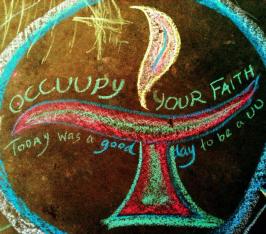
But for families in particular, the need to bringour faith home and apply it liberally, via a daily dose, is compelling. One of the new challenges that religious leaders are taking on is how to think outside the church walls, supporting a missional approach that encourages us to consider how to live out our UU identity and values 24/7/365: each hour, every day, all year.
One of the most exciting innovations in this area is something called “Full Week Faith” (read all about that here). This concept encourages RE leaders to curate and share content that is focused on “walking the talk” of our religious principles, so that the learning and living can go on after Sunday morning ends!
Here at UUCA, we offer a weekly RE newsletter, sent via email, that still shares pertinent information and activities and events–what is happening on Sunday morning, when the Children’s Choir is practicing, who we are learning about in our Spirit Play story, where the 7th graders went for a Buddhism field trip last week. But we have gone further in the last year, adding WHY and HOW to the resources shared in this communication. (By the way…miss something from the past or want to refer to it again? You can access our previous Enewsletters here on the UUCA website. Make it a resolution to read your news each week!)
This week, for example, we pull together resources for talking about religious tolerance, diversity, and conflict at home with children and youth.
Parents of Spirit Play children can read about the story of Francis David, a Unitarian hero who encouraged radical inclusivity in a time of religious strife, and explore the wondering questions with kids, helping to solidify and deepen their understanding of this piece of who we are as UUs: those who draw the circle bigger, inviting everyone in. The story itself and the wondering questions are linked in the newsletter, allowing you to continue the learning from this upcoming Sunday throughout the week.
Parents of older children and youth can reflect on the Francis Davis story, and go deeper: a link to a 30 Days episode called “Muslim in America,” following an evangelical Christian with little understanding for Islam as he lives, eats, prays, and grows with a Muslim family for a full month. Watching the episode together, then using the discussion guide for further conversation, can be a meaningful way to think about what your own family values are around religious pluralism, interfaith dialogue, and democracy.
We hope you enjoy and find useful the Taking It Home: Full Week Faith resources we will continue to develop and share. Living our faith is full-time work, and we need as much support as we can get, especially in orienting our children and youth toward how we are called to reflect faith values as Unitarian Universalists!
Dec 10, 2015 | Weekly Message
As we settle into our new and welcoming home, and in this time of holidays, it’s a good time to pause and reflect on what we want to be as a UU community. Or, as Lead Minister Mark Ward challenged us this past Sunday, “It is fine to be a gathering place of liberal-minded people, but to what end is our gathering? It is good that we proclaim freedom of thought and conviction, but what is that freedom for? It is laudable to affirm love, justice, compassion, equity and acceptance, but again – to what end?”
Your Board of Trustees held a series of listening sessions last year with the Congregation and, from those meetings, distilled the input and updated our congregational Ends Statements. These Ends Statements, listed below, act as our strategic vision and capture the specific areas in which we seek together to impact our lives and further our Mission.
Our Mission
As a Unitarian Universalist faith community, we nurture individual search for meaning as we work together for freedom, justice and love.
Our Ends
Within Each Congregant: We Seek
Embrace principles, values and practices which explore the sacred in the world and the mystery of existence.
Gather together in worship which guides and sustains our individual and communal response to the sacred through multifaceted creative, artistic and musical experiences.
Among the Congregants: We Care
Feel welcome and connected with each other.
Share generously of our personal resources of time, talent, and money.
Honor and support each other in times of celebration and need.
Beyond our Congregation: We Work
Act meaningfully and visibly in community service, advocacy and education.
Serve as a beacon of liberal religious thought and action.
Offer our space for events which serve a varied audience and inspire community dialogue.
Partner with other congregations and organizations in support of shared objectives.
We seek to achieve these Ends as we work on 1) our own spiritual development, Within ourselves, 2) as a community of seekers in relationship to each other, Among ourselves, and 3) improving the world for the better Beyond our own walls. Our wonderful, professional staff helps us in achieving these Ends by offering a wide variety of programs and services. They seek to integrate congregational ideas and participation with these Ends. Each member and friend in the Congregation has a responsibility to work with other Congregants and our staff toward our Mission and Ends, as this is our Covenant to one another.
Finally, it is important that you provide open and honest feedback on our programs and services, so we know what’s working and what we can improve. Consider the following questions for helping assess progress on meeting our Mission and Ends:
- What did we set out to do?
- What actually happened?
- Why was there a difference?
- What do we do next time? (which activities do we sustain, improve or eliminate)
It’s best to provide feedback face-to-face at the end of each meeting or program. However, feel free to provide feedback to any of the staff or Board members at any time. Let us know how we are doing in achieving our shared Mission and Ends.
Dec 3, 2015 | Weekly Message

When Debbie and I were raising our children, Thanksgiving was always a big deal, with guests often joining our family for a big meal. But with our daughters now adults and leading busy lives we’re finding that they’re often not around at the end of November. So, as an alternative we’ve been experimenting with traveling to interesting locations within a drivable distance over Thanksgiving weekend.
This year we chose Savannah, Georgia, a location we like not just for the interesting history and architecture, but also for the natural beauty surrounding it. The salt marshes and tidal islands represent a stunning but fragile ecology endangered by global warming and coastal development. So, Debbie and I like to make a point of seeking out “eco-tours” of the area to acquaint ourselves with the wilder side of these gems while they’re still around. This time we got out to Wassaw Island, a federally-protected isle that has never been cut and so offers views of what the undeveloped coastal landscape is really like. It was a fascinating and delightful tour.
 This experience got me reflecting on a dimension of our Welcome Project that hasn’t received much attention. While it’s true that our Welcome Project has disturbed much of this site, our planning team wanted to be sure that we remain good stewards of the land we occupy. For one thing, we are trying to assure that as much as possible rainwater that falls on our site remains on the site to recharge the groundwater and be available for our trees. Ordinarily, when developers build plazas like the one off Edwin Place they install drains that guide rainwater away from the site. Rather than doing that, we created rain gardens off Edwin Place and behind Jefferson House
 that will capture and retain that water as well as water from our roofs, allowing it to be drawn back into the soil and made available to native vegetation planted above it. In fact, if you look at all the plants added to our site, you’ll notice that they’re all natives indigenous to our region.
All of this is an important way that we continue to live our Seventh Principle affirming the interdependent web of existence of which we are all a part. We can make a difference on our own site and be examples of the kind of practices that serve the Web of Life.
Nov 25, 2015 | Weekly Message
So how do you do Thanksgiving? And this time I’m not talking about the recipes. I’m talking about honoring the spirit of the day, and engaging in conversation with your loved ones about what is important to you. I find it helpful to focus on the spirit of the holiday, rather than the complex historical reality of its origin.
Many of us will be celebrating with family members or friends that come from different religious traditions. I know that because it did not used to be my habit to pause before a meal. I would be startled and embarrassed when the people I was with stopped to say grace, and I very slowly and quietly put down my fork and hoped nobody noticed. When I started seminary, I often got asked to pray, but I didn’t quite know how. But when everyone is holding hands and looking at you, you can’t really say, “I’m sorry, I haven’t had that class yet…!”
Even if you aren’t in seminary, you can avoid this sort of awkward moment by planning ahead. Especially if you are hosting the meal, you can start your own tradition, and explain it to the people who are at your table so that they know what to expect. It doesn’t have to be a traditional prayer before the meal. Depending on your setting and your own beliefs, you can do all kinds of different simple things, with adults and children, to bring your attention to the moment.
Here are some ideas:
- Focus on the things for which you are grateful, by going around the table and each saying something.
- Light a chalice. If you don’t have one at home, you could put a tea light or other candle in a small bowl, or use any candle flame and share a moment of silence or a short reading.
- You could try saying a spiritual or secular grace. Some ideas about gratitude are available in this article from the UU World http://blogs.uuworld.org/parenting/2010/11/15/if-you-want-grateful-children/, which also has a number of helpful links at the end.
- Ask your children if they have something they would like to say, or if there is something they learned in church or at school they could share.
Honestly, the possibilities are many, and limited only by your creativity. I am grateful for the sacred circle of this beloved community, and the ways we challenge each other to learn and grow together.
Happy Thanksgiving!
Nov 18, 2015 | Weekly Message

Singing is great, you may be saying, but HOW is it religious education or faith development?
I’ll start here: Our theology tells us that revelation is not sealed and is constantly unfolding; we are constantly learning how religious education can touch our children and youth, encouraging their open minds, loving hearts, and helping hands. Especially for young children, we have moved away from a “sit-down-and-listen” style of RE instruction and towards programming that reflects our understanding of child development, the variety of learning styles found in any classroom, and the changing landscape of recruitment of RE teachers/leaders (the need to do more with fewer teachers). We have recognized that art, contemplative practice, nature, drama, and Makerspace work provides excellent targeted opportunities for our children to process what they learn in our story-based Spirit Play.
Music has often been an option in Spirit Play but few leaders have been recruited, perhaps because folks don’t feel comfortable “leading” music if they aren’t professionals. Yet, music is a uniquely compelling way to learn, and research tells us that group singing increases bonding and fellowship. And we’ve known for some time that group singing makes us happier: it reduces stress, heightens endorphins, and relieves anxiety. But did you know that when individuals sing together, their hearts begin to beat as one Learning the songs and rhythms of our faith, and joining in the worship service to make a joyful noise together is another way to do religious education, building UU identity and faith community for our kids.
Our hopeful goal is to have the Singing Souls children’s choir be a regular choice for RE families at 9:15. We would love to be able to offer this opportunity all year long!
Singing Souls welcomes 2nd-7th graders for a special class in RE on Sunday mornings at 9:15. We will rehearse then and perform at both the December 20 Sunday service and the Christmas Eve service at 4 pm. Contact UUCA Interim Music Director Melody McGarrahan for more info, or just show up THIS SUNDAY at 9:15 downstairs in Religious Education!
Nov 12, 2015 | Weekly Message
Like many of you, my work and faith are intertwined. I work for the National Oceanic and Atmospheric Administration (NOAA) and use satellite data to study the global water budget. For the last 5 years, I’ve helped lead coordination of space agencies around the world to observe and understand essential climate variables through the Committee on Earth Observation Satellites (CEOS). I just ended my term as chair in our meeting in Kyoto, Japan, in the same international conference center where the Kyoto Climate Accord was reached 20 years ago to limit dangerous emissions of greenhouse gasses. That accord is up for renewal at the Paris climate conference that begins at the end of this month, the 21st Conference of the Parties or COP-21. You’ll be hearing a lot about COP-21 in the next few weeks as they negotiate a new treaty aimed at limiting greenhouse gas emissions. My role at the recent CEOS meeting in Kyoto was to present and win approval for our report on the use of satellite observations in climate monitoring, research and services.

UUCA’s Rain Garden
Kyoto also the home to numerous Buddhist temples and Shinto shrines and Mara and I had a chance to visit some of them and their Zen gardens. This gave me some time to reflect on the role each of us can play in improving the environment. I’m proud that UUCA is a green sanctuary and of the special effort of the Welcome Project to capture and reuse the rainwater that falls on our campus and to move to LED lights. The sum of a lot of small things we do every day can and does add up to something larger. So, as we watch and hope for a new accord on limiting dangerous global greenhouse gas emissions, take a moment to reflect on what more you can do individually to improve the local environment.
Nov 5, 2015 | Weekly Message
There is a bittersweet taste to autumn that I find I appreciate more and more each year. I think it’s the way that both beauty and grief are entwined in this brief season that helps us appreciate the wonder and loss that are bound up in our experiences and puts our brief lives in perspective. Transition is something that we talk about, but in autumn we experience it all around us as the weather cools and the trees blaze in color. It helps us see that everything in our lives is in the process of change, even those things that can seem so enduring.
This congregation is a good example. It’s been a part of Asheville for 65 years and planted in this location for a little more than 40. In that time it has grown and changed in all sorts of ways. This summer and fall we have seen a lot of changes to our physical presence – expanding and enhancing our main building and larger campus, the most significant change to our physical space in more than 30 years. It’s meant giving up some familiar aspects of our campus while creating new space that we believe will serve us better. Please plan to come to worship at either 9:15 or 11:15 on December 6 to help us celebrate and dedicate all the work that has been part of our Welcome Project. You’ll hear more about all that this project has brought us and a bit about where we have come from to get here and what it could prepare us to do.
And that, of course, invites us into an important conversation: What are our hopes for the future? Your Board of Trustees and I have begun talking about ways to approach that question, and I’d love to have your input, too. For it’s true that along with the rest of the world, this congregation is in process. Who we are and how we envision our role changes as the congregation and the times change. Each generation in a sense reimagines that role, grounded in a rich history yet oriented to a future that is only now coming into shape. We are, as I have said, a community of memory and hope.
How we embody that hope is up to those who are here to carry it on. With our inviting new exterior we are sure to draw newcomers to check us out. What will we have to offer them? Your staff has developed activities and programs that we think advance our mission, but it is how you, the congregation, take ownership of them that will determine how they fare. Let us all together live into the promise that this congregation is.
Oct 29, 2015 | Weekly Message

As a member of UUCA, you are also an employer of 10 “regular” staff members and about 13 other support staff members (music, sound system, childcare, bookkeeping). Operating expenses devoted to personnel salaries and benefits amount to 68% of the budget. Although our budget process shields you from choosing among the various scenarios that can be funded with our projected income (having a sensible projected income number to work with is the reason we need your commitment by mid-March), your vote to approve or not approve a proposed budget at the annual meeting implies that you have made these considerations as an employer:
- What skills do we need to pay for? Or, conversely, what jobs are you (as a volunteer) willing to do?
- How many employees can we afford? And its flipside, what if we don’t have enough employees to make “that” happen, with “that” being anything we wish we could do but don’t have staff for? Would you be willing to do it as a volunteer?
- Are we fairly paying our employees?
- Are we providing opportunities for skill development?
- Do we reward strong performance?
- Do we offer good working conditions?
The employer-employee relationship is a significant human relationship of mutual dependency that has great impact on the people involved. The employer has a moral obligation to look out for the welfare of employees. It is not a question only of fair pay and good working conditions; there should be a real and enduring concern for employees.
UUCA currently has an exceptional staff. There’s no other way to say it. This is a group that is made up of individuals who each have a skill set that aligns nearly perfectly with their job, with personalities that function well together, and with commitments to the congregation’s well-being that result in prodigious work and idea production within the parameters of the hours available.
So, what skills do we pay for?
We pay people to lead:
worship for adults, youth and children; music programming; education programming for adults, youth and children; our pastoral care ministry
We pay people to organize:
worship experiences, newcomers’ experiences, volunteer opportunities, programs in lifespan religious education and social justice, a congregation-wide “care” system, our small group ministry
We pay people to manage:
the congregation’s staff, the congregation’s finances, a complex database, the congregation’s physical structures and grounds, facilities rentals, vendors, the sound system
We pay people to write:
sermons, blogs, eNews articles, web content, emails, announcements, brochures, pamphlets, scripts, lesson plans and curricula
We pay people to train:
worship associates, pastoral visitors, religious education teachers, connecting stewards, and new member connectors
We pay people to support volunteers who:
sing in the choir, teach lifespan religious education classes, wish to raise money for UUCA or various other causes, desire to become leaders in the congregation, welcome newcomers on Sundays, help integrate new members into the congregation, organize congregation-wide parties
We pay people to produce:
orders of service, website, Weekly eNews and inserts to the order of service, monthly mailed newsletter, RE News Weekly, videos, audio copies of sermons, music, posters, announcements
We pay people to enter data for:
a membership directory, financial accounting, religious education, room reservations,
We pay people to clean our buildings, host our coffee hours, take care of our youngest children on Sunday mornings and whenever parents need childcare to attend a UUCA event
We pay people to think about:
why do people join UUCA; what will be a compelling topic for worship; how can we help people learn what’s going on in the life of the congregation; what are the theological underpinnings of religious education for youth and children; do we have enough fun around here; why are nearly all religious organizations experiencing a decrease in funding and levels of volunteer commitment; what is the future of the institution of “church;” how do people develop the spiritual gift of generosity; what happens if our second service begins to regularly “overflow;” what does it mean to be a “beacon of liberal religious thought and action;” why do people say they want more opportunities to participate in social justice and then not respond when more opportunities are provided
Are any of these things something that you could do as a volunteer? You will have to make your own judgment about that, but so far we have chosen to hire for a position when we have learned that volunteers cannot or are unwilling to provide consistent quality in a program or administrative function. By hiring someone, we can demand a greater level of accountability, excellence and commitment to our mission.
How many employees can we afford? Unfortunately, at this exact time we can’t quite afford all the employees we have. We remain in a deficit-spending situation that will require some very difficult decisions in the next year or two if we cannot increase our income.
Are we fairly paying our employees? This is a bit of a trick question because it very much depends on how you think of the word “fair.” If by “fair” you mean everyone is paid no less than the Asheville Just Economics Living Wage, then yes, this congregation pays fairly. And we might be considered to pay fairly if you ask if everyone is paid at about the “Asheville norm” for their jobs. However, there are three exceptions to this since the salaries of both of our ministers and our administrator are considerably below the UUA norm for their levels of experience and responsibilities and are likely to be below the norm for Asheville.
Are we providing opportunities for skill development? Once an individual has been hired, professional development becomes the responsibility of the organization. Although the employee was hired with a certain set of knowledge, skills and abilities, if the roles and responsibilities of the position change—and they will—the employer has a moral responsibility to invest in their employees. This is also often the way new ideas are discovered and brought back to the congregation. For our hourly employees, we provide a pool of $2,800 to be accessed by 5 employees for annual training/learning opportunities. For our salaried (exempt) employees, we provide 6% of their salary for this (the UUA recommends 10%). This is not a huge sum and does often restrict these employees’ abilities to get out in the world to meet with peers, visit innovative congregations and attend trainings and events that may provide insights into new ways of doing things at UUCA. It can be difficult for employers to swallow the costs associated with employee professional development, but ultimately the organization benefits when its employees have the capacity to bring home changes and innovations that may make a big difference in working toward our mission.
Do we reward strong performance? Over nearly the past decade, no employee has received any pay increase except for annual cost-of-living adjustments when the federal government declared such an adjustment for Social Security beneficiaries (except when changes in an employee’s job description absolutely required a pay adjustment to bring that pay more in line with Asheville norms). So, the answer to that is “no.” Whatever an employee accepted for a salary at the time of hiring is all they will ever get, along with cost-of-living increases. Our projections indicate that this will continue to be true for the foreseeable future.
Do we offer good working conditions? This is certainly the secret to our success in holding exceptional employees. The staff culture is supportive, generous, helpful, understanding and competent. The kind, friendly congregants who interact with staff outnumber the more challenging ones. Health insurance coverage is available for eligible employees (those working more than 750 hours per year). So is dental insurance. Long-term disability is paid for. There is no short-term disability program; we are essentially self-insured in that category. Contributions are made to a pension plan for eligible employees. Staff supervisors show compassion during times of stress for employees. Our bereavement and extended family leave policies are generous compared to most other employers, and we recently updated our personnel manual to provide an extra week’s vacation (more or less—many of us do work on Sundays) by closing the office between December 25 and January 1. Of course, it also helps the cause that people who work in churches choose that work as a calling rather than a job (lucky for us).
Here’s the bottom line. As an employer, how do you feel about the status of your employees? Are there changes you would make? Are you satisfied that you are a moral employer who is looking out for the welfare of your employees?
Oct 22, 2015 | Weekly Message

For the past two days, Joy Berry and I have been in Morristown, NJ for a two-day module of Beloved Conversations, “an experiential curriculum that provides a space to re-form/fuse the brokenness of racism into new patterns of thought and behavior ushering in social and spiritual healing. New ways of being are learned through the actions of conversation and probing dialogue.” We are participating as a staff team, and will come home with a project, which we will share with all of you.
So far, the module has been thought-provoking, and has called us to deeper engagement with our own experiences of race and oppression, our white privilege, and the ways in which our other identities intersect. For me, there have been a number of moments of making mistakes and being vulnerable that have felt uncomfortable, but have drawn me deeper into reflection about who I am and how I move in the world. I have had the opportunity to grapple with some of the challenges of my privilege, and to receive support from colleagues. It has been life-giving and inspiring, and it has pushed me out of my comfort zone.
This work of digging deep into uncomfortable spaces, learning how to create a container that can hold our varied experiences, and continually recommitting to being a force for change – called to create just relationships – is powerful, life-giving work.
It is the foundation of our Black Lives Matter initiative. We have envisioned this work in three parts: Engaging our personal internal work, supporting and building relationships with community organizations, and working to dismantle the systems that oppress us. This internal work is foundational because it is how we undergird our work in the community with integrity and authenticity.
I can’t tell you what our project will be because it is still in its infancy, but I very much look forward to sharing our ideas with you when we return, and continuing this challenging and engaging work for freedom, justice, and love.
Oct 15, 2015 | Weekly Message

Our youth program for senior high students has undergone a renovation as valuable and as transformative as our church construction project this year. After a decade of discernment and data analysis, the UUA has grouped youth ministry with young adult ministry at the department level, and is sharing a wealth of resources and energy to help churches create programs that succeed. Read more about the UUA’s suggestions.
The “youth empowerment model” that has been the UUA’s recommended program for youth for many years, too often meant that some very focused youth thrived while others felt left out, and the emphasis on that word empowerment too often meant a lack of integration with the larger church community. As such, youth group members often never made connections to the church and had no or little experience with being in worship, leadership roles in multi-age congregational groups or events, and few meaningful relationships with anyone not their age. Youth groups at their worst could be cliquish or go rogue, forgetting that we have a duty to learn how to be in covenant together and to integrate our children and youth into the life of the faith community.
After all, Bridging should be more than a one-Sunday event where we publicly recognize and honor our seniors when they graduate out of school and Sunday RE programming. In truth we have too often pushed our youth off a bridge to nowhere, having not prepared them for congregational life outside RE. Our new approach to youth ministry (and that word matters) compels us to see the three years leading up to graduation as a time to prepare youth for a journey. In packing their metaphorical backpack with experiences, competencies, and faith formation, we believe we will:
- Increase the chances that even when they leave, they will see themselves as UUs and act in the world in reflection of our values.
- Increase the likelihood that they will seek out UU community on campus or attend churches elsewhere, both during the young adult years and when they begin their own families.
To that end, our new YRUU group has a year of varied experiences planned.
First Sundays
Because we know that a real relationship with clergy is highly correlated with continuing to practice the UU faith, and that worship is an experience of high value to adult UUs but we give children and youth little time there to form positive experiences and memories and competencies there: youth will attend worship as a group with an advisor and meet afterward for pizza and conversation with one of the ministers. This day also affords youth the chance to get involved in helping produce worship; we have developed several ways for youth to be included as a service participant.
Second Sundays
Because we believe that social justice is a core component of the work our theology compels us to do in the world, and because there are many opportunities to BOTH integrate with others in the church and to create their own social justice strategies and activities: students gather to both plan and manage, as well as join in and go out to, activities and events they choose, with supervision by a dedicated and veteran social justice advisor.
Third Sundays
Because we know that covenant groups are an essential piece of UUism for many adults, teaching what it means to be in covenant as a people of faith, and because we know youth groups need to form deep bonds and discuss what matters most to them about personal, political, social, and global matters: youth will gather regularly to share deeply, to create a living covenant to guide them, and to connect to their peers and advisors.
Fourth Sundays
Because we know that youth need an opportunity for unstructured time and that food is a highly motivating factor, and because we want youth to have more opportunities to interact with the life of the congregation: youth will gather in the kitchen to cook and eat food, and, on some Sundays, cook and offer food to the congregation as a fundraising effort toward an immersive youth trip.
Add in a youth-led worship service in May, trips to youth cons at The Mountain in December and April, and the possibility of a trip to General Assembly or elsewhere this summer, our year looks busy, but spiritually engaging and very different from youth groups of the past. We believe our approach will serve the youth of our congregation more fully, and increase the health of the congregation as a whole, as we fulfill the promises we make to be as inclusive, encouraging, and supportive as possible to all the parts of our faith community.
Click here for a printable flyer to hang up as a reminder about each Sunday’s opportunities. Please let me know if a youth in your life would like to join us!
Oct 8, 2015 | Weekly Message
As the physical work on the Welcome Project nears completion, it’s time to turn our attention to the important work of becoming more welcoming as a Congregation. In last week’s eNews, our Lead Minister Rev. Mark Ward talked about the Ends Statements that the Board has recently updated after listening sessions with the Congregation last fall. The second group of Ends is entitled ‘Among – We Care’ and the first statement reads ‘feel welcome and connected with each other’. So, among our friends and members of the Congregation, how can we do a better job of making everyone feel welcome and connected with each other?
I propose we use the annual auction as a test of our becoming more welcoming by pushing our individual comfort zone to ensure we make every member and friend feel welcome and connected with each other. Instead of claiming all the chairs at a table at the auction with your usual friends, consider seeking out and inviting that couple or that single person you have seen around but haven’t had a chance to really talk with or get to know. Perhaps you never knew that the single person you see all the time actually feels left out and would so welcome the chance to be invited to your table. Asheville is a couple’s town and it’s hard to be single. Or maybe you didn’t realize that the couple who has been attending now for a year or more still doesn’t feel connected. For them, the auction is a new way to roam and talk and they’d really enjoy the invitation to sit with you.
So as we look forward to the dust settling, the most important part of the Welcome Project is just beginning. I hope you’ll join me in making UUCA even more welcoming than it already is.
Oct 1, 2015 | Weekly Message
How we focus our work as a religious institution is something that evolves over time as we in this community come to a growing understanding of who we are and what we feel called to do. It can be hard work to figure this out, but one of the benefits of Policy Governance, the way that we organize ourselves as a congregation, is that it guides us to a process to be clear on those points.
Any conversation about our purpose begins with our Mission Statement. From it our Board of Trustees is tasked to create Ends Statements that describe what it believes we must do to fulfill our Mission. The Board passes those Ends Statements on to me, who as Executive is charged with achieving those Ends. I then say how I interpret those Ends Statements and how we plan to achieve them through the ministry of our congregation.
Described in the abstract that way all this can sound very removed, but it’s not. Because these high concepts guide all the particular decisions we make about concrete things like staffing and programming, how we shape worship and religious education, what is the focus of our social justice work and our caring ministry. You get the picture.
When we first adopted Policy Governance about five years ago, the Board and I went through this process of them writing Ends Statements and me writing interpretations. These have guided us through those years, but in reviewing those old Ends Statements the Board decided recently that they could use some improvement: they were a little wordy and vague. So, earlier this year they rewrote them, trying to make them tighter and more focused. This month I am submitting to the Board my interpretations of their revised Ends, and I thought it was something that it would be good to share with everyone.
In my report to the Board I go into some detail on specific ways I think we can measure whether their Ends are being achieved. I’d be happy to share this longer report with you if you’d like to know more, but for now let me just offer this document giving you the Board’s Ends and my interpretations that I offer to guide our work together.
Sep 24, 2015 | Weekly Message
Have you wondered what is up with the Earth & Social Justice Ministry here at UUCA these days? Here’s a little update. Our social justice work falls under the “Beyond” ends statement in the governance document, which says that, “Beyond our Congregation: We Work to Act meaningfully and visibly in community service, advocacy and education. Serve as a beacon of progressive thought and action…”
Over the past few years, we have worked hard to raise our profile in the larger community, building relationships with organizations like Moral Monday/Forward Together, the We Do Campaign, Democracy Now, and others. We get reasonable turnout for events that call for a Standing on the Side of Love presence, and we continue to have groups of people working in Affiliate Groups like Move to Amend, the Hunger & Homelessness Committee, and Room in the Inn. I also know that many of you volunteer regularly on your own for organizations from Habitat for Humanity to Read to Succeed and more. We have increasing numbers of participants from UUCA at Building Bridges, as well as meetings and activities relating to Black Lives Matter.
However, when I speak to individuals in the congregation about our activism, you tell me you want more. You tell me you want broader engagement throughout the congregation. You want more people engaged. And since my job is to help you implement your vision of what you want the congregation to be and do, I want that, too. Broad participation throughout the community is part of meaningful, visible action, part of being a beacon in the community. And yet, when the Earth & Social Justice Ministry (ESJM) meets, we have less than ten people in attendance. Sometimes less than five.
So, in September of 2014, we suspended meetings of the ESJM. Since attendance was so low, regardless of whether we had discussion topics or programming or required attendance, we put the group on hiatus. And the Affiliate Groups (Hunger & Homelessness Committee, Room in the Inn, et. al.) continued their work. In December, after I preached about Black Lives Matter, that initiative rose to the surface, and a good number of people expressed interest in and commitment to that work. I am proud of the work you have done in this area, and look forward to continuing it.
After a year of no official Earth & Social Justice Ministry meetings, it’s time to regroup and see how we as a congregation want to move forward with this essential work. Toward that end, Tom Blanford and I will be co-facilitating a study group exploring the book Doing Democracy: The Map Model for Organizing Social Movements. This study group is designed to bring UUCA activists and aspiring activists together to discuss strategy, reinforce each other, and improve our effectiveness in our respective arenas. It is my hope that this will serve as a starting point for a new collaborative vision of how we work together to promote justice in the community. The study group will meet four Thursdays over eight weeks: November 5 & 19, December 3 & 17 from 6:30-8pm.
Please let me know if you have questions, suggestions, or would like to participate in the study group.
Sep 17, 2015 | Weekly Message

We have just launched our first week back to class in Religious Education, and there are what feel like a dozen balls in the air, so I’ll keep this brief.
- We have a great year planned. You can read about all our classes for children and youth, as well as see our mission and my philosophy of RE, here.
- We have a couple of gaps in teacher recruitment that really do HAVE to be filled, or we may need to combine the 6th and 7th grade classes (and we lack a space big enough for that). Please take a look at the planned classes in the document above, and consider joining one of our excellent (but incomplete) teaching teams for those classes.
- Renovations are complete and classrooms are beautiful. Take the time to tour RE, both downstairs and over at Jefferson House, to see our inviting, delightful spaces for children and youth classes. It’s great to have the place look as awesome as our volunteers and programming actually are.
- All classes for K-9th are underway, and the high school youth group (YRUU) begins this Sunday, with attendance at the worship service and a talkback in Jefferson House with pizza afterwards.
- THIS SUNDAY: Parent orientation is required for registration of kids to be complete. This is a quick self-guided walkthrough in RE Commons this Sunday between services. Sign in, pick up the RE calendar, read about our Faith in Action (social justice) project in RE this year, meet your kid’s teacher and socialize with other parents. See classrooms downstairs while you are there! The last stop is the confirmation of your child’s registration with RE staff.
Sep 10, 2015 | Weekly Message
Through the construction and short relocation this summer, our community has continued to flourish. Attendance at the services has remained high and the topics as challenging and thought-provoking as ever. At the end of August, guest ministers, the Revs. Kerry Mueller and Dave Hunter, took on the issue of “spiritual but not religious.” In this wonderful sermon our guests discussed why we need to come together in community and what we gain by having a vessel (our congregation and UU religion) to host our tea (our individual spirituality). I’m sure each of you have an answer for why you show up and contribute so much to make UUCA work. For me, it boils down to something really simple; it makes me a better person.
Earlier in August, Rev. Mark Ward took on the topic of “remembering,” how we deal with the loss of a loved one. He concluded his sermon, “How we grieve, how we remember clears the way to compassion that opens and soothes our hearts, that reanimates our tired souls, that shows a way when it seems there is none to be found.” I didn’t know when he said this that I would so soon face grieving.
My father has been ill for the last year, so it wasn’t a particular surprise when I got the call from my brother that my dad was going into hospice care. Yet the emotions came, as they should. I flew up to Chicago to be with Dad and help transition him to hospice care in his condo. The memories of growing up and all the fun times with family played back in my head as I drove the familiar old neighborhoods. He lives close to the magnificent Lake Michigan which has always been a source of solitude anchoring the city. As I walked the shore before going back for one last visit with my dad, I thought of our closing hymn, “Longtime Sun,” and how we hold hands in community at the end of each service. As I was saying goodbye to Dad, I told him he could join me as I would sing it twice. We joined hands and I sang softly and, as I neared the end of the second round, he closed his eyes and joined in, ‘…may the pure light within you, guide your way home.’
Being in the UUCA community has made me a better person, able to deal with life’s challenges in a more meaningful way.
Sep 3, 2015 | Weekly Message
 After the service on August 30, I made a brief visit to one of the few spots on our campus that is not currently being disrupted: our Memorial Garden. Each year I make a practice of pouring the water we receive in our Water Service onto the area of the garden where we inter the ashes of people in our congregation who have died. It feels to me like it completes a circle, offering a reminder that all things that come from the earth – soil, water, us – eventually return to it. This gesture also serves to remind me how we as a community continue to hold each other, even after death. I look over the brass plates and see names of people I remember, which brings to mind other people who may not be there, and I can imagine a crowd of witnesses around me.
 It’s been amazing to watch the changes on our campus. This week was an especially big one, when construction workers took out the window and busted through the wall on the west side of the sanctuary to create a new, accessible doorway. The doors on the old foyer are gone, and suddenly we have a sense of the full expanse of the larger foyer. It’s pretty amazing, and, I have to admit, a little unsettling, too. It will take a while to settle into this new space, but now that I see it I’m more confident than ever that it will serve us well.
How will we grow into that space? What new possibilities will it open for us? These are among questions that offer themselves to us. And so, your staff has spent the summer working on ways to invite you deeper into the life of our congregation where we might answer those questions together. You’ll be hearing more about this soon, and keep an eye out for where you can bring your energy and enthusiasm.
Amid all these changes, there is much that endures in this outpost of liberal religion in the western mountains of North Carolina, this crucible of community affirming each person’s worth and dignity, celebrating our diverse and evolving understanding of the world and our place in it, awakening to our spiritual centers while working for justice and learning the lessons of compassion, tolerance and peace.
How great to begin a new year!
Aug 27, 2015 | Weekly Message

I walked into Target last week and was nearly overwhelmed by swarms of families and kids out procuring school supplies. I was surprised, because I’d forgotten to pay attention to the school calendar. But it wasn’t upsetting. What was upsetting was the Halloween candy. I can handle school supply displays – those are timely and appropriate. But to see Halloween displays in mid-August is more than I can handle. It makes me feel rushed, pushed along faster than I want to go.
I’m not ready for the summer to be over – I’m enjoying the sun and the warmth, how easy it is to open up the grill three or four nights a week, having fresh, yummy dinners full of freshly harvested vegetables. I love all the seasons of the year (especially now that winters are NC winters, not Boston ones!) and I want to experience all of them! Soon, it will be fall, and I can luxuriate in cozy sweaters and cool breezes, and pick yummy cozy yarn for a new knitting project.
I don’t want this moment in the life of the church to pass too quickly, either. There has been a great deal of energy with the building project this summer, planning programs, and building excitement for the new year. Soon and very soon, we will be able to see the completed construction and landscaping, we’ll have a new pulpit and welcome table, and a shiny new single-stall, all-gender family restroom. And, of course, the new sign that started the whole thing!
My hope for this time is that we will not rush through it too quickly. Let’s take some time together to honor the work we’ve done to get to this point, to enjoy the energy that comes from these changes to the building and grounds. Who knows what the changes will bring, and how exciting it will be to the watch the possibilities unfold.
As your children get settled in school, or your summer travels draw to a close, and you anxiously await (or dread) the arrival of the pumpkin-spice-flavored product lines, enjoy this transition time between summer and fall. And then, when the summer is truly over, we’ll jump into the next stage of our life together with joy and thanksgiving!
Photo credit: / Foter / CC BY-NC
Aug 20, 2015 | Weekly Message

School has started back up, and RE classes are not far behind. I’ve spent the last several months telling you about wonderful things going on in our program.
- You may have heard about our cutting edge Makerspace Program, featured on numerous UUA pages… or the Little Free Library our kids are dedicating soon…or sampled delicious food harvested from the container garden our kids created (with help from our kid-constructed vermiculture farm!) UUCA is being talked about nationally as an RE program that is trying new approaches that work for kids, youth, and families.
- You might be as excited as I am to hear about UUCA’s FIRST EVER multigenerational Sunday morning classes, where parents can learn with their own children (or without!) and elders and young adults and youth can explore together with a class on Miracles (from a UU perspective), in our brand new All Ages classroom.
- You might think that our extensive renovations in RE reflect a passion to look as progressive and open-hearted and hip as our program really is, and want to enjoy more time in such a cool space. Plenty of adults tell me they’d like to just stay in our Contemplation Center indefinitely.
- You might know that being a part of a teaching team means a special kind of spiritual growth.
After a year of progress, change, renovation, and making our classes reflect and amplify our church’s mission, we are still missing something… YOU.
I spend lots of time asking parents to help in RE. We have a FREE but cooperative program, so each family is expected to volunteer in some way each year. Most do so in the classroom but others choose to help out with tasks that can happen throughout the week, or for special events or hospitality, or on vision teams that have taken the place of our RE committee.
So I have LOTS of thirty-something parents leading and assisting and mentoring and visioning. In other words, the people who teach and lead our kids MOSTLY look a lot like their parents. Frankly, we need greater diversity of age (and every other kind!) in our RE programming.
The wisdom and experience and patience and spiritual maturity that comes with age (for most!) is priceless. The need children and youth have for elders as mentors is immense, especially in a culture where few of them live near their extended families, so that grand-uncles and grand-aunts and grandparents can be close enough to talk, and share, and listen, and teach our youth.
Perhaps your own children have grown up and out of RE and you want to build your skills for grandchildren that are surely on the way. Perhaps you don’t have children of your own but want to connect and serve and grow in your own faith development, as you teach (and learn) with kids. Perhaps you want to see for yourself why our RE program is getting rave reviews from kids and parents and becoming known as a space where new approaches to RE are working. Perhaps you just want to hang out in the amazing Contemplation Center and help children learn healthy spiritual habits in a strangely quiet yet full of children space.
Want to help out once a month with young children, storytelling or assisting as part of the Contemplation, Drama, Music & Movement, or Makerspace centers, or the new Nature classroom?
Want to dig deeper with a team, volunteering twice a month to lead a multigenerational class at 9:15 or a 4th-9th grade class at 11:15? Here is a rundown of our most pressing needs:
9:15 and 11:15: Spirit Play Storytellers and Activity Center helpers needed. This radical approach to religious education uses storytelling and a vast trust in the child’s ability to apprehend, question, and process BIG IDEAS through active listening to stories that reflect our principles and hands-on engagement with play and work in our activity centers. This is unlike RE as you’ve ever seen it! Storytellers and helpers agree to be with us eight times each year and work within a team to rotate Sundays. If you can volunteer once or twice a month, this is the job for you!
11:15 am 6th grade: “Riddle and Mystery” and supplemental curriculum of “The Gospel According To the Simpsons.” Two more teachers needed to lead/assist in 14 sessions (twice a month) with team during the fall and spring.
11:15 am 7th grade: “Amazing Grace” and supplemental curriculum of Morgan Spurlock’s “30 Days.” Two more teachers needed to lead/assist in 14 sessions (twice a month) with team during the fall and spring.
9:15 am “Miracles” Multigenerational (MG) class – second graders through adult. FALL semester. We need four teachers able to lead twice a month.
Consider becoming involved by leading one of these classes. It is a great way to deepen your faith as well as connect and journey with others at UUCA.
Email Joy Berry, the Director of Lifespan Religious Education at dlre@uuasheville.org. Let’s talk!
Aug 13, 2015 | Weekly Message

I’ve decided a good analogy for my experience with the building of the Welcome Project this summer is like riding a great roller coaster. It’s a bit scary as you get on, there’s the big anticipation as you slowly climb the first big hill, gears and chains clanking away. Then you’re on your way—no turning back. There’s exhilaration as you speed down and around, sometimes a bit weightless, sometimes experiencing several G’s going around a corner fast. The occasional surprise dip or unexpected turn, but by now you have a wide smile, feel exhilarated, and a have a sense of accomplishment as you see the final set of turns and dips ahead.
I grew up in the 1960s in the Chicago area and during the summer we always anticipated the annual pilgrimage to Riverview Park, an amusement park just west of Wrigley Field. Riverview was old-school amusement park; Aladdin’s Castle, the Chutes boat ride into water – “Don’t rock the boat, keep your hands inside the boat” repeated endlessly waiting to get on – and then, there’s the roller coasters. These were all wood roller coasters, one of which was perhaps the world’s greatest ever wooden roller coaster: The Bobs. There was nothing like riding The Bobs. Seeing the expressions of exhilaration and joy on the faces of those finishing the ride and getting off as you waited to get on were all you needed to overcome your trepidation. As the building of the Welcome Project nears completion over the next weeks, I hope you feel the same joy, excitement, and sense of accomplishment.
Aug 6, 2015 | Weekly Message
Here’s a quiz: What do the following words have in common?
Invitation
Letting Go
Ancestry
Expectation
Resistance
Desire
Liberation
Creation
Blessing
Simplicity
OK, maybe that wasn’t fair without any advance notice. In any event, I hope you find these words intriguing because these will be our themes for worship and small group ministry in the coming year. How are we invited into a religious life and what exactly are the attributes of such a life? What does letting go have to do with spiritual growth? What do we claim as our ancestry, and how does it, should it influence us? Those are just some of the interesting questions that these themes raise in my mind, and I’m sure you have more. It should make for a fascinating year.
These themes were chosen with input from people in about 100 UU congregations – including ours – who with us are taking part in what’s called the Soul Matters program. This program was created some years ago at the Unitarian Church of Rochester, NY, as a way for UU congregations to share resources that can enrich their worship and deepen their conversations in small groups. Each month a staff person at the Rochester congregation gathers suggestions from participating congregations for resources to explore these themes – poems, quotes, films, websites, YouTube videos as well as provocative questions and personal reflections that address this theme. Then, that person distills all those resources into a file that is sent out to the congregations that are involved.
I’ve found it a rich resource for worship, and our small groups have enjoyed it as well. So, I hope this whets your appetite for some wonderful digging in the coming year in the company of your fellow UUs. Our theme groups and covenant groups will be recruiting new members, and we’re going to make every effort to make sure that everyone who’s interested finds a place. We’re paying attention to this, because we believe that it is those groups that are among the places where being a member of this congregation has its greatest impact on our lives.
And let me make sure to add that, as usual, our summer services will close with our annual Water Service, this year on August 30. Its focus this year is “I’ve Seen Rivers.” Please plan to bring water from your travels or a place that has meaning to you to share in the common bowl at our service. And may you find some renewal in these lovely summer days.
Jul 30, 2015 | Weekly Message
Change is afoot in the RE spaces! The construction project necessitated some changes, and opened the door to others. I want to share what we are doing to make the RE class and common spaces better and more welcoming.
I began working here a year ago this month (that’s right, it’s our anniversary, y’all, and I got you paint and flooring!) I was delighted to learn there was a restricted fund for RE Renovations. It had been tapped for some big, wonderful work in the playground, but still had about $18K set aside for more work.
Last Summer I requested that we repaint two of the classrooms that were ready for a facelift as we planned our new Contemplation and Drama/Movement/Music centers. They were painted and we have enjoyed the radical change in those rooms that just new paint created.
 This Summer, we faced major changes as our renters, Friends of Mine preschool, made the decision to move over to Jefferson House from the room (RE5) they have been in for some time. This freed up that classroom for other uses, and also brought to light the fact that it was badly in need of new flooring and paint. In the next few weeks, a hard floor will go down, replacing the carpet, and painting is planned as well. RE5 will now become the space for our new Multigenerational Classroom. Read more about why we are offering this ALL-AGES Sunday 9:15 class, and consider registering in MY INFO.
 The RE Commons and the NEW nursery (RE1) and NEW PreK room (RE2) will get some new paint and are undergoing a major assessment and de-clutter to make the rooms age- and developmentally appropriate and reflective of our values and goals. In particular, the curricular play and work that take place in PreK require a deep re-do on the room. We lost all the PreK furniture, materials, and resources we had previously shared with Friends of Mine PreK when they moved, so we have the opportunity now to make the space reflect our understanding of what a UU PreK consists of, feels like, and looks like.
In addition, a mini-theater space is being created in the RE Commons, with a ceiling-mounted projector, allowing us to use multi-media as part of our RE toolkit. Chalkboard walls are being added to the RE Commons so that our learning together becomes more interactive, and more engaging.
In Jefferson House, a fresh coat of ivory paint throughout the downstairs has brightened the whole house considerably. Both bathrooms have been renovated and are clean and welcoming–a much needed change! And the RE classrooms (JH7, 8, and 9) have all been repainted. A wall damaged by a leak from the roof has been fixed, and both JH8 and 9 now have a snazzy midnight blue chalkboard wall that complements the rooms and gives students and teachers a space to be creative and expansive, share ideas, and generally express themselves. In JH7, which has been the Coming of Age classroom for some (and is the 8th/9th grade Building Bridges/Neighboring Faiths classroom this year), the entire room has become a chalkboard, meaning a group of youth can truly “make their mark” on their space, yet leave it a “blank slate” for the class to come.
In 23 Edwin, what was previously the office of the music director is being changed to a dedicated space for the 10th-12th grade YRUU group, and they, too, will have a chalkboard wall.
In the playground area, we have installed a Children’s Garden with mosaic paving stones, a vermiculture condominium (worm farm! It will stay inside until the worst heat of summer is past), and a tumbling composter will be in place soon. Our very own Little Free Library is being placed later this summer after the kids get it ready. All these projects are part of our Makerspace Summer Sundays program, but constitute changes to the outside space you may notice and wonder about.
Bottom line financially? All in all, we’ve spent about $6500 from the Renovations fund this year, leaving us with about $10K for future projects in RE renovation. I hope this rundown helps you understand the “what” and “why” as well as the “how much” questions you may have about the renovations and changes you may see in RE spaces. And PLEASE DO come see us and one of the RE staff will be happy to give you a tour any Sunday just after church service is over. We would love to welcome you, as we do new families, into an RE space that feels and looks bright, open, nurturing, energized and well-cared for–just like our classes and the whole RE program!
Jul 23, 2015 | Weekly Message

A few weeks ago on this blog, Mark discussed some of the spiritual lessons present in the Welcome Project. The day-to-day experience of change is a powerful teacher. It is not only the spiritual lessons that are meaningful, but also the ordinary ones.
I have spoken to some of you over the past few weeks about how frustrating it is on Sunday mornings, how challenging it is to find your way, or to anticipate which path is going to be clear and accessible. As we all know, there is no way out of this upheaval but to move through it. And so, all of us in this community are experiencing the upheaval of this construction in different ways.
I know that a few of you are avoiding church altogether for the summer, knowing that there is no way you will feel comfortable coming in the building, using stairs, or walking a longer distance from the parking lot. We miss you! And I, for one, look forward to the time when this is all finished, and we can be together again.
As a physically able-bodied person, I am noticing that my ongoing discomfort is giving me a deeper sense of empathy for people who struggle with mobility and access to space every day. I realize that my experience of having to go around the block to find an entrance I can use, or limiting my movement throughout the day due to shifting, changing progress outside, is a common occurrence for others. This is the kind of experience that stretches my understanding of what it means to be a welcoming community.
The best part of it all, though, is the enthusiasm and cooperation I see happening around me. I see that you are working hard to make things work, even though it is confusing and different. You are helping each other and being resourceful, and enjoying our Sunday time together in the midst of the chaos.
I am so excited to see this progress being made on such an important project, and to live and work in a cooperative and helpful community.
Jul 16, 2015 | Weekly Message
The past month has been one of full immersion into the wider Unitarian Universalist community for me. First, Mara and I went to the Unitarian Universalist Association’s General Assembly in Portland at the end of June. General Assembly consists of a series of plenary sessions to discuss governance, provide worship, and celebrate achievements. On the governance side, there were several actions of immediate witness, most importantly one was adopted supporting “Black Lives Matter.” It was unique and special to attend a UU worship service with 4500 people in attendance and a huge choir. A special “pop-up” service celebrating the Supreme Court’s ruling on marriage equality took place on Friday that was both celebratory and emotional. Also special was being there as our own Clark Olsen was awarded the Distinguished Service Award where Clark’s achievements were lauded by Rev. Mark Ward.
In addition to plenary sessions, there were also a series of workshops that provided an opportunity to learn about a variety of different topics. I attended a couple of great sessions, including one on the importance of covenanting, and another on a model for UU ministry in the 21st century called “Fulfilling the Call.” Fulfilling the call provides a new resource for both clergy and laity to identify and understand the expectations placed upon UU ministers, and ministries, in the 21st century. It provides performance-based rubrics that provide guidance for assessing how well a minister performs ministerial responsibilities outlined in a set of profiles defined by the UU Ministers’ Association. Our ministerial task force recommended this approach be used to help guide the congregation’s ministerial review in the future.
Then, this past weekend, Wendy Seligmann and I attended the UUA Southern Region President’s Convocation. As I describe in my News from the Board eNews article, the President’s Convocation provided a great opportunity to share common concerns and solutions with other UU congregational leadership. It was inspiring to see what everyone else is doing and to learn about the many different approaches that are being used in other congregations. We’ll be moving ahead in our board to adopt some of these best practices other congregations are doing.
So, it’s been a very busy month in my UU life and I’ve been inspired getting to know so many other UUs from around the region and from around the country.
Jul 9, 2015 | Weekly Message

It’s a little unsettling coming to work each day in a construction zone. Right outside our windows at 1 Edwin Place we watch as trenches are dug, trees are uprooted, and jackhammers pound to the chorus of construction vehicles beep-beeping along. But bit by bit as the foundations are poured we get the first glimpses of how the vision this congregation created a year ago is taking shape, and it’s thrilling to see.
For me, there’s a spiritual lesson in all of this. Change is something we all know something about, and whenever we’re caught in the middle of it we recognize that there are always losses that we regret as well as new opportunities that present themselves. There will be aspects of the space where we gather that we like that we will lose in this project. But it is our hope that the changes we are making will open new ways for us to grow that will strengthen and empower us to realize the mission that this community has set for itself.
I keep in mind that amid all of this turmoil there is a plumb line that guides us. However our building is configured, our hopes for this congregation remain what they have been: to create here a community of memory and hope that serves the hopes of liberal religion, that regards as sacred the essential worth and dignity of each person and that honors our dependence on and responsibility to a larger world of all life, that invites each of us into lives of compassion, service, meaning and joy. How we will live into this charge remains to be seen, but at a time when so many forces are splintering communities and threatening our planet there is no debating the urgency of the need we seek to serve.
I hope that as we watch our new spaces take shape, we will also look to lay the groundwork for the next stage of the beloved community that we aspire to create.
Jun 24, 2015 | Weekly Message

As I write this, I am on a plane headed to Portland, OR, for General
Assembly. By the time you read it, the annual conference of the Unitarian
Universalist Association will be in full swing, with approximately 5000 UUs
from across the country attending. GA is held each year at the end of June,
a week of workshops and worship, all centered around the main purpose of the
gathering, which is to conduct the business of the denomination. We as a
congregation operate under congregational polity – in which the membership
has a voice regarding what they want the organization to accomplish. The UUA
operates under the same principles, which means that we meet annually, each
congregation sending delegates to vote on the important business of the
denomination.
For some of you, this is old news, you’ve been to GA or at least heard of
it. For others, it is new information. In either case, you may wonder why I
mention it, why it matters. One of the things that I observed when I went to
Boston last week with the Coming of Age group is that the trip, particularly
the visit to the UUA headquarters, gave the youth a clearer sense of being
connected to something larger. Most of the youth grew up at UUCA, and
therefore it was their only reference for a UU congregation – it felt like it
existed on its own. I imagine that it is also true for some of you that this
congregation, here in Asheville, is your first interaction with Unitarian
Universalism, and so you are not particularly aware of its connection to the
larger denomination.
It can be an important part of UU identity to know that there are other
people who worship together and lift up the same values as we do each week.
It matters that we are not alone. General Assembly is only one way to
accomplish this goal. There are other congregations nearby, as well as the
Cluster (which includes parts of North and South Carolina) and Region. We
also see UUs working together on regional and national campaigns with
Standing on the Side of Love. The Moral Monday action in Winston-Salem on
July 13 is one such event (see the enews FMI).
I invite you to explore ways to become involved with Unitarian Universalism
outside of the congregation — it can be a great complement to our work as a
congregation — sharing best practices and experiences around social justice
initiatives, or just getting to know like-minded people. Check the enews for
announcements, and let me know if you would like more information about any
of these possibilities in the year to come.
Jun 18, 2015 | Weekly Message
I often hear parents talk about how much they would like to have more time with their kids. Sometimes, church can get in the way of that. I have a few families currently whose younger kids attend service with parents – which I think is great. And we know that children and other adults in their communities – like extended family, neighbors, and church friends – spend less time together than ever. Many grandparents and grandchildren live far apart, a fact we have come to accept in the post-modern world that is a relatively new phenomenon in human history. For the vast majority of human experience, young and old people, even those not directly related, have learned and lived side by side.
What are we missing when we don’t make space for multigenerational community? What could we gain by doing so?
We know that church is one of the last places in our culture where multigenerational community is still possible, with people of all ages under one roof at one time. Possible, I say, but that’s not always the case. Worship provides a powerful way to share in multigenerational community, and one way that is particularly good at reminding us we are a community, but the opportunity for interaction during worship is relatively low.
Here is another opportunity for sharing faith development together: a regular RE class that is multigenerational. The Unitarian Universalist Association has developed classes meant for children age eight and up and adults of all ages. Parents could attend with children, or not, and non-parent adults could also attend. Everyone would still have a chance to attend worship during the second service, so one wouldn’t have to miss the sermon. If offered at 9:15, it would expand the program offerings for 6th-12th grade youth, who currently only have classes offered at 11:15. All adults would have a background check, and teachers would be skilled in a multi-age learning atmosphere. Participants would still attend Time for All Ages and Multigenerational worship with the whole congregation.
Would this work for you or your family? Perhaps you would be interested in teaching? Classes under consideration are an eight-session “Wisdom from Hebrew Scriptures” course and an eight-session “Miracles” course, one after the other as a single, year-long class.
I believe a set of classes that explore a few seminal biblical stories from our Judeo-Christian heritage, followed by an exploration of wonder and awe – miracles, from our unique UU perspective – would be a compelling way to dig deeper into faith development with adults, parents and kids. And I believe we all benefit from spending time with our elders and with children.
There is so much to learn from each other, if we make time and space to be together in our faith community.
If such a class interests you, how likely would you be to attend on Sunday morning, at the first service? Do you have any thoughts/questions you’d like to share as I think about offering the class? See curricula descriptions below.
Miracles
A miracle: An unexpected event or revelation that brings an outcome one has hoped for, perhaps yearned for, perhaps despaired of, perhaps never even imagined. Whatever one believes about how or why it occurs, responding to a miracle with wonder and awe is entirely appropriate.
This eight-session program invites a prolonged encounter with awe and wonder. Stories from our Unitarian Universalist Sources and hands-on activities engage a wide age span of participants to discern miracles, experience and express awe and wonder, and discover their own agency for miracle-making. Participants make a uniquely Unitarian Universalist inquiry—a religious search which simultaneously embraces the awesome truth of a miracle’s mystery and the “how and why” of rational explanation. Participants explore different kinds of miracles, from the awesome, ordered beauty of Earth and all life on it, to their own capacity to transform themselves and others to bring forth love and justice.
Wisdom from Hebrew Scriptures
This program offers multigenerational workshops based on eight stories from the Hebrew scriptures. Some of these stories are well-known and others less so. Some have been told to children in Sunday school classes and Hebrew school for generations; others will be unknown even to some adults. Some of those narratives fit well with contemporary Unitarian Universalist values and others are more challenging in both the theology and the values expressed. All of these stories offer wisdom that can help people of all ages growth in spiritual depth and understanding.