Sep 1, 2016 | Weekly Message
Last weekend I met with Worship Associates for the coming year for our annual training session. It’s a good time to review what we hope to achieve in worship here, what we understand as the role of Worship Associate, and to talk over some of the mechanics of how we make it happen. I am deeply grateful for those in our congregation who volunteer to serve in this role. They are a huge help to me and contribute a lot to what happens on Sundays. Look for the following people to be helping out in the upcoming year: Louise Anderson, Juliana Austin, Jane Bramham, James Cassara, Lisa Forehand, Jennifer Gorman, Nancy Heath, Isabel Horak, Charlie Marks, Stan Nachman and Sharon Van Dyke.
Especially since I’m making a few changes in how we regularly do things on Sunday, I thought it might also be a good time to share some of my thoughts on how I seek to frame worship here. Not every Sunday follows the same pattern, but there is a rhythm that we try to establish, and there is a goal we are seeking to achieve.
We begin with an important assumption that is central to our tradition, which is that religion for each person begins with individual experience. We each have foundational experiences that shape our deepest beliefs. One way to describe the feeling is as a sense of wonder, that we are deeply connected to each other and all things. Those are the experiences where we discover the centers of meaning in our lives. The point of religion, then, is to help us get clear on these discoveries and then help us draw them together into an ever-evolving fabric that gives our lives a sense of wholeness.
Another way that we describe this is the journey of faith. We are all born with faith, a feeling of that in which we can trust. This sense evolves over time in response to our experience. Liberal religion celebrates trusting that is life-giving and hope-filled. But it also provides space for us to reflect on and challenge trusting that results in ways of thinking and being that are unhealthy or destructive. In the end, the goal is to help us each discern that which we can trust so that we might live with compassion, integrity, service and joy.
So, our services begin with a Gathering time that starts with music and words that we hope will take you into a space where you are ready to engage with some of your deepest concerns. And we frame this within our Unitarian Universalist tradition with the lighting of our chalice and the singing of a hymn.
The biggest change to our Sunday worship is that every week we will begin with our entire community gathered in the Sanctuary. This change comes in part from the request of parents who wish they share the Sunday experience with their children more often. But since announcing the change, I’m finding that older members are happy about having the children present more often, too.
So, there will be a Time For All Ages every week where we’ll sing together and share stories and rituals. Then, the children and adults leaving with them will light a special chalice that they’ll carry on their way.
Once the children leave, the Worship Associate will open worship with a personal reflection on the topic of the day and invite the congregation into the practice of generosity with the announcement of the offering. We will continue to name community partners, who we hope you will make an effort to learn about and consider volunteering with. The Offering of the last Sunday of each month will go entirely to our community partner.
The middle of the service is largely unchanged: Spoken and Silent Meditation offer space to bring your true self present and open your heart to the work of growing faith; and the Musical Reflection, Readings and Sermon are constructed to invite each of us to the use all of our senses in wrestling with our own journeys of faith.
The other big change that you may have already noticed is that the section I had called Welcome has been moved from the beginning to the end of the service and been renamed Work of the Congregation. This is intended to remind us all that the work of our congregation extends beyond Sunday into the rest of our lives. This is where we welcome visitors and make important announcements.
I hope that you find our worship services meaningful and that they feed your spiritual hunger. Please send me any feedback you may have on our worship program at UUCA.
The service is intended to offer many different ways that you might be fed: perhaps the sermon or reading will do it, or if not, then perhaps the music, if not the music, perhaps the Time For All Ages, or perhaps the blessed opportunity for a few moments of gathered quiet in this community of your choosing.
Rev. Mark Ward, UUCA Lead Minister
Aug 25, 2016 | Weekly Message
 I’ve always giggled at the idea of that obligatory grammar school essay titled, “What I Did This Summer.” I don’t recall ever being assigned one, but I know that I’ve thought about it, and never was sure what I would say. It feels so navel-gazey and boring. But this summer, while I was on sabbatical, I was able to delve into some learning and reflection, and I thought you might like to know a little bit about what I was up to.
When you tell someone you’re on sabbatical, they invariably get a bit of a glazed-over look, wistful, as if they wish they could have three months of paid vacation from work. And I totally get that. In some ways, sabbatical seems like quite a luxury. And it is. But one of the things I realized while I was gone is that there is an impact to being constantly on call. It becomes really difficult to stop and rest, to turn off your work brain. And (act surprised when I say this!) I tend toward over-functioning, so it’s easy for me to “forget” to take all of my vacation time, to work through my days off. And that tendency means that by the time I left for sabbatical I was pretty exhausted and ready for a break.
So, while on sabbatical, I was primarily able to experience life with just a little bit more spaciousness in it. I took more naps, and cooked more complicated recipes. I had the time to take a course through Columbia Seminary in Decatur, GA on “Leading from the Second Chair” (as associate minister, I’m in the second chair) which gave me some good insights into how I execute my job responsibilities, and how I live out my call to ministry in this congregation. Mark and I are slated to have some conversation about what I learned and how it might impact the ways we work together.
And, I attended General Assembly in Columbus, OH. Primarily, my role there was to be the lead Co-Chair of the Right Relationship Team. But I also walked at the Service of the Living Tradition, which honors transitions in ministry – I was able to celebrate attaining Final Fellowship with my family and friends, and a few congregants and staff from UUCA who were in attendance.
The folks from UUCA generously gifted me with a lovely stole in honor of that milestone, for which I am grateful. With that, and another stole given by a friend from seminary, I started reflecting on what the ministerial stole means to me. When I was in Massachusetts serving a more formal congregation, I wore a robe before I was ordained, but the stole was most definitely reserved for after ordination. To me, it symbolizes the weight of the office of minister and the sacredness of what I am doing when I wear it. It has never been a tradition for ministers here at UUCA, and I have followed that tradition since I have been here. And yet, I have missed claiming that marker of my role, and the way it calls me into a head and heart space that is different from my every day work.
Mark and I have since had some conversation about our personal thoughts and feelings about vestments of all kinds, and we know that every minister has different perceptions and needs around this sort of thing. Mark and I don’t land in the same place on this one. But the conversations have been interesting and illuminating. And so, as we begin to mix things up a bit in worship, our attire is going to get mixed up a bit, too. You’ll begin to see me wearing a stole when I am in the pulpit.
These deeper reflections on what ministry looks like, and who we are as individuals and together, are the kinds of things that get pushed to the back burner when I’m in the day to day of managing programs and solving problems. It is good to get to pause and go deeper.
As I said in my first sermon back, it was good to be away, and it is good to be back.
Rev. Lisa Bovee-Kemper is the Associate Minister of UUCA
Aug 18, 2016 | Weekly Message

We all joined hands to learn about covenants this Spring. Feeling deeply included in this church is important for people of all ages.
This September, we begin a change in the way we worship together. As Rev. Mark Ward announced in his blog a few weeks ago, we will now begin each Sunday together as a faith community, for the first part of worship. Children and youth, as well as teachers, will now be with the rest of the congregation for the beginning of each worship service. This means they will be present for the chalice lighting (recruiting now for older chalice lighters: 8 and up), a hymn, a story or other element with layered meaning for adults and children alike, and a ceremonial leave taking, including passing the flame from the chalice. Then the RE community will go down for multigenerational classes and activities (at 9:15) and regular, age-separated classes at 11:15.
We believe this special time together, specially constructed to maximize involvement and spiritual development in children, will have many positive effects on the whole community. We also recognize that such a change can be hard to imagine, amd may present challenges for some. Change can feel hard! We will all be learning together how to be together, leaning in to our covenant and growing our sense of who we are, what we are called to do, and how we are, together!
It is in this awareness that I share the following document with you all, to help ease the transition. In it, you will find suggestions for parents and families, children, and others in the congregation, to support and enhance this time together.
We look forward to being “all together now” this Fall!


Aug 11, 2016 | Weekly Message
 RELIGION AND POLITICS
I just love presidential campaigns. Months and months of drama. Best of all (IMHO) is the intersection of religion and politics. Fascinating.
There is the BBC News report about the formation of an Amish Pac dedicated to getting the Amish, who have never seen a Trump tweet, to vote for Trump. Amish generally don’t vote preferring to “leave it up to God.” However, they live in substantial numbers in the swing states of Ohio and Pennsylvania. So, I guess God is getting a helping hand.
Here’s a riddle: What do Donald Trump, Tim Kaine, and Pope Francis have in common?
Answer: all three were educated by Jesuits.
Catholics represent about one-fifth of the voters. Generally, 40 percent goes to each party, leaving 20 percent up for grabs. They are heavily concentrated in, oh-oh, the mid-west swing states.
So it has become almost a requirement to have a Catholic running mate. Obama & Joe Biden, Romney & Paul Ryan, Clinton & Tim Kaine (a Pope Francis Catholic) and Donald Trump & Mike Pence (an Evangelical Catholic.)
Be that as it may, let us remember the wise words of Richard Nixon – “The Vice President can’t help you . . . he can only hurt you.” And he would have known.
How are the campaigns doing religion-wise?
During the pope’s visit last February, Trump called him “disgraceful” and a “political pawn” of Mexico. Pope Francis responded, “A person, who thinks only about building walls, wherever they may be, and not building bridges, is not Christian.”
However, James C. Dobson, founder of Focus on the Family, would disagree. He has assured gatherings of Evangelicals that Trump has accepted a “relationship with Christ” and is now “a baby Christian” implying that Trump would grow in this faith.
Meanwhile, Ben Carson is warning about Clinton’s connection with Lucifer. Clinton wrote her 1969 Wellesley undergraduate thesis on Saul Alinsky. Carson pointed out that the dedication in Alinsky’s book Rules for Radicals acknowledges Lucifer as the original radical who gained his own kingdom. Carson asks, “Can you vote for someone whose role model someone who acknowledges Lucifer?” Could be a case of better the devil you know . . . ?
While Trump is dealing with a “Gender Gap,” Clinton is dealing with the “God Gap” – where regular worshipers more often vote for Republican candidates.
In this week’s news, it appears that Mormons, with a history of being an oft-maligned religion and with a commitment to welcoming refugees, are put off by Trump’s stance on Muslims and immigration. Their ambivalence is putting the strongly Republican Southwest into play.
See, I said it was fascinating.
The U.S. Internal Revenue Code limits the political activities of tax-exempt nonprofit organizations, including churches. They can talk about issues but can’t endorse candidates if they wish to retain their tax-exempt status.
A recent Pew Center survey shows that some clergy have been speaking out about at least one or more social or political issues – conservatives on religious liberty & abortion; liberals on immigration & environment; more divided on homosexuality & economic inequality.
The provision of the tax code that prohibits endorsing political candidates was added in something called the (Lyndon) Johnson Amendment. This year’s Republican platform calls for the repeal of the Johnson Amendment as it limits free speech.
Maybe. Is it really a very big step from opinion on issues to opinion on candidates?
On the other hand, candidate yard signs in front of a congregation might not be supportive of congregational harmony.
Which would you prefer?
Aug 4, 2016 | Weekly Message
We are One – Coming Changes in Worship
 Last spring we began some important conversations around who we are and what we do as a truly multigenerational congregation that are opening up some new thinking. Like many churches, the model that we tended to follow divided what happened on Sunday mornings into two areas: “Worship,” an activity that was principally for adults, with occasional visits from children, and “Religious Education,” an activity intended principally for children.
In “Religious Education,” children were assigned to age-specific classes where adult teachers conveyed content of an agreed-upon curriculum. A sort of tacit understanding was that in time children would learn the stories and lessons that arise within our tradition and that would prepare them well for when they headed out into the world on their own.
There is a lot of good in that model – I’m a product of it myself – but in recent years people have been questioning whether it fits us. For one thing, it splits us into separate communities that rarely interact, and that doesn’t feel right. Families especially would like more opportunities to worship together, and both older and younger people would enjoy more chances to get to know each other. For another, we don’t really see our children as containers to be filled. Rather, we see them as curious, questioning souls who we hope grow into spiritually mature human beings. As William Ellery Channing put it nearly 200 years ago, “the great end in religious instruction is not to stamp our minds upon the young, but stir up their own.”
We’ve come to see that what we hope to achieve is not so much “religious education” as “faith development.” We seek to guide and encourage a nascent faith, that locus of trust and love that exists in every person, not so much by conveying information as seeking to awaken and develop a capacity that is already within us. Of course we still have much to convey, but it comes more often in the form of stories than facts and figures. And, more importantly, we remember that this is lifelong work: not just for children but for all of us. Joy Berry and I as well as other staff and lay leaders are still processing all that we learned in those conversations last spring, but expect to see our lifelong learning play out as we enter the year ahead.
One change I want you to know about will begin on September 11, and it’s intended to help break down the boundaries that our Sunday morning structures can create, albeit unintentionally. Beginning September 11, we will begin every Sunday service gathered as a full community with our children present. We will sing together and share a story or ritual together before separating for continued worship in our Sanctuary and Spirit Play and other activities elsewhere. Note that there will be opportunities for adult classes and activities on Sunday mornings outside of worship and more opportunities for older children and youth to participate in worship.
It’s a pretty big change, and I welcome your feedback on how it’s working for you. It will stay in place at least through the fall, and then we’ll assess what tweaks or changes we need to make. In the end, our goals are simple: to increase spiritual depth in each of us, to build a caring community across the congregation and to put that community to the service of freedom, justice and love in the world.
Rev. Mark Ward is the Lead Minister of UUCA.
Jul 21, 2016 | Weekly Message
We love to think of childhood as a magical kingdom where nobody dies, as Edna St. Vincent Millay wrote. The reality, as we know, is that many of our own childhoods were fractured and imperfect. And we know, too, that there are many children today–in our community and beyond–whose childhoods have rarely, or never, been so safe or pleasant.
Like many of you, I have struggled in the last few weeks and the last year. Violence and injustice have become a presence even to my kids, who have been privileged (notice I don’t say blessed) to grow up safe, relatively whole, and healthy. I became a mother as a teenager, and considered it my responsibility to not only protect my first child from harm, but to also protect him from knowing about the harm and damage in the wider world.
In the 22 years since then, my view of my responsibility as a parent has shifted, in tandem with my growing sense of what I was meant to do and be. As I became a more spiritually mature person, I began to see that protecting my children completely from the heartbreak of the world is no longer a primary goal. Of course I am focused on making sure my children’s experience of the world is developmentally appropriate. I’m picky about what they see or play on screens, and I still do my best to reduce the risk of trauma and harm in their lives. But it’s no longer the words of Edna St. Vincent Millay, but the Rev. Fred Rogers, I now lift up as my guiding parenting principle.

We kid ourselves when we believe that our children, as they grow, don’t hear, see, and know about scary things happening. None of us can keep our four year old from seeing the car wreck as we drive by with no detour possible. None of us can erase the knowledge of the death of someone they love at 6 or 7. And none of us can completely insulate them at 8 or 10 from the news, these days so full of death, guns, and hate. All we can do is to attempt to build resilience, and to make sure they know that helpers are always on their way–to protect, to heal, to repair, to serve. And help them believe that they too, as they grow, are learning how to become a helper.
I had just begun my career as a professional religious educator and was in my home church working with a group of parents and children (including my own) when I received the call that my youngest brother and his partner had been murdered. I was 16 years into my mothering career, and I knew better than to think I could hide what was about to happen in our family. My children saw me grieve and rage. I had to make phone calls to the DA and the police and the news while they were in the car with me at times.There were funerals. Children left without parents. Shock and blame and anger and deep sorrow in every direction. I did the best I could to shield them from gruesome details or my worst reactions, but it wasn’t really possible, and I felt so sorry for that.
Two years later it became even harder to buffer them from painful reality. A member of my immediate family shot and killed his partner in a terrible moment catalyzed by extreme intoxication, but she was gone just the same, and he had pulled the trigger. My parents staggered under the weight of a second violent tragedy, and we all witnessed the anger and blame and shock of an entire community, this time pointed at our family, even as we too grieved her death and tried to come to grips with who we were, what had gone wrong, and so much loss. Then, too, my children saw and heard much more of this than I would have liked. And there was no way to protect them from it.
But in this second, unpreventable experience of exposure to violence and traumatic events, I began to have a different perspective on my responsibility to them, with respect to how I could best “protect and serve” them as a parent. I began to see that for my two younger kids especially, and for millions of others, having a firewall between them and the realities of the world is not an option. When your child’s family, neighborhood, larger community, or the world is beset by violence, it is that world they must find their way in, heartbreak and all.
I don’t normally speak of these very personal things in my professional life. But they came up for me in the last several weeks as I prepared to be with your children, and my own, in religious education activities and especially circle time on Sunday mornings. That special time when we gather and share is often the place where the difficult thoughts and fears they have been carrying get unshouldered and held in sacred space. This Summer our very theme, Mission: Makers!, has called us to think and talk about how we could work to make change and a positive impact in the world. Especially, they’ve been sharing about big problems they are aware of, and brainstorming the kinds of inventions and changes that could help solve those problems.
Often the problems they mention include things they have seen or heard that they are clearly still needing to process. Sometimes they want to talk about what is on the news. I hold space for that, but guide them away from recounting a litany of scary details by telling them, basically, what Mr. Rogers shared above. That no matter what happens, no matter what scary or troubling thing occurs, help–and helpers–are on the way. We talk about who in our community they know as a helper. We talk about how those people are makers, too, because they help make things better. And then I bring them back to our work at hand, reminding them that THEY are makers, and they can help the world too, even right now. And we go on to discuss our project for the day, and how our mission as UUs calls us to keep striving to do whatever we can to make small changes that add to the net good in the world.
But I wanted to make sure I share with you my complicated, evolving take on what they need most from us right now, in such complicated times. Parents know best how to guide their children during traumatic events. Even for grown-ups, a constant stream of adult-focused news certainly isn’t good for any of us, so I encourage everyone to take in the information they need to be informed, but be sensitive to the need to have balance in their exposure to the news, especially graphic images. But please don’t go so far as to assume you will harm your school-aged child by discussing racism or the realities unfolding on our streets today, disturbing as they are. Your family values can still serve as the container that holds such conversations, and I hope you will remind your kids that there is much good in the world, and it’s that truth that we seek to increase.
But remember that only some of our kids get to be blissfully ignorant of the struggles and truths we often seek to keep from our own. And I wonder: if we want them to change the world, in reflection of our principles that hold up respect for all beings and the democratic process and equality for all people…do we do them any favors by pretending everything is fine? And if we hope they aren’t harmed by the reality we can’t change, doesn’t it help build resilience in them to see us commit ourselves to making things better, more just, more peaceful?
I look forward to talking more with you about how you are managing your children’s and grandchildren’s emotional and spiritual needs right now. And I appreciate the chance to share a bit more deeply about my own experience as a parent, and how it has changed over the years. Know that we are all holding each other in this challenging time, doing the very best we can. Take care of yourselves, and your kids–and stay open to having the difficult conversations that will best help build our children’s confidence, resilience and determination to create the world we dream about, for all children.
Jul 14, 2016 | Weekly Message
 If the next generation is the future – What do we know about them? What’s important for them? Who are they?
Millennials are the young adults who were born beginning around 1980 and who began to come of age around the year 2000. Google “Millennials” and you can find all kinds of fascinating information. Not surprisingly they are of great interest to those who do marketing, to political and tech types and, yes, to religious groups.
What’s this research have to say for us?
First, there are lots of Millennials. In 2015 there were more 24-year-olds in the U.S. than people of any other age (Census Bureau data). And more than half (56%) of minorities are Millennials or younger.
Millennials have fewer attachments to traditional political and religious institutions. They connect to personalized networks of friends, colleagues and affinity groups through social and digital media.
Overall, 35% of adult Millennials are religiously unaffiliated.
And Millennials’ opinions of churches and religious organizations have become markedly more negative in the past five years. Since 2010 Millennials’ ratings of churches and religious organizations have dropped 18 percentage points. Five years ago 73% said churches have a positive impact, now 55% say churches have a positive impact.
It is possible that more Millennials will begin to identify with religion as they get older, get married and have children, but previous Pew Research Center studies suggest that generational cohorts typically do not become more religiously affiliated as they get older. And some suggest they become less so.
We exist in a rapidly changing world environment that is calling into question our traditional modes of operation. How will we respond? Your Board is tasked to think about what our congregation will be like one or two generations from now and this is the main focus of our meetings. Stay tuned. We’ll be having ideas to share.
Kay is the President of the UUCA Board of Trustees
Jul 7, 2016 | Weekly Message
 After attending several workshops on stewardship at General Assembly and being in the room for several very successful “asks” during worship services, here’s what I want to tell you about raising money for our operating fund, our annual budget drive, from my perspective.
All fundraising is relational. It is about your relationship with the organization and/or the person asking you for a gift. Yes, you read that right–the way this works best is to be asked by a person who truly believes in the worthiness of the institution they are representing. It is also about being able to tell a compelling story that shows the worthiness of the institution in (at least) one particular case.
At General Assembly’s Service of the Living Tradition (the one where Rev. Lisa was recognized as attaining Final Fellowship), a particular UU minister, Rev. Abhi Janamanchi, told his story of how money from the Living Tradition Fund was vital to saving his family after they were inundated by medical bills after the near-death of his son. At the Saturday morning General Session, Kenny Wiley, a quite amazing black UU, delivered an impassioned appeal about funding a relatively new group, Black Lives of Unitarian Universalism, being fairly specific about using funds for funding UUs of color to attend more UU gatherings such as General Assembly. This appeal resulted in a collection double the average amount collected at a Saturday General Session.
At a gathering of people who had no prior relationship to Meadville Lombard Theological School but were invited to a breakfast because they had registered for GA, Denny Davidoff described the programs of the school, showed a 7-minute video of a specific student’s financial journey through the school, and then asked for donations. Meadville Lombard left with $101,000 in donations before the end of the breakfast.
So why can’t we do that? Having been involved now in 4 separate annual fund drives at UUCA, I can tell you what I have seen. I have seen two dysfunctions in the congregation that have negatively impacted our fundraising. One is that many people in the congregation are highly resistant to any reference to money or fundraising at all. We hear, “All we ever talk about is money,” or “the only time I’m contacted is for the annual budget drive,” or “‘they are always asking me for money.” Non-church non-profits ask for support over and over and over. Maybe you won’t give on this ask, but then a different story, a different program, may resonate with you and you give. The organization requires money to operate, we need to ask for it. That’s all there is to it.
And then there’s that resistance to talking with a visiting steward about money. Yes, it is likely that we can only muster a contact of everyone in the congregation once a year. As we learned during the Combined Capital/Annual Campaign, it is a massive undertaking to organize an every-member campaign. So, we combine our objectives. A single visit incorporates a discussion about your commitment and connection to the congregation, a discussion about the worthiness of this organization (do you believe UUCA should exist? why?), and a request for support—usually an increase in support since our expenses continually rise if for no other reason than modest inflation.
As long as our church culture resists the “money” word and opportunities to discuss our congregation’s future, I don’t see how we will be able to 1) continue maintaining our current staffing level and 2) find volunteers who are willing to run an annual budget drive when it is such a frustrating endeavor and 3) eventually maintain our campus. I know we are better people than this. We understand that every charitable organization literally runs on money. No money, no organization. Is UUCA worthy of our time and money? Is it actually worth more to you, more to Asheville, more to the region, than you are currently giving? I would love to hear YOUR story of a time when you experienced the worthiness of UUCA. Because this is the conversation we need to be engaged in.
Linda is Director of Administration at the Unitarian Universalist Congregation of Asheville.
Jun 30, 2016 | Weekly Message
It’s an old metaphor that you see popping up more and more these days: that of the frog placed in a pot of water that is brought to a boil. The story goes that if you drop the frog in when the water is hot, the frog will jump out. But if you raise the heat slowly, the frog will stay: adjusting itself to the warming water until it is cooked.
It’s a particularly good metaphor for the phenomenon of climate change since it applies literally. Rising global temperatures threaten many of the systems that support life on Earth. While awareness of this trend is growing, the responses of our institutions, governments, even how we organize our individual lives don’t come anyway near meeting the urgency of this crisis. Can we mount a response adequate to the challenge before we are cooked?
We understand the inertia that keeps us from acting. This is arguably the biggest, most complex crisis humankind has ever faced. But the good news is that its resolution is in our hands: after all, we caused it. After decades of research, we understand that the massive industrialization and heedless development that our species has pursued in the last several centuries are the primary drivers of the climate chaos we are now living with.
Yet, even knowing this makes it no easier to choose a way forward since there are so many constituencies with conflicting agendas. It can make us numb trying to keep track of it all. So, what do we do? On Sunday, July 10, I plan to argue that our role as a religious people is to help reframe the work before us so that we might be reenergized for the critical task of saving our planet.
But I don’t plan to argue that I alone have the answer. I believe that this reframing will come out of a wide conversation that embraces many people of integrity and compassion. There is meme popular in cyberspace these days called “hive mind.” Essentially, it envisions a large number of people offering reflections on a topic with no one guiding the process. So, for the next week I would like to invite the “hive mind” to help me work through this question:
How might religious people reframe how we address climate change so that it might reenergize the work of saving our planet?
Feel free to respond directly to this blog or send me your thoughts to me at minister@uuasheville.org. I will also be posting this question on our congregation’s Facebook page. Feel free to respond there, if you’d prefer and share this question and your responses. I will integrate what I learn into the sermon on July 10. Have at it, friends!
Rev. Mark Ward is the Lead Minister of the Unitarian Universalist Congregation of Asheville.
Jun 23, 2016 | Weekly Message
Cecilia Rawlins and Eleanor Lane are standing in for Rev. Lisa Bovee-Kemper, Associate Minister, while she is on sabbatical.
Members of the Interim Steering Committee from ESJM (Earth and Social Justice Ministry) recently met with the Community Plate Committee to discuss how the two groups could work together. As the Interim Steering Committee of the Earth and Social Justice Ministry (ESJM) was envisioning a direction for moving our congregation forward, numerous people expressed a desire to increase the collaboration between the ESJM and the Community Plate Committee. When members of these two groups met recently, exciting ideas emerged.
As part of the discussion, we focused on the need to better explain to our congregation how the Community Plate will work. We envision looking to the various ESJM action groups to identify organizations in which they are involved and have clear needs, and recommend these as Community Plate recipients. As a member of an action group, you may be called on in the future to educate us about the good works of community organizations already known or new to us. We hope this will support heightened volunteerism from our congregation. This means that everyone’s time, talent and money are needed and appreciated. We want to continue to try to donate a substantial financial amount to various community organizations while at the same time encouraging our fellow UUCA congregants to volunteer at the selected organizations. In this way, we will view the community organizations as partners. Our sweat equity will become equally valuable to our financial contributions.
Since we also take our responsibility for the social justice development of our youth very seriously, we will meet with RE staff to further discuss ideas for the involvement of our youth in this process
We are excited about the further development of the Community Plate program and encourage the full participation of all congregants with our envisioned community partner program.
Jun 16, 2016 | Weekly Message
 The Mission: Makers! Summer Program: Makers!
Missional UUism, Makerspace, and Religious Education
Makerspace as RE is a new way in UU religious education that aligns with our legacy of
progressive, engaging, and important work with children and youth. Much has been written about this emergent educational approach, but a good overview can be found here. Missionalism is a religious approach that calls us to doing real work in the world as a people of faith. You can read more about how Missionalism and UUism intersect in this great short film by Texas minister Rev. Joanna Fontaine Crawford.
I am on vacation this week, but wanted to share with you some of the work I have been doing in the larger faith community, writing about UUCA’s innovative Mission: Makers Summer program, now in its second year. It’s an excerpt of a recent essay I wrote to describe how Makerspace RE and Missional UUism are a perfect match. If you are interested in going deeper than I am normally able to share about in these blog posts, understanding the philosophical grounding in one of our most popular programs and, frankly, our entire program, you may enjoy this post. It also describes in detail a couple of the big maker projects on tap this Summer at UUCA.
From the beginning, Unitarian and Universalist religious education has been uniquely
progressive. Universalists were first to create church-based programming especially for
children, in 1790. At first, the focus was on to teach working children to read, after founding father Benjamin Rush organized to create “First Day Schools” in every Philadelphia Universalist church. Children forced to work full-time, after all, were deprived of their right to receive basic education. At its core, this was a social justice issue. Churches had a set-aside time and space
where they could choose to teach what their leaders thought most essential, and most lacking, in at-risk children’s lives. In a time when many religious people thought that only the eternal soul mattered and earthly life was meant to be a challenge, Universalists were doing a kind of religious education meant to make life in this world better for children.
Unitarian and Universalist church school classes evolved to be more like catechism in the 1800s, mostly reciting and memorizing from the Bible. Unitarian William Ellery Channing responded vociferously to that approach, saying children deserved more than rote learning: “The great end in religious instruction . . . is not to stamp our minds irresistibly on the young, but to stir up their own.”
Then Sophia Lyon Fahs went further, creating “curricula based on the philosophy that religious education should be grounded in the firsthand experiences of children.” Her curricula used teaching stories from around the world and human history, not just the Bible. And it was age graded, meaning that there was an understanding that children’s needs and challenges around faith development changed with age.
Angus MacLean built on Fahs work and reoriented RE pedagogy once again, emphasizing the family as the central site where faith formation happens. He also suggested that most of early learning should be experiential. His most notable claim was that “the method is the message”: the WAY we teach religious education should reflect its central goals. Children should be taught religion in religious ways, not authoritarian ones, because we believe that the learner is assimilating not just the explicit curriculum, but from the whole of the learning experience.
This history (and the work of many other unsung RE leaders) laid the groundwork for an
essential understanding. From the beginning, our UU heritage of religious education is one that has both supported children in a journey of faith and human development as an end to itself, as well as part of a larger mission to build a world more aligned with our values. We have seen Unitarian and Universalist religious education align and re-create itself according to our understanding of the greatest need on the part of the living learner, not to its proposed impact on their eternal soul. The very etymology of “religious education” clarifies our goals, in a poetic way: from the Latin religare (“to bind together”) and educere (“to draw out”.) We have seen our primary role as gathering, identity building, and bringing out the very best that inherently exists in a child. My interest is piqued, however, in another of the meanings for educere: “to send out”, like mission, whose Latin root missio means “to send”. Perhaps the next great change in UU religious education should be a mission to bind up and gather our young people, solidifying their sense of who they are as individuals and as part of a wider community, and then send them out into a world that needs them.
For Missional UUs, our theology’s great calling is to take our faith outside the church and to the wider world. We are called to be its hands and feet, doing faith as a verb. We are called to embody and manifest our theology’s teaching that we each have a divine spark, and to let that light shine, with work that is real. Missionalism is uniquely incarnational in this way. This call to active duty can be seen in our understanding of our actions in the world, not our beliefs, as the most important reflection of our faith. Forrest Church reminded us that we are a faith of deeds not creeds, and Rebecca Parker encouraged us to choose to bless the world. To be incarnational means we are active participants in the creation and realization of the beloved community. Where do children fit in? How can we embody the call to incarnational missionalism in religious education, while staying connected to our legacy of intentionally child-centered, experiential, and developmentally-appropriate faith development? I believe Maker Culture is a valuable part of a new way to create opportunities for missional faith development.
Every Sunday in our Spirit Play program, I gather the children and we say together: We are Unitarian Universalists. We are a church of open minds, loving hearts, and helping hands. For 225 years we have succeeded in religious education programming and curricula that do the first two pretty well. For Missional UUs, the question is this. How do we best develop and teach a “helping hands” approach that respects the unique needs of children, yet prepares them for the work we are called to do in a world that needs us–all of us– to do more than think and love?
Ask adults what they remember from Sunday School and you’ll hear memories of doing. That convinces me that religious education should be as hands-on, innovative, and creative as possible. Like Makerspaces. Around the country, “Maker Culture” is developing. Communities, libraries, and schools have installed “Makerspaces” that encourage kids to design, collaborate, and create. According to the Makerspace Playbook: “Makerspaces serve as gathering points where communities of new and experienced makers connect to work on real and personally meaningful projects, informed by helpful mentors and expertise, using new technologies and traditional tools.”
If we ground our children in the idea that real problems can be approached and solved, and support them in building those skills, we just might be making the next logical leap in UU religious education pedagogy.
Wondering what missional makerspace RE looks like in real life programs? An overview: We begin with a grounding that reminds us of our UU identity, and how we are called to do all we can to bless the world, and a reminder about the nature of makerspace learning. The key is to allow children as much freedom as possible to comprehend a real challenge, then plan and act in ways that seek to solve a problem–or at least a piece of it, using real world technology and tools. (A word of caution: Adult facilitators need support and reminders in stepping back, letting kids do as much as possible, especially to allow failure and reboot, where maker culture tells us the real learning happens.) We work on our projects and come back to a circle to debrief and regroup, and send families home with info on how the kids can continue the learning or actions outside the church through the week.
We begin our Mission: Maker! Sundays in a circle, as described already, with a chalice lighting. We sing “Gathered Here” together, reminding us that we are called to act in one strong body, in the struggle and the power we hold as a gathered people. Instead of joys and sorrows, I ask them to share a problem or challenge in the world they know about, and that breaks their hearts, or to share a big problem they know is being fixed by human helpers. I share that we are called to help, to repair, and to bind up a broken world as UUs (and that many other faiths and peoples are working to do the same thing.) I ask them to consider that even children and youth can make a difference in the world, through real work with real tools, and that they are doing so in every country in the world. I tell a story or show a clip about a youth who has done something amazing to help fix a big problem. I ask them to come up to the altar I have prepared that day, which contains a variety of tools depending on our work projects–like a hammer, bandages, a key and lock, a spade, an iPad, a compass, a measuring tape, a telescope, a flashlight, and a small broom and dustpan. I ask them if they know about or have used any of these tools. I choose one of the altar items and describe how we are called to use the tools of our faith to dig deeper, look closer, unlock new ideas, find a new way, shine a light in dark places, see things differently, explore, clean up messes, heal, build, and repair what is fixable. I tell they are makers: of change, of meaning, of new possibilities. I remind them about how they
are supposed to use teamwork and lead as much as possible in our projects today, and that adults are there to support and collaborate, but not to be in charge. I describe what our maker projects today are, and send them out to do the work in activity centers. Later, a closing circle brings us back together to share our challenges, successes, and failures, as well as any further work that is planned on their projects.
Some of our Mission: Makers projects are described in some detail below, but it is important to unpack why and how missional RE for children should differ from missional work for adults. Missionalism as it has been described to date has concentrated on adult and sometimes multigenerational projects. Missional UUism calls us to engage deeply with the world around us, outside the church walls. It asks us to consider who, in our communities, our hearts break for. Yet it is often challenging to engage in this kind of missional work via a church RE program. Families are best suited to make choices and shepherd children around “heartbreak”, so I believe a multigenerational approach works best for such missional activities outside the church. But in a standard Sunday School RE program, what kind of activities would build missional muscles and also honor the work of Channing, Fahs and MacLean, urging us to prioritize experiential, developmentally appropriate, child-centered RE? Problem solving and project planning within church programs are developmentally appropriate ways for kids to encounter challenging issues in a safe space, and then expand toward the world with their skills. Our unique third place status, neither work nor home, allows us to think creatively and use our time to plant seeds for future action, so that children are better prepared to be justice-
workers as they grow. To that end, we can provide a kind of spiritual scaffolding in RE space, both preparing for and actively engaging with the foundational elements of missional work now.
In every makerspace project, we honor the developmental needs of the child and youth by
beginning with safe spaces and projects with a degree of risk (acceptable failure), where
children gain confidence. Projects that are successful and that kids are passionate about can be expanded to become congregational, multigenerational, community-based, or global in nature, looking more like previously described (adult) missionalism. Here are some examples of projects in our Mission: Makers! program.
Children building a Little Free Library, curating the content from our RE library (with discussion on which of our principles the book reflects), and placing near the church gave a perfect opportunity to talk about literacy. We explored how access to books is a key factor in learning outcomes, but is not equal across our community. Going further: A similar project we are working on is a Little Free Blessing Box, using the “Blessing Bags” our children and youth have been assembling to share with the local in-need population. A year of using these bags as our social justice project helped me see the deep desire families and kids had to engage meaningfully with our community’s sizable homeless/in need population. Families reported how grateful they were to have something real to share in those moments when a person approached them and asked for help: a small bag filled with snacks, water, bus fare, clean socks, warm gloves, and personal items, as well as a hand written note from our children. We want to multiply this effect by creating boxes around town, stocked with such care packs. Our kids will map out areas of our community most in need, seek permission from property owners, and place boxes in those areas, with each child having the opportunity to “adopt” and keep the box stocked for two weeks. A makerspace classroom will serve all year as a workshop for building both Little Free Library and Little Free Blessing boxes, and for project planning–with kids at the helm.
Makerspace projects can be also be meta. We are working to create a video about our second year of makerspace programming, with kids taking primary roles in the process. They will interview both their peers and adults, film and edit the finished product, then plan how to publicize and share it with other churches. By doing so, they will not only learn skills in videography and social media communication, but also take active roles in understanding why we engage in this kind of work, and how it reflects our seven principles and our church and RE mission. Going further: In a world where mass media and social justice go hand in hand, these are competencies that can help our children feel confident in using technology as a tool to take our faith into the world, to change it. Once you have a team of kids or youth who have can make, edit, and share a video, it provides a uniquely “safe” way for them to go out into the world to communicate and advocate outside the church walls.
Our kids thrive on DOING. It changes their brains and the way they see themselves: When we make things, we are more confident, more open, and less anxious about perfection. We naturally collaborate and take risks, and we begin to see ourselves as creators of the world around us, not passive consumers. We know our children need RE experiences that help them “take it home” every day of the week, in all their activities. Makerspace work lets them bring skills and passion into their daily lives. We can bring our UU values and theology to life when we build capacity in our kids for imagining, doing, helping, healing. We say we are the church of the open minds, loving hearts, and helping hands. Makerspace work in RE programs can help make
that a reality.
Jun 9, 2016 | Weekly Message

Guide my feet while I run this race,
For I don’t want to run this race in vain!
-African American Spiritual
The journey to racial justice is not a 100-meter dash. It’s more like a relay with the baton being passed generation to generation. Each generation adding to our understanding, revealing another layer in the “onion” of racism. Each generation taking action, making progress. At our Annual Meeting we took one more step in that race with the adoption of a Resolution in Support of Black Lives Matter Movement.
Adopting social justice resolutions is not something that we, as a congregation, do lightly or very often – in fact hardly ever. With the adoption of this resolution we have taken a public stand of commitment to:
- affirm unequivocally our support of the UUA Action of Immediate Witness to “Support the Black Lives Matter” movement;
- educating ourselves about and deepening our understanding of white privilege and oppressive systems; and
- partnering with local organizations to harness the power of love to combat racism and oppression at all levels within our communities.
The Ends Statements in our Governance Document reflect the outcomes that our congregation has agreed upon. Over the summer the staff and board will be identifying how this resolution is reflected in the three areas of the Ends Statements – Within each Congregant, Among the Congregants, and Beyond in the Community. And grounded in our Ends Statements we’ll be creating an action plan in all three areas for your participation. The race is on so please –
Hold my hand while I run this race
For I don’t want to run this race in vain!
Jun 2, 2016 | Weekly Message

I’ve made a practice in recent years of speaking to the State of the Congregation during our annual meeting. It’s a nice moment to step back and assess how things look – what challenges face us and what is going well. I hope that you’ll come.
This year while I was mulling this over, my wife, Debbie, daughter Anna and I attended daughter Erica’s graduation from Starr King School for the Ministry in Berkeley, CA. As I mentioned in worship last week, it was a wonderful occasion, filling us with pride as we watched her take her next steps into ministry. And it got me thinking about my ordination into ministry, which took place right here in Asheville on the same day in February 2005 when you installed me as your minister. That, too, was a wonderful occasion and, for me, very inspiring.
One of the high points of that day for me was the ordination sermon from the man who was my advisor at Meadville Lombard Theological School, the Rev. David Bumbaugh. David recalled the year of his own ordination – 1964 – and what a tumultuous yet hope-filled time it was. Yet, still there remained, in his words, “the dream of a society lay within our reach if we had the courage to reach out and grasp the possibilities,” in short, the opportunity to save the world. And ministry, the work of religion, it was agreed, was a way to accomplish it.
In the time since, he said, many of those early expectations for a changed world were disappointed and trimmed to realistic size. Also trimmed were the expectations for religion, letting go of the dream that it might be a vehicle of change and instead seeing its mission as simply, in his words, “helping people to feel better about themselves.”
He told us that “every fiber of my being cries out against this diminished understanding of the church and its ministry.” Instead, he said, “The purpose of its ministry, lay and clergy, is to enlist people in a vision that lifts them out of dumb fascination with themselves, that lifts them out of their little local universes, that helps them understand themselves as part of an ongoing venture, responsible to generations past and generations yet to come for building a world of justice and mercy, a world of peace and hope.”
Almost 12 years later, those words still ring in my ears. Especially at a time when this congregation, like nearly every congregation in every denomination, is struggling to get a handle on our future, to understand how it will endure, we need to remind ourselves of the true work before us.
It is work that challenges us, that pulls us out of our comfort zones, that makes demands on our attention, our compassion, our resources. For all that, what we receive in return is a richness in our lives that it is hard to give words to, a deeper sense of meaning and purpose, an embodied hope that finds in a community of struggle and support the improbable yet transformative work of saving the world.
May 19, 2016 | Weekly Message

Ready for what’s next? After four productive, inspiring sessions of congregational conversation, we are ready to roll out some changes to our program of Lifespan Religious Education, this Fall! Thanks to all who contributed their time and energy to help give us a shared vision as we move forward. Here’s what you need to know about new opportunities and activities for an integrated faith development program at 9:15, and our planned schedule of classes at 11:15.
9:15 RE becomes a time for all ages to grow together in faith, come September. Yes, adults can now experience RE on Sunday mornings! Check out the bulletin board in Sandburg Hall for the options we are currently offering (dependent upon recruitment). For now, we know we will have a rotating schedule each month, with the following All Ages activities available at least one Sunday morning each month:
- Worship + Social Justice
- Yoga
- HymnSing
- Spirit Play + Drama
- Miracles and UU–a Tapestry of Faith class.
What does All Ages mean? Any registered adult may attend, any registered child or youth may attend–and they can come together or separately. You can come alone or with your child or grandchild or partner to an activity; parents can attend one activity while their child attends another.
Please note: Registration for the All Ages Activities above is for the 9:15 program in general: once that is completed, attendees may attend any all ages class at early service. We’ll also be offering K/1st OWL (8 sessions) in late Winter at 9:15–you’ll need to register children separately for that class. This year, we will not use MyInfo to register–we are moving to Google Forms.
2016-17 RE Registration will be open today (5/19)! Just click here:
Want to get involved in 9:15 RE?
We have a few opportunities to offer–come grow with us!
- We’d love to offer a dedicated MakerSpace activity, tinkering and building and engineering projects with real tools for 4th graders and up. This could be a great place for youth to bond and grow, for families who want to attend first service only, but want something at that time targeted to their older kids/youth. Read more about MakerSpace as faith development here, on a blog the UUA published about our program: We are in conversation now about constructing several Little Free Libraries and Little Free Blessing Boxes this year, sharing books and the kind of care packs we made in RE this year. This would combine hands-on work with social justice–perfect for kids! We may also have a chance to work on a film editing project–stay tuned, and let me know if this is the kind of faith development you’d like to be involved in.
- We are looking for leaders for our most popular activity center, Contemplation. This is a space dedicated to helping us learn healthy contemplative habits, and is often a quiet place filled with children sewing, stringing beads, setting up their own prayer or meditation altar, creating sacred spaces with special blocks, reading, or creating mandalas. We’d like to open this self-directed activity to all ages on one or two Sundays each month.
- The “Parents as Primary Sexuality Educators” class we offered this Spring was a HUGE success. The parents who attended this class bonded, laughed, worried, and eventually felt more confident about talking with their kids about sex, relationships, puberty, and more with their kids! In fact, this class immediately converted to a Parent Covenant group, a sign of success at bringing congregants together in a way that helps build what I call “sticky faith”–a sense, built through diverse connections, that this faith community is a priority in one’s life! We’d like to offer it again in the Fall–you don’t have to be OWL trained to lead it,nor do you have to have a kid in an OWL class concurrently. The ,class leader is really a facilitator for the discussions and activities, not a teacher. RE staff mostly led this class this Spring, but we need others to do so this time. Let us know if you’d be willing to teach, even if just a few sessions, sharing the task with your fellow classmates–offering this class is a priority!
11:15 programming looks almost the same as usual.
K-3rd graders will attend Spirit Play, and 4th-12th grade classes will be offered, including OWL for 7th/8th graders, Coming of Age for 9th/10th graders, and YRUU (Youth Group) for 10th-12th grades. Details below:
4th/5th Grade will work with Sing to the Power, a 16 session UU Identity curriculum that uses the earth’s elements and an exploration of how powers such as listening, persistence, action, and flexibility enhance our agency and ability to change the world. The class will also use a Wisdom from Hebrew Scriptures curriculum to build their foundational understanding of Judeo-Christian faith. Through discussion that helps them understand the cultural context of stories from the Old Testament, kids will use critical thinking skills, exploring what the stories meant and mean to the people for whom they were written. They will also have a chance to reflect on UU values while acting out the Bible stories–first, as written, and then, with a UU twist that helps them understand key similarities and differences between UUism, Judaism, and Christianity.
6th graders (and 7th and 8th graders NOT in OWL–see below) will enjoy Neighboring Faiths. This curriculum focuses on learning about and then experiencing other faiths and ways to worship, right here in our local community, by going out to those communities of faith and experiencing them directly. In Spirit Play, we learned about the stories and mythic dimensions of other religions; now “we turn our attention to the experiential or emotional dimension: what does it feel like to be part a worship service in another faith community? And we consider the social component: how should we behave so that we fit in as well as possible to another faith community’s social structure? Finally, in this course we directly experience the material or artistic dimension: when we visit another faith community, what beauty do we experience, what art and architecture, what music, what smells, what tastes, what movement or comfort or discomfort?” (Dan Harper, author). Each of several diverse neighboring faiths is explored for three Sundays in a row: on the first, we learn about it; then we go out and experience it; finally we take time to discuss and share how the experience was for us. We believe such careful consideration of other religious experiences enlightens and opens our minds to the value of diverse worldviews–and to the commonality of the human search for truth and meaning.
7th and 8th grades will have the opportunity to take Our Whole Lives (OWL), with full recruitment. While Our Whole Lives is secular, it is not value-free. The program gives clear messages about the following key sexuality issues: self worth, sexual health, responsibility, and justice and inclusivity. Our Whole Lives recognizes and respects the diversity of participants with respect to biological sex, gender identity, gender expression, sexual orientation, and disability status. The activities and language used throughout the program have been carefully chosen to be as inclusive as possible of this human diversity. 7th and 8th graders not in OWL: see Neighboring Faiths for middle school grades (6/7/8), above.
9th and 10th grades will have Coming of Age, a program meant to support and mark a time when youth are coming to a fuller understanding of themselves as individuals on a journey that includes their religious and faith exploration. CoA students develop and share their personal credos (what I set my heart to) in a special worship service in the Spring, and a special Summer trip that enhances their understanding of UUism and their own faith. UUCA’s CoA class has been an important part of so many youth’s experience here; it serves as the last standard RE class and youth go on from there to senior high youth group.
11th and 12th graders will have YRUU, a special program meant to help high schoolers bridge from RE classes to the life of the congregation before they graduate. Our goals are to include multigenerational relationships, shared covenantal leadership, justice making, Beloved Commuity, pastoral care, faith exploration, spiritual development, and identity formation i our time together. One Sunday each month is dedicated to worship and talkback with a minister, social justice, small group ministry, and the ministry of the feast (cooking and eating a meal together). YRUU youth have opportunities to take part in an array of activities in the church, building connections to the congregation and the larger faith as they move toward adulthood.
Ready to register? We are using Google Forms this year.
2016-17 RE Registration will be open today (5/19)! Just click here:
Want to help or get involved at 11:15? We need teachers and advisors at every level, and more people willing to be mentors for CoA! See the bulletin board in Sandburg Hall or stop by the RE table this Sunday, 5/22, for our final day of conversation with RE staff and parents, information and recruitment. We would love to help you find the place where you will be transformed, learning and growing in the ministry of faith development!
May 12, 2016 | Weekly Message

Calvin and Hobbes was one of the great comic strips of the late 80s and early 90s. A recurring theme was Calvin imagining gravity had been turned off or altered, with consequences just for him. I’ve been feeling that way the past month or so as a medical emergency involving my wife, Mara Sprain, evolved. Mara had been feeling constantly tired and unable to focus since early March. Several trips to the doctor and blood work did not reveal a cause. Then, by later in April, her physical condition rapidly degenerated and we ended up in the emergency room at Mission Hospital.
An MRI revealed a tumor, on the brain, called a meningioma and typically non-malignant. It had grown large and was pressing on the brain. Suddenly gravity no longer seemed to apply and our world changed. Mara was stabilized in the hospital and two surgeries took place; first to cut off the blood flow to the tumor and then a second to remove it. All went well; as well as 11 hours of brain surgery can go. Visits from our friends and the Pastoral Visitors has meant a lot. Don’t hesitate to call on our wonderful Pastoral Visitors to help out.
Mara’s recovery continues. However, recovery from a tumor that was in place for quite a while will take some time. I’ve had to step away from being President so I can focus 100% on Mara and dealing with all the other stuff that just started floating around when gravity got turned off. Thanks to my fellow Board members and others in the Congregation for stepping up to help in our time of need. We miss you all and will be back soon.
PS I’ve been posting updates on Facebook. To find it, search “mara’s meningi get well” on Facebook. You don’t need to have a Facebook account to see it.
May 5, 2016 | Weekly Message
 I have some exciting news to share with you: after a nationwide search lasting some nine months, I can now announce the next Music Director at UUCA. He is Dr. Leslie Downs, who goes by the name of Les. He starts June 13. As it happens, Les is a local candidate, but only recently so. He came to Asheville three years ago from Oklahoma, where he received his doctorate in piano performance in 2010. There, he was also a musician at a progressive Baptist Church, started an arts academy, taught and coached pianists and singers, and was music director for community theater productions of a number of musicals. Before that he lived in New York City, where he was principal accompanist for the New York City Gay Men’s chorus, worked as an assistant at Carnegie Hall, taught piano, and was music director for music theater productions.
Since arriving at Asheville, he has been a regular soloist for the Asheville Piano Forum, coached and accompanied for the Asheville Lyric Opera, taught at Mars Hill College, and played piano for Spencer Baptist Church in Spindale. Earlier this year he was the pianist for Ann MacPherson’s memorial service at UUCA. As part of the interview process for this position, Les also had a 45-minute rehearsal with our own choir.
This hiring comes at the end of an exhaustive – and sometimes exhausting! – search process. This was the first time that we conducted a nationwide search for this job. Listings were posted in with the UU Musicians Network, the American Guild of Organists and the American Choral Conductors Association. Altogether we received interest from some 30 candidates from across the country – we even had one international candidate! We culled that group to around 13, interviewed nine of them and had six finalists, five of whom we invited to rehearse with the choir.
At the center of this process was our Music Committee, which I expanded to eight members last summer but later shrank to five, due to other obligations of some members. The core committee was Gwenn Roberts, chair; Mike Ellis, Beth Gage, Kassie Hughes-Lamprose, Langdon Martin and Jeff Robbins. Together, we spent many hours first defining the position, then sorting out our priorities for skills and experience, and interviewing both in person and by Skype or FaceTime.
We also felt that especially with candidates we didn’t know it was crucial to experience them with the choir. So, Interim Music Director Melody McGarrahan graciously agreed to let our search process take over two regular choir rehearsals, and choir members generously agreed to come in for one rehearsal on a Saturday. I am so grateful for so many people – Music Committee & choir, especially – for doing so much to get us to this place.
Please plan to welcome Les when he arrives in June. He will need help from all of us to get oriented to this place. And he is interested to learn more about how we tick musically – what kind of music works well for worship – and what the musical interests of the congregation are. The choir will be finishing their regular schedule with Music Sunday on June 5, but please keep an eye out for announcements about rehearsals resuming in August for the new worship year. It will be an exciting time with a new person, so please plan to come and try it out.
It’s been a long haul, but I think the attention and diligence given to this process will serve us well, and I’m delighted with the choice we arrived on.
Apr 28, 2016 | Weekly Message

It is time for me to leave you for a short while. It is only three months that I will be away on sabbatical, and I know that it will go quickly for us all. And yet, I find myself anticipating missing this place a great deal. I will miss your smiles and your hellos, your passion and your struggles. I will miss the work that we do together. I will miss you.
As I’ve said before, my work portfolio is in good hands, and I am grateful to all of you who are helping out with pieces and parts of it. I look forward to hitting the ground running in August and picking up with the many terrific programs we’ve got going on here. I won’t be getting any email at all while I’m gone, but I will be spending time with my family, doing lots of art, and taking a short course on systems theory for second ministers.
While I will be doing some short trips here and there, the bulk of my sabbatical time will be spent in Asheville. So it is possible that you might see me around and about. Should that happen, I look forward to greeting you warmly, and not talking about church.
I hope to see you at this Sunday’s service, which will be all about Pete Seeger, with singalong songs and original music from Chris Rosser. If I don’t see you there, then farewell and see you soon. I leave you with this short blessing from John O’Donohue.
May you know that absence is full of tender presence
and that nothing is ever lost or forgotten.
May the absences in your life be full of eternal echo.
May you sense around you the secret Elsewhere which holds
the presences that have left your life.
May you be generous in your embrace of loss.
May the sore of your grief turn into a well of seamless presence.
May your compassion reach out to the ones we never hear
from and may you have the courage to speak out for the
excluded ones.
May you become the gracious and passionate subject of your own life.
May you not disrespect your mystery through brittle words or false belonging.
May you be embraced by God in whom dawn and twilight
are one and may your longing inhabit its deepest dreams
within the shelter of the Great Belonging.
Apr 21, 2016 | Weekly Message

Can you feel it? The energy around our religious education program and our conversation about shaping faith development for the future at UUCA is palpable. I’m reminded of the quiet but intense buzz of bees in my blossom-laden back yard right now…it’s something you can feel around you!
As we look to Summer and Fall classes and programming, the RE-Visioning is providing a congregation-wide discussion and collaboration to improve and expand the scope, impact, and quality of our faith development offerings. The RE-Visioning for Family Ministry process has been an excellent way so far for families to share their experiences, hopes, and areas of interest and commitment for our classes and activities for children, youth, and adults in the Fall–and beyond. In our final two RE-Visioning sessions, we invite non-parents to join us in shaping a core ministry of this church, in recognition that faith development DOES take a village–and we believe it also MAKES a village! The health and vitality of this congregation, our ability to touch people’s lives, reach out to new members, and sustain a viable and vital membership and ministry, within and beyond our walls, depends on it.
We have two sessions left: please do plan to come, come, whoever you are!
Potluck dinner and discussion, with childcare (RSVP needed to lrec@uuasheville.org)
Led by Rev. Mark Ward & Joy Berry
Sandburg Hall, 5-7pm
April 30 and May 14 (note May’s date change!)
Key takeaways from visioning thus far:
- Family ministry focuses a congregation on the unique needs of each age/stage in the lifespan. We have noted that one challenge for families in particular at UUCA is a fairly soloed system that keeps most parents tied to connecting and volunteering and leading ONLY in RE, because the recruitment needs are high and parents of course want their kids to have a great program of religious education. One consequence of this reality is that adults with children and youth often don’t have an option to pursue their own faith development, or to experience worship with the larger faith community, or to commit to leadership roles in other activities, committees, or groups. In order to have greater integration of parents and families across the life of the church, we need to reimagine how we can run a great RE program that doesn’t need the majority of parents to be teachers and leaders. The following takeaways describe our ideas to creatively change in ways that have broad benefit to all involved.
- Family ministry encourages us to see faith development as a lifespan process; we are always growing in faith. As such, opportunities to engage in structured learning can be an important and valuable part of an adult congregant’s experience at church. To that end, we have developed some offerings that adults (not just parents!) can take part in on Sunday morning. In particular, too, multigenerational learning offers particular impact on both younger and older participants, but we have had too few opportunities to experience its blessing with our current approach. To that end, we have developed all-ages offerings at 9:15 (Yoga, Worship, HymnSing, and a class on UUs and Miracles) where adults of all ages, children, and youth can be together. Children may attend with or without parents; adults may attend anytime. Interested in trying something out, or leading such programs? Look for registration and recruitment info at the RE table on Sundays through May in Sandburg Hall.
- Those in committees, on the Board, and in adult activity and learning groups are particularly invited to take part in our final two RE-Visioning sessions. We will collaborate on ways that intentional planning of multigenerational activities and events that serve the mission of your group can invite people of all ages, including parents and children, into the diverse work of the church. If we can help our adult working and learning groups build access for some adults (especially parents) they may not have previously experienced, it can be beneficial for all involved.
We are blessed to have a congregation that sees faith development as a central process. We are blessed to be part of a community open to new ideas and to sharing a process that lets us collaborate our way into a future together. Please share your blessing, and your voice, in this process.
Join us April 30 and May 14 to be part of the conversation!
Apr 14, 2016 | Weekly Message
In a large congregation such as ours, we offer a wide range of activities, often on small scales: Covenant Groups, Theme Groups, Pastoral Visitors, religious education classes, etc. These afford opportunities to let us really get to know one another on an intimate level and grow in deep and meaningful ways. Other times, the Sunday services in particular, we meet as a larger community to share, learn, and together try to make our lives, and our community, a little bit better.
And then there is the business of the congregation where we need input from all. Over the next 2 months in particular, your input is needed on these congregation-wide issues:
- Sunday, April 17, 1pm in the Sanctuary – Town Hall Meeting: Budget Hearing on the proposed 2016-17 annual budget. Our Annual Budget Drive results are below last year and the Executive and Board are proposing a lean budget focused on what we believe are those programs and services of highest priority to the congregation. Please participate and let us know what you think. If you can’t be there in person, let anyone on the Board know your thoughts.
- Tuesday, April 19, 5:30pm in Sandburg Hall and Sunday, April 24, 12:30pm in Sandburg Hall – Town Hall meetings to discuss the proposed “Congregational Resolution in support of Black Lives Matter.” Our Earth and Social Justice Ministry has done an outstanding job in crafting a resolution that embodies our UU values. It also calls on members to push our comfort zones and confront our white privilege. We need your input. Please attend either meeting and let us know what you think.
One of the main reasons I attend UUCA is the shared community of values. We have a community that listens, values, and evolves due to the full, respectful, and meaningful participation of all members and friends. Let us be All Together Now as we take on these challenges.
Apr 7, 2016 | Weekly Message

Spring, as usual, is tempting me. On my first visit to the city tailgate market recently I couldn’t stop myself from picking up trays of Russian kale and rainbow chard seedlings for my raised bed at home. Yes, I know we’re still in for a few cool nights before growing season starts in earnest, but I’m hoping that with care these hardy plants will survive.
Warm weather triggers my gardening genes, and I long to get my hands in the soil. But it also serves to remind me of the struggles we humans seem to have confronting the consequences of climate change. Only recently there were reports that massive ice sheets in Antarctica appear to be more fragile than had been thought, and that they are in danger of collapsing before the end of the century, resulting in coastal flooding around the world.
In this election year it’s frustrating to see this critical issue being reduced to a political ping-pong ball. And unfortunately religion has often proven to be one of the more divisive players in this debate. So, I was encouraged earlier this week by how this topic was addressed in a meeting of clergy and laypeople from about a dozen faith traditions.
The speaker was Katharine Hayhoe, a climate scientist who is also an evangelical Christian. She made the point that people who are unfamiliar with the science around climate change may be inclined to reject it if they feel it threatens their beliefs. But she said she has found that they are more likely to listen if it is framed in the context of their tradition by someone who shares their beliefs. For example, Hayhoe said when talking with evangelicals she makes a point of reminding them of their shared belief that the Earth is a gift from God that people are charged to care for. It’s a good reminder that there many ways of helping people with diverse religious understandings unite on issues important to them all.
We UUs not only affirm that climate change is a significant threat to health and even the sustainability of many forms of life on Earth. We also identify it as an important justice concern that disproportionately afflicts poor and marginalized people. The UUA’s national Commit to Respond initiative has named the month of April Climate Justice Month.
Also, please plan to come to our multigenerational Earth Day service on April 24, and then return at 2pm, later that day, to help us welcome our neighbors as the Board of Trustees hosts a community Open House to celebrate our Welcome Project improvements of our building and grounds.
Mar 31, 2016 | Weekly Message

“Liminal space” was the topic when Rev. Lisa Bovee-Kemper shared the pulpit with Rev. Mark Ward a couple of weeks ago. This term refers to the period when something is ending but the new thing is not quite starting. It’s like a threshold. When the entire UUCA staff met to discuss the topic, we were appalled and amazed that we were able to name many (too many!) liminal spaces in the culture that affect our congregation as well as those within the congregation itself.
One liminal space we find ourselves in is the one between losing many hours of staff time due to budget constraints and resettling into new, different work patterns. Similar to most endings, we are clearly losing something. We’re losing relationships (farewell and godspeed to Jules and Christine), we’re losing administrative staff time, we’re losing expertise, we’re losing support in our religious education program, we’re losing continuity, we’re losing “normal.” We’re gaining new people who will become our “regular” music director, connections coordinator and bookkeeper, but we don’t know who that will be or how it will feel. Except it feels scary and tentative right now.
In a liminal space there is also the possibility of opportunity. While at the threshold, we can see that promise, that possibility, yet we can’t quite resolve the picture. We need to wait…..
While we’re waiting, we can be learning. In this case, I’m going to re-read a portion of Susan Beaumont’s book, Inside the Large Congregation, and I’m going to think about policy governance (because that’s what I do!). Here, too, we remain in a liminal space—still working with policy governance and trying to re-adjust the work of the congregation as we live into our promise as a large congregation—not quite through the threshold where everyone is comfortable in our new configuration.
Here’s what Susan Beaumont notes when a congregation moves to the more staff-centered configuration that healthy large congregations should be using: “When faced with the transition from being a congregation that is managed by the laity to being one that is managed by the staff team, a variety of missteps can take place. Some congregations move into a mode of operation that treats the staff team like hired help, employed to do the ministry of the church on the congregation’s behalf. This mindset results in a disengaged laity who see their roles as executive directors and financiers of the work.” To be honest, from where I sit, this feels very much like where we have accidentally drifted.
Susan continues, “Healthy large congregations realize that the ministry of the church still belongs to the members, who must actively participate in the ministry. The staff team manages ministry efforts but does not do the ministry on behalf of the laity.”
So here is at least one picture of a future beyond the threshold of major staff losses. Maybe we can get better at balancing the work of the staff, which is to do the background work, the consulting and the structural work that equips the laity (that’s you), to do the real work of the congregation—fulfilling our mission. The congregation determines where it wants to go, the staff keeps an eye on that prize and supports congregants in their ministries, and the congregation makes it so.
Of course, there are other futures, too—other possibilities of how these staff changes will play out. But for now, we wait….
Mar 24, 2016 | Weekly Message
You may have seen the announcement in the Weekly eNews last week that I will soon be leaving on a three-month sabbatical. It is a pleasure and a privilege to have this opportunity to rest, recharge, and refill my cup of inspiration, and I am grateful that this congregation provides such to its ministers. That old-timey picture of the minister in his study reading and writing all day is not much of what happens in my day-to-day work life, what with email and protest rallies and the rest of modern-day life. And yet, there is an essential function of that unscheduled time to learn new things and find time to engage deeply with the things that keep me inspired and grounded.
I will be gone from May 2 through August 6, and during that time I will be dedicating most of my days to making art. It is the foundation of my personal spiritual practice, and central to my vocation as a minister. I also have lots of books I plan to read, squirrelling away inspiration for the next year’s sermons and reflections. It will be a simple time for me, without much travel, spending time with my family and enjoying some unscheduled summer days. I will attend General Assembly in the middle, since I am Co-Chair of the Right Relationship Team, and will participate in the Service of the Living Tradition honoring ministers who have attained Final Fellowship.
You may have questions about how my duties will be covered while I am gone, and I’m happy to answer any of them via email or in person. But here’s a quick overview of the plans so far:
Pastoral care will be managed by the eminently qualified Jill Preyer. I am so grateful for her willingness to take on this role and work with Mark and the Pastoral Visitor Team to be sure that you continue to get high quality and responsive care when you are ill or in crisis. Don’t hesitate to reach out if you need anything.
The Connections Program will be managed by a team of volunteers, each taking on responsibility for leadership of one segment of the program.
Small Group Ministry remains in the capable hands of Joy McConnell and Nora Carpenter, with assistance as needed from Mark.
And you’ll see a few extra guests in the pulpit in my stead as well.
I expect that there will be a few bumps along the way, but I know that all of these essential programs are in good hands, and that I’ll be back in August, bright-eyed and bushy-tailed and ready for a new church year. Keep your eye on the Weekly eNews for more updates on sabbatical logistics.
Mar 17, 2016 | Weekly Message
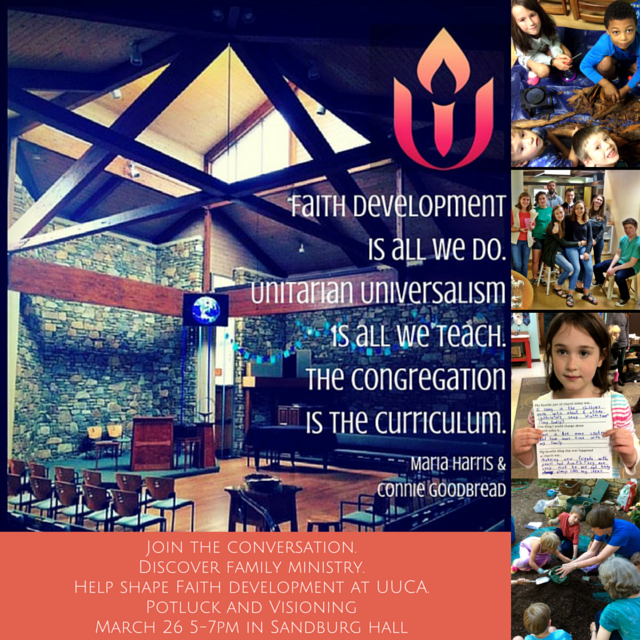
It may be that when we we no longer know what to do
we have come to our real work,
and that when we no longer know which way to go
we have come to our real journey.
The mind that is not baffled is not employed.
The impeded stream is the one that sings.
~Wendell Berry, The Real Work
When I can’t figure something out, I start asking other people for their ideas. As I’ve gotten older, I realize that a willingness to be open to collaboration is a hallmark of (growing) wisdom and maturity! We don’t have to go it alone in solving the big problems–in our own lives, in our families, communities, or the world. That’s something I think we get right in Religious Education: kids learn in our classes and activities that we are stronger, smarter, and more likely to solve a problem together.
The thing I’m having trouble understanding is how we move through some challenges in Religious Education. We are beyond blessed in so many ways. Our strengths? A supportive senior minister who gets the value of the ministry of faith development, and a senior staff team who sees RE as central to the larger mission of the church. An RE staff who are committed and work as a team to orchestrate the communication, supplies, recruitment, and logistics needed to keep a big program’s parts running together. Beautiful, well-curated spaces that are energizing and welcoming. A budget that allows us to offer great projects and resources to make activities truly engaging and creative. Smart, open-hearted children and youth who surprise and inspire me and their teachers each and every Sunday. Families who show up again and again to make it all worthwhile, offering their helping hands and great ideas to help make Sundays sing.
Then there are the numbers. We combed through them this year to assess the right number to “certify” with UUA. They give instructions to count enrolled and regularly attending but non-registered children and youth. We counted 205 in our faith development family, up 13.25% from last year’s numbers. Our nursery is bursting at the seams and parent covenant groups have multiplied.
So, what’s the problem? Even with all this, we are struggling to recruit Sunday morning leaders for our youngest age group, Spirit Play. It takes 12 volunteer leaders total to run both the 9:15 and 11:15 program for K-3, with another 12 leaders committed to showing up to lead 4th-12th grade classes. (A bit of of historical context about our program: I was delighted to learn when I began this job in the summer of 2014 that the RE committee had worked diligently to create a new approach in Spirit Play to respond to recruitment challenges. The plan was to get volunteers throughout the year on a date-by-date basis, rather than ask for a yearlong team commitment.) We asked families to make a “cooperative commitment” to help out 8 times a year in the SP centers, join a 4th-12 grade team, or help with tasks like hospitality, special events, greeting, and clerical work. Many, but not all, have done so. The unintended consequence of this decision has been two years of hours spent in weekly recruitment emails and phone calls, often still looking for leaders on Wednesday or even Thursday, the end of the RE workweek before our Friday/Saturday sabbath. Having faith that it will all fall together, again and again, is tough–though it normally all works out.
A couple of times this Spring we have needed to plan an alternate activity when we didn’t have volunteers in sufficient numbers to offer our normal Sunday morning experience. We made it work, but it wasn’t easy or fun. And that’s when I realized we need to come together to find sustainable solutions.
Trying my best these last two years to make the program I was handed succeed has been a series of technical fixes. Switch this for that, start a new class, try a different recruitment communication strategy, take in feedback and try new things suggested by parents.
I have become increasingly convinced we need a paradigm shift instead of a technical fix-an adaptive solution that reflects where families are and what they need, rather than attempting in vain to try to make them fit our expectations. A shift in congregational thinking that raises awareness of the unique needs and blessing families bring to church, and a consideration of how we can ALL collaborate and support this foundational ministry of lifelong faith development.
This is our congregation. It is a whole church family. We must consider each of the stages in the lifespan in our ministry as we covenant together and commit to “how we do church.”
In supporting our elders, we recognize their unique spiritual and physical needs and attend to them as best we can, building supportive networks and opportunities for their experience and wisdom to guide us.
In order to have such elders in 20 years, we need to support and intentionally include those in mid-life, often sandwiched between caring for both young adult children and ailing parents, and also, often, taking key leadership roles in the congregation.
To have committee leaders and board members and worship leaders and connectors and pledgers in midlife, we have to intentionally welcome and engage young single adults with their unique competencies and energies, meeting them where they are. And we must consider families with parents in their 20s and 30s and 40s. We want to facilitate and sustain their connections to church. Most of them say they are here because of their children and youth, so excellence in our RE programming is essential.
And to help those parents connect and build their own faith, we have to be willing to share the blessing and the work of faith development for their children and youth. A parent who can’t worship or lead or deepen their faith because they are constantly being asked to teach their own children is a parent who isn’t getting “sticky faith,” who isn’t exploring and questioning and being challenged to grow as a Unitarian Universalist in the way we affirm as essential for every other demographic.
If we can’t support parents’ connections and spiritual well-being because they are always needed in RE, where does that leave us? We send some parents (the very ones, incidentally, that made and keep their RE commitments and more, to make up for those who don’t) home on Sunday with an empty cup and no oxygen mask-even though we know full well they must also serve as their own children’s primary faith development guides throughout the week.
Church, for these parents, isn’t a chance to catch a breath and remember their best selves and reconnect to others in a similar place in their faith journey, to meditate or light a candle, to recenter and go deeper. Church can become instead one more fraying thread in the raggedy, unraveling grace of their lives, one more email to read or ignore for sanity’s sake, one more request for time and energy they just can’t meet, because the demands of caretaking and work and school and multiple schedules leave them completely wrung out.
And then we wonder, frustrated, why they only come to church twice a month or less; why we can’t get 20 or more parents every Sunday to help us teach their children and youth.
Is there a better way? Join me, senior minister Rev. Mark Ward, congregants from every stage in our church family, and many parents in collaborating on the program of faith development we want and that we can support at UUCA. Our visioning conversations around family ministry and RE continue, in potluck gatherings on the last Saturdays in the next few months: March 26, April 30, and May 28, from 5-7 pm in Sandburg Hall.
Mar 10, 2016 | Weekly Message

On Sunday, 28 February, Associate Minister Rev. Lisa Bovee-Kemper led a service exploring the Movement Action Plan (MAP) Model of Doing Democracy (big thank you to Tom Blanford for his help and interpretation of the model). We heard compelling stories exploring the four roles: The Citizen, The Rebel, The Change Agent, and The Reformer. I never cease to be amazed by what our members are doing as Bruce Larson, Sue Walton, Sue Steffe and Mike Horak described their actual work as representatives of their roles.
In the past, the Congregation has made major commitments to become a Welcoming Congregation and Green Sanctuary. With the leadership of our Earth and Social Justice Ministry, the Board at our most recent meeting agreed to move forward with empowering an ad hoc team to draft a racial justice statement/call to action. The idea is to engage the Congregation during the next two months to get input and thoughts on how and why UUCA should make a deeper commitment to racial justice — as a Congregation. This proposed commitment by the Congregation has emerged from the “Action of Immediate Witness-Support Black Lives Matter” from the Portland, OR General Assembly (2015), the first and seventh principles of the UUA, the New Jim Crow study group at UUCA, and other Black Lives Matter-related initiatives within the Congregation since December of 2014.
Given this work, and the harsh racial language increasingly being used over the past months in politics, the Board believes the time is right to engage the entire Congregation in exploring how we might make an explicit statement and then take concrete actions supporting racial justice and dismantling systems of oppression.
Over the next few weeks, the ad hoc Task Force on Racial Justice will share a draft statement/call to action and, with the Board, will organize opportunities for the Congregation to provide feedback and input. Your participation, in whatever activist role fits you best, is essential. Throughout history, UUs have been at the leading edge of many social justice movements. History now calls us again to get up, stand up and live our faith.
Mar 3, 2016 | Weekly Message
What a serendipitous moment for us to have LIBERATION as the theme for worship and small group ministry this month! Liberation, after all, is one of the hopes that are central to the religious life – personal liberation from worries, troubles and fear, but also giving oneself to the larger work of liberating all people from oppression.
Liberation is central to the narrative of just about every religious tradition I can think of. And that’s not surprising, since at the core of every religion is a path to freedom and wholeness for the believer and eventually all things. It’s true of us as well. Our seven principles offer practices, disciplines, ways of thinking that we believe will help us and all people fulfill our promise as human beings and find right relationship with the Earth.
This March with the upcoming primary elections we focus especially on our fifth principle, which calls us to “affirm and promote the right of conscience and the use of the democratic process within our congregations and in society at large.” We are reminded that elections can be a vehicle of liberation, and indeed we are in need of some liberation this year: liberation from fear and oppression that are written into so many of our state and national laws, often by people elected by narrow constituencies that seek to control the political process.
That’s why we as a congregation right now are giving so much time and energy to the electoral process, to ensuring that as many people as possible are informed about the candidates and issues and are able to get to the polls to vote. Central to the commitment to the democratic process is the belief that we are best served when our leaders are chosen by as broad and representative an electorate as possible. It’s a consequence of our belief in the inherent worth and dignity of every person.
So, please make sure to get yourself to the polls – early voting starts today – and consider joining others of us in the congregation in the current campaign by Democracy NC and the NAACP to help get people often marginalized in the electoral process to the polls. Let us all be part of the work of liberation.
Feb 25, 2016 | Weekly Message

To be honest, when I list the most exciting things that happen in church, policies are not the first thing I would identify. But I’m actually really excited about a shiny new policy that just went into effect this month. We’ve created a Congregational Care policy that lays out exactly what our pastoral ministry looks like in this congregation. The process of creating the policy document was extraordinarily helpful in clarifying the scope of the program, and I hope that it will be useful to you to see it and learn what support is available, as well as ways you can be part of providing assistance in a crisis. I hope that you will take a look at the policy.
We are a congregation that cares for one another. This is accomplished in many different ways. Primarily, Rev. Mark Ward and I work together with the pastoral visitors to make sure that everyone in the congregation who asks for support receives a visit, a card, or other support appropriate to their needs. The pastoral visitors are the core of this team, and I am deeply grateful for the work that they do. I run trainings for new pastoral visitors annually, and we meet monthly for support and continuing education to help hone our skills.
One simple way that all congregants can be a part of this work is to sign up for the Caring Response Network. We need more volunteers to participate. The Caring Response Network is a simple email list that goes through our database. If someone needs a ride to a doctor’s appointment or meals, you will receive an email with the details of the request. If you are not able to help in that situation, you just let the email pass by. If you can help, then you will follow instructions in the email to contact the person requesting help. This is a simple way for us to support each other in concrete ways and to make sure that nobody is alone or unfed during a crisis. If you’d like to join the Caring Response Network list, log in to MY INFO and sign up, or you can call or send me an email and I will add you to the list.
The pastoral work of the congregation belongs to everyone. We work together to create a web of care that connects each and every one of us. I hope this new policy will help to clarify the process.
Feb 18, 2016 | Weekly Message

Everywhere I turn, conversations about the future of the church and organized religion and even Unitarian Universalism in America are happening. Some believe faith communities are in certain danger of extinction; some believe that it’s only a matter of time, unless we chart a new course. Luckily I still have faith: I believe that people always have been and always will be in need of sacred spaces and experiences, a tribe, and a way to make meaning of their lives. (And help with the children, forever and ever, amen.) Whether we have the will and the energy to make sure our churches can still do all those things in a world changing beneath our feet is an open question, but a hopeful one.
After all, it’s ours to do, and no one can stop us. Should we decide to focus our energy on making the church more responsive, we could more finely tune “how we do church” to the needs of today’s congregants. We can decide to consider how best to raise our youngest congregants with strong UU faith identity that is more likely to keep them with us, rather than continuing as a faith that replaces those we lose only by welcoming new converts and seekers. We can decide how to help families see our congregations as an essential helpmate in the overwhelming work of raising their children, and where they too, as grown-ups, continue to learn and grow as UUs. My training and education sets my sights on family ministry as an essential element in how we do church that has the capacity to help us live responsively in the now and be ready to adapt for the changes the future will bring.
Recently, 40 adults and many children gathered in Sandburg Hall with Rev. Mark Ward and me to begin a conversation about “what we set our hearts to” at UUCA, particularly in the area we have called religious education. The conversation is ongoing; look for more opportunities to gather, to dream, to conspire about our work and play together. But the heart of why I see such an urgent need to begin that conversation is what I want to share here.
I believe that a new paradigm or way of seeing the work we do in faith development is needed. Sunday morning classes for children and youth, and child care for babies, is no longer enough as we consider what parents and families in post-modern America need from their faith communities. Although “RE” is still important, I believe that Family Ministry goes further and can help us orient ourselves in faith to a brave new world and the unique responsibilities and competencies that we should be willing to claim and manifest as a faith community.
Family Ministry: what is it? The UUA defines it as a way of seeing what we are called to do in congregations, one that must be defined by individual congregations through a process of discernment. Read more here.
With the firm belief that effective ministry with families involves building a partnership between congregation and home, (we) offer…questions to help congregations become more family-friendly and to help families at home nurture their Unitarian Universalist faith.
The questions asked do two things: both reflecting the unique needs that families have in church and helping us see that families are essential to the growth and vitality of our faith communities–which is why we must start posing the questions the UUA encourages us to ask.
Our visioning process at UUCA began with my belief that we should pivot to a family ministry approach from a strictly “religious education” one. After all, both adults and the children they are raising need faith development, including classes and other opportunities for learning (which happen throughout the church, and not just on Sunday morning). And both adults and children need opportunities to worship, to do social justice, to engage in fun and fellowship together. When we move to thinking about family ministry, we recognize that we are called to integrate all ages more fully in our shared human work of faith development: in our congregations, in our families, at home, in the pews and the classrooms and at coffee hour–and in the wider community as we work to build the beloved community we dream about. This is all faith formation.
Maria Harris wrote decades ago, in Fashion Me a People (see a synopsis here) about the congregation being the true curriculum in any church. She meant that who we are as a people of faith – through our actions, our inaction, our values, our welcoming and inclusivity (or lack thereof) – teaches more deeply and fully than any one class or program can ever do, especially to our children and youth, who are soaking up and forming identity from all they witness. Connie Goodbread, part of the UUA’s Southern Region staff team, adapted Harris’ idea further, saying.
“Faith development is all we do.
Unitarian Universalism is all we teach.
The congregation is the curriculum.”
This approach means that our ministry of faith development is happening all the time, whether we recognize it or not, and that we as a faith community need to think deeply about how and what we are teaching.
I believe our work in Religious Education ministry in the next few years can and should pivot to Family Ministry: an approach that sees faith development not as a transactional method through which we give and children and youth receive, but as our central calling, meaningful work for all ages, and transformational for individuals and the whole church.
Family Ministry can more fully recognize and support the whole church family as a joyfully integrated one, with work and learning that happens in both age-graded groups and in multigenerational ones. It can help us begin to see children and youth as a blessing, not units in a program, to which resources must be allocated. It can lift up the youngest congregants, as not only needing our shared support, but also in a unique position to transform our congregations, reminding us that we are still alive in a world that keeps telling us churches are a dying breed.
Family ministry can also help us see the unique needs of families, who remain the primary religious educators of their children and youth six days of the week–and ask us how we might serve them better on Sundays, so they can do the work only they can do at home. It will help us help them grow in their faith journey together away from church, by focusing on providing more resources and support for that unique role. We can expect them to come back to church on Sundays more energized, more centered, and more committed to the work that can only be done in the place we come together. After all, church is a touchstone that reminds us who we are – and who we want to be. I believe that vision of a new way to keep our individual identity, our local church, and our wider faith alive and vital begins with Family Ministry.
In my upcoming communications, look for a presentation of the ideas, hopes, and challenges we heard from families at our recent RE Visioning night, and be ready to share your own. I hope you will join in our upcoming and ongoing conversations about the future of religious education and family ministry in our congregation.
Feb 11, 2016 | Weekly Message

At the monthly UUCA Board of Trustees meeting on February 2, Shel Altschul updated the Board on a recent meeting with the City of Asheville concerning flooding in and around 23 Edwin. We were happy to hear there was progress. The city considers this the highest priority flood mitigation project, has developed draft plans, will be hosting meetings in the coming months, and hopes to have approval to move forward by the end of the year. Our optimism was dashed when a flash flood event happened the next morning and 23 Edwin was again flooded.
By the time I was able to get away from work at noon and stop by to see 23 Edwin, the water had drained and the cleanup had begun. It was sad and frustrating to see the damage and yet heartening to see Bob Roepnack and the cleanup professionals already at work. I walked across the street to talk to our neighbor. His garage had again been flooded and his back yard was a lake. He shared a video on his smart phone of the flooding; I’m always awe-struck by the power of Mother Nature.
So what can we do about the weather? Well, as someone in the profession, I’m hopeful that the recent agreement to limit greenhouse gases will limit harm to future generations. However, there is a certain amount of climate change ‘baked into’ the system and so we are working increasingly on mitigation and adaptation. Rev. Mark Ward and the Campus Development Committee are considering what additional mitigation we can do at 23 Edwin to adapt to more frequent heavy rain events and minimize damage.
We are also working to ensure the safety of everyone. If you hear the weather service has issued a flash flood watch (watch indicates it may happen within the next few hours) or warning (flooding is under way), stay out of flooded areas and rapid flows. Contact the front office to report flooding or damage and follow their instructions. Check with staff prior to putting anything in the basement of 23 Edwin.
We can’t do anything about the weather, but we can do something about how we cope with it.
Feb 4, 2016 | Weekly Message
This congregation is lucky to be served by highly capable, effective and committed staff members who help us develop, administer and perform many dimensions of ministry that realize our mission. But as most of you have learned by now, as we look ahead to the challenges this congregation faces in the coming budget year, we at UUCA will, unfortunately, have to shrink the size of our staff.
It’s a difficult moment for us all. All of our staff do a terrific job at work that is important to our success. We hate to lose their services, and we feel sad about the impact this has on them. At least one staff member, Communications Specialist Jules Smith, will be leaving us by the end of the fiscal year on June 30.
This has forced us to think again about how we accomplish the ministry of this congregation and the role that our staff plays. In that vein, I’d like to share with you some thinking that comes from a congregational consultant who worked with us a few years ago. Her name is Susan Beaumont, and she has a special expertise on working with what are generally called “large” congregations, which basically means anyone with more than 500-600 members.
Congregations of that size, she says, face special challenges that are different than smaller churches, and one of them has to do with staff. As congregations grow, she says, they add staff who have the expertise to carry out increasingly complex duties that are needed. Once these people are employed, though, some congregation members make the mistake of assuming that the staff will simply do the work of the congregation for them. After all, that’s the model we know in the secular world.
The fact is, though, that the world of religious institutions is different. Ministry, the work of religious institutions, is not a product or service that members of the congregation passively receive; it is something that the members themselves accomplish.
As Susan Beaumont puts it, “the staff team works in service to the mission and on behalf of the congregation but does not carry out the work of the congregation. The work of the congregation always belongs to the laity.” The staff team exists, she says, “not to undertake the work of ministry in place of the congregation, (but) to equip the laity in pursuit of the congregation’s mission.”
I seize on that word “equip” because I think it speaks well to this point. For example, I measure my success as a minister not by quantifying some product I have produced – how many sermons I have given, how many pastoral visits I have made, or whatever. I succeed to the extent that I have invited you into a ministry that, say, has helped you live into your deepest values, to relate to others more compassionately, to act for justice in the larger world.
There are many dimensions of this, but you get the idea. Religious institutions like ours exist to invite people into deeper, more fulfilling ways of being, what I have described elsewhere as lives of compassion, integrity, service and joy.
So, how might we as staff help equip you to accomplish that sort of ministry? I welcome any thoughts you would care to share with me about this. Meanwhile, we as staff will work in coming months on how to configure our work so that we best serve the ministry of this congregation.
Jan 28, 2016 | Weekly Message

Remember when you were young enough to say how you’d like to change or grow without feeling embarrassed at all? On the first Sunday in January, the kids in religious education set their intentions for the year, and I was delighted (as usual) with their honesty and their sweetness.
It was a Faith in Action Sunday, so the kids and helping adults were working on our Kids Care! blessing bags. These are ziplock gallon bags stuffed with a handwritten note from a child, personal care items, snacks, socks, gloves, water bottles, and other items meant to help out a person in need that families may encounter in Asheville. The work of creating and sharing these bags also helps families “take it home,” supporting them as they teach our children a valuable lesson about how our faith compels us to “choose to bless the world,” as theologian Rev. Rebecca Parker said. Rev. Lisa Bovee-Kemper joined our group and shared the story of The Good Samaritan, asking the kids to really consider “who is our neighbor?”
Then kids got to process the story and the Faith in Action activity by considering how they’d like to grow and change in the upcoming year. This is the second time we’ve done this exercise at the New Year, and it amazes me how focused and clear they are in this work. I know that not all of you can join us to experience firsthand how transformative and deep the faith development we do in RE can be (but I encourage more of you to take the time to do so)! In the spirit of bringing more of you into awareness of our work, here is a sample of the kind of faith development our children are doing in RE.
A tree on the wall provided the backdrop for our conversation about growing up from where we are planted, from our roots, and putting out branches, leaves, and fruit. Kids were asked how they want to change and grow in the upcoming year, and here are some of their responses. How many of these are what you would expect to hear from 5-10 year old children? How many are ways you would like to grow in the upcoming year?
- More play!
- I want to read more
- Not to fight with my sisters
- To help more people
- I will ‘lern’ more
- Climb a tree barefooted
- Smile more
- Eat less sugar
- Read more
- Don’t be mean
- Stop fighting with my brother
- I will help more
- I want to meditate
- I want to learn something new every day
- Playing more
- I want to be nicer
- I want to play outside more
Are these intentions that would be good for people of all ages?

Intentions set last year by children in RE. We considered what progress we made this year.
One of my greatest hopes is that we will recognize that children and adults are not nearly as different as we sometimes like to think when it comes to faith development. James Fowler, faith stages researcher and thinker, said that we all move in a spiral through six stages of faith, coming back to the same lessons, stories, parables, challenges again and again as we grow more spiritually mature. Famously, UU Robert Fulghum said, “All I needed to know I learned in kindergarten,” and that’s what I am getting at: our children in RE already face the same spiritual, ethical, and moral issues as adults, in slightly different packaging. The difference, often, is that they are still willing to name how they want to change and grow. They feel safe enough and supported enough and good enough to be vulnerable and honest in their intention-setting. What could we adults learn from their teaching?